
Here’s a fun fall harvest pumpkin watercolor art project lesson that kids and adults of all ages can enjoy at home or in the classroom!
This watercolor pumpkin painting idea is a fun art activity for both kids and adults, offering an enjoyable project for artists of all skill levels, from beginners to advanced. Learn how to use the raised salt watercolor painting technique to paint a pumpkin that looks like it’s sitting in a pumpkin patch at harvest. Alternatively, you can skip the glue and salt outline and use the step-by-step instructions to paint the pumpkin with watercolors alone. Painting a pumpkin with watercolors is a magnificent way to celebrate the autumnal equinox, Halloween, Thanksgiving, and the fall harvest season.
Fall Harvest Watercolor Pumpkin Art Activity
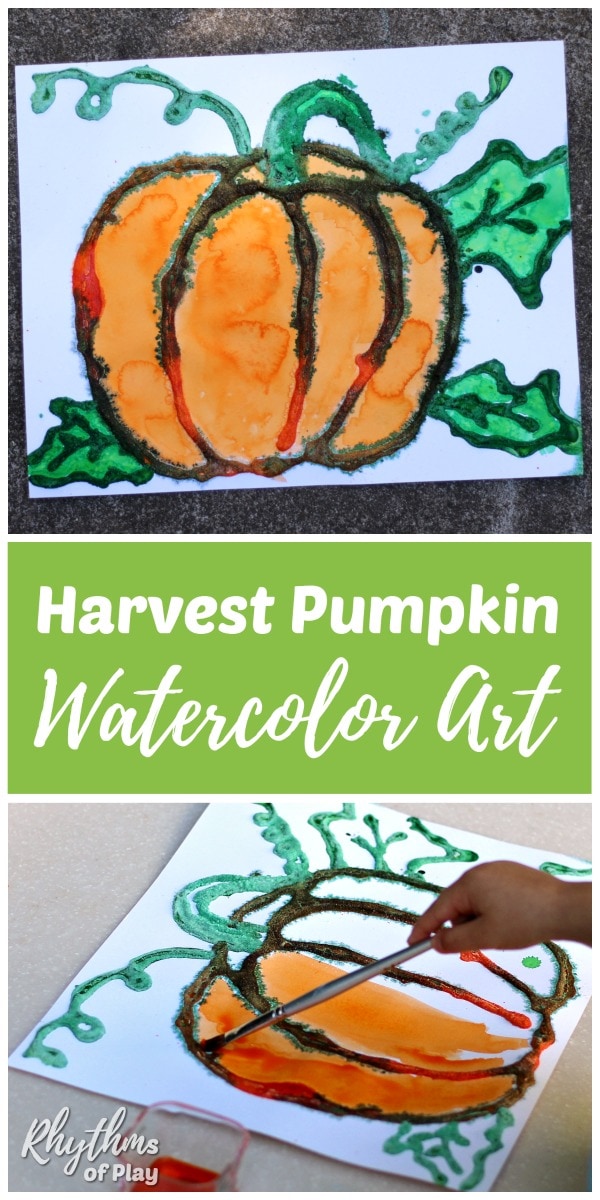
This simple fall painting idea is fun for kids from preschool age and up. Even older children, tweens, teens, and adults will enjoy the simple art process of salt painting and making a raised salt art pumpkin. The step-by-step art tutorial guides you through creating a raised salt art pumpkin outline and then painting it with watercolors to produce a gorgeous harvest pumpkin painting, similar to the one shown in the photographs.
By sprinkling salt on the glue before painting, artists can achieve intricate, raised crystalline textures that enhance the visual appeal of their pumpkin artwork. In other words, this unique raised salt art form allows the painter to create textured, three-dimensional effects on the pumpkin’s surface, bringing the depiction of the harvest gourd to life with unique patterns and contours, as shown in the photograph below. You might also enjoy these fall art projects and painting ideas.

First published on September 28, 2016, this pumpkin art activity is regularly updated to enhance the content and ensure its current relevance. Paint a pumpkin that looks like it is sitting in a pumpkin patch with the step-by-step art tutorial instructions below. Children and adults of all ages will enjoy the easy salt painting watercolor technique used to create this gorgeous watercolor pumpkin art. You might also enjoy using the same raised salt painting method to create a Halloween Pumpkin with a friendly (or spooky) Jack-o’-Lantern face. For more fall ideas, check out this list of autumn activities with a printable bucket list.
What do Pumpkins Symbolize?
Pumpkins are a traditional fall harvest symbol that represent prosperity, nourishment, and gratitude, reminding us to appreciate our hard work and share our blessings. Spiritually, pumpkins symbolize abundance and growth, linked to the bounty of harvest and each of life’s blessings. Their transformation from seed to maturity symbolizes change and fulfillment.
Pumpkin seeds symbolize dreams and opportunities, while a pumpkin growing on a vine emphasizes the importance of friendship, family connection, and community. Since pumpkins ripen during the transition from autumn to winter, they also represent the cycles of nature, especially themes of death, dormancy, and rebirth, mirroring the rhythm of life.
Fall Harvest Pumpkin Art Project Activity for Kids and Adults:
I’m in love with how this pumpkin painting art project turned out. However, it is not at all what I imagined it would look like. Instead, it turned out even better than I thought it would! Please read about my daughter’s pumpkin painting below to find out what happened, or skip to the step-by-step raised salt pumpkin art tutorial in the next section to learn how to create your own pumpkin art with watercolors.
My Daughter’s Pumpkin Watercolor Painting:
My daughter has been totally and utterly obsessed with pumpkins since early childhood. She was instantly enamored with them when they started showing up on neighbors’ doorsteps during our daily walks, which began in the fall before Halloween when she was an infant. Believe it or not, she loves everything about them, including going to the pumpkin patch.
I even made her a pumpkin sensory bottle that she plays with all year, Halloween or not, and she is just as enamored with skeletons. I didn’t know this before starting this pumpkin art project, but unfortunately, she thinks all gourds must be orange. Allow me to explain: This pumpkin art originated as a simple salt painting, similar to the Halloween salt painting my daughter created with a jack-o’-lantern face.
However, for this pumpkin art project, I wanted to help my daughter paint a pumpkin with a stem and leaves, rather than a jack-o’-lantern face. Neither of us realized how much we would learn about raised salt painting when we started this harvest pumpkin art activity. I knew the green watercolor paint that she used to paint the leaves and stem would run into the orange a little, but since this was the first time my daughter had tried salt painting with pipettes, I didn’t know how heavy her hand would be or how much paint she would dump upon her pumpkin artwork.
Harvest Pumpkin Salt Painting Process:
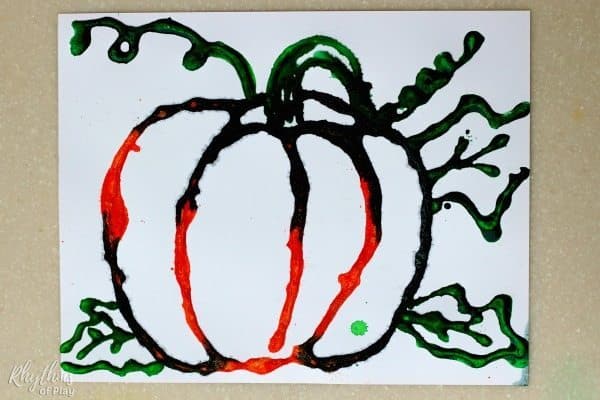
Of course, my daughter enjoyed using the pipettes and watching the colors mix. However, she was upset that the pumpkin wasn’t entirely orange once she finished painting it. In other words, she threw a fit when parts of her harvest pumpkin painting turned green after she had painted the leaves and stem. You know how those toddlers and preschoolers can be. I did my best to convince her that it looked great because it made her pumpkin art look more like a gorgeous autumn gourd straight out of the pumpkin patch, but that didn’t stop her from complaining or crying about it. In the photo below, you can see how her harvest pumpkin painting looked once it was dry.
From Messy Pumpkin Art to Cinderella’s Perfect Pumpkin Painting:
As she whined and fussed, I suddenly had a fantastic idea. I put a flat-wash paintbrush and watercolors on the table next to the paint and asked her to repaint her pumpkin art between the raised salt lines. In other words, I told her that she could use watercolors to fill in the outline of the pumpkin art to make the pumpkin orange again. She was hesitant at first, but decided to give it a try.
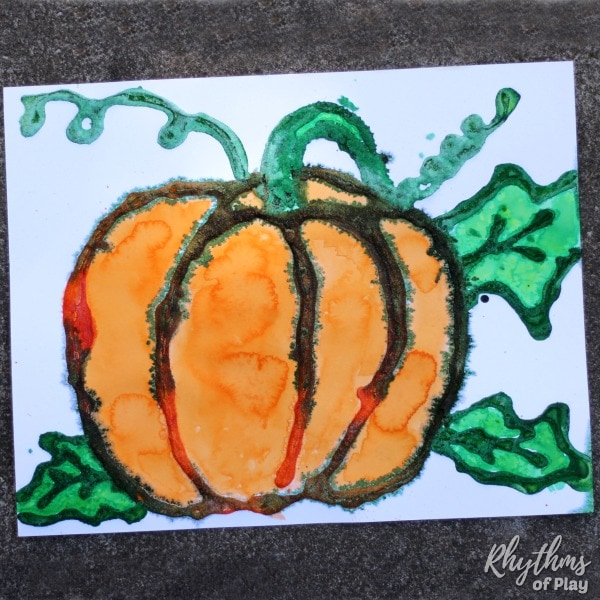
Once she was finished painting it orange, she was thrilled, and we both LOVED how beautifully her raised salt pumpkin watercolor art turned out. Even that little spot of green in the middle of the pumpkin she lamented disappeared, as you can see in the photograph of her finished pumpkin painting below. (She used a large flat watercolor brush to add water and orange watercolor paint over it to remove it.) After she painted the pumpkin orange, she used green paint to color the leaves and stem. In the picture below, you can see my daughter Charlize’s gorgeous finished harvest pumpkin painting. You might also enjoy this list of fall painting ideas. As I mentioned earlier, it turned out better than I expected!
Watercolor Pumpkin Painting Beautiful Oops!
What a beautiful oops we created together! Beautiful Oops! is a children’s book that demonstrates to young readers that every mistake is an opportunity to create something beautiful. Creating pumpkin art and experimenting with a new watercolor painting method allowed my daughter to experience her own beautiful oops. It was lovely witnessing her initial anger transform into utter and complete joy as she worked to paint the pumpkin orange. Ready to try this raised salt art process for gorgeous results? Use the pumpkin painting tutorial below to help you paint a beautiful fall harvest pumpkin.
Related: The Best Anger Management Books for Toddlers to Teens
How to Paint a Pumpkin:
This pumpkin painting consists of two parts: Start by creating a raised salt pumpkin outline. Then, paint the raised salt pumpkin with watercolors once the salt and glue outline is dry. The tutorial below teaches how to make a pumpkin salt painting similar to the one in the photographs. It also offers a few alternative options if you don’t want to create a raised salt pumpkin outline.
In other words, you are welcome to skip the salt outline (steps 2 -5) and paint your hand-drawn pumpkin with watercolors or one of the alternatives included in the step-by-step instructions if you prefer. Please read through the step-by-step instructions below before starting this harvest art project. This will help you understand the steps involved and make a more informed choice about the art supplies you will choose to paint a pumpkin from the list of options below:
Fall Harvest Pumpkin Painting Supplies:
- Watercolor paper

- Pencil
- White glue
- Table salt
- Choose one of the following watercolor paint options:
- Liquid watercolors
- Solid watercolor palette
- Stockmar watercolor paints .
- You will need to mix paint to create orange (from red and yellow) and green (from blue and yellow), which is a great learning opportunity for children of all ages if you choose this option.
- Liquid watercolors
- Paintbrush or pipette (Choose one or the other)
- Baking sheet or tray


 .
.
Related: The Best Art Supplies for Kids and Why Young Artists Should Use Them
Watercolor Pumpkin Painting Step-by-Step Directions:
Painting a harvest pumpkin is a perfect fall art project for kids of all ages. Preschoolers and younger elementary-aged children will need assistance creating pumpkin art, while older children and adults can complete this project independently. You might also enjoy using this same art technique to paint a Rainbow Shamrock.
1. Draw a harvest pumpkin:
- Use a pencil to draw or sketch a pumpkin on watercolor paper or heavyweight cardstock.
- It doesn’t need to be perfect because you will cover the pencil lines with white glue in the next step.
- Feel free to draw a pumpkin shape similar to the one in the photographs with a stem and leaves, using the step-by-step instructions below, or create your own unique pumpkin design.
How to Draw a Pumpkin with a Curly Stem and Leaves:
- Start by drawing a large oval shape in the middle of the paper; this will be the front center of the pumpkin.
- On each side of the oval, draw curved shapes (like vertical parentheses) or tall skinny forward and backwards “C” shapes to create the pumpkin’s ribbed sections on the left and right.
- The middle oval should be the widest, with the side shapes curving in to give the pumpkin volume.
- Leaving a small space for the stem at the top of the pumpkin, draw a wide, flat “M” shape, like a bird flying from one side of the front oval to the other.
- Then, draw a line curving slightly to the right and down the middle of the oval (from the middle of the flat “M” shape) in the center to complete the pumpkin sections.
- Draw a stem arching to the right and back down, emerging from the small section at the top of the pumpkin.
- Add a second, parallel arching line next to it, following the same path to complete the arching stem.
- At the end of the stem, add a curly vine going up and to the right, as shown in the photographs.
- Starting at the base of the stem, draw a thin, swirling line that curls upward and to the left to create the second curly vine.
- Draw leaves around the pumpkin. Pumpkin leaves are large, wide, and have jagged edges. Use wavy, zigzag lines for the leaf edges and long veins to give it texture.
- The photographs show leaves on the bottom left and right of the pumpkin, as well as one positioned behind it, located below the curly stem on the right.
2. Trace the outline of the pumpkin art with white glue:
- If you want to create a raised salt outline for this pumpkin art activity, start by tracing the outline of the pumpkin with white glue.
- Alternatively, you can trace the outline of the pumpkin with black oil pastel or crayon, then skip to step 6.
- Alternatively, use orange oil pastel or crayon to trace the outline of the pumpkin, and green oil pastel or crayon for the outline of the leaves. Then, skip to step 6.
- If you’d rather not do any of these options, skip down to step 6 to paint the pumpkin with watercolor paints alone.
- Children may need help with this step in the raised salt painting process.
- Keep the glue lines separate if you do not want the colors to run into each other and blend, as seen in the pumpkin art in the photographs.
- The fall harvest pumpkin art photo collage tutorial below shows what happens when the salt and glue lines touch.
- If you’re curious to learn how we created this pumpkin painting project, the story above shares what happened when my daughter made it.
3. COVER The Lines of Glue (Pumpkin Outline) WITH SALT:
- Place the pumpkin art outline on a baking sheet or tray.
- Cover the glue lines with salt.
- Do not wait for the glue to dry before moving on to the next step.
4. Shake the excess salt off the Pumpkin Outline:
- Gently shake the salt off the pumpkin outline onto the baking tray.
- Pour the remaining salt into a small bowl, mason jar, or storage container to save for your next raised salt painting project.
5. Use a pipette or paintbrush to apply watercolor paint to the salt lines and glue:
- If you use liquid watercolors to paint your pumpkin art, you can use a pipette (as shown by my daughter in the photos above and below) or a paintbrush.
- If you use a watercolor palette for this pumpkin art painting, gently apply the paint by touching the paintbrush to the raised salt lines.
- If you choose this pumpkin painting option, you will need a cup of water to rinse your paintbrush.
- Enjoy the transformation of your art as the green runs into the orange. If you do not want the colors to run, keep the different colored salt and glue lines separated.
- The photo tutorial below shows the green bleeding into the orange lines as my daughter applies green to the raised salt pumpkin artwork.
- For more photos that show the salt painting process in action, and share more tips about this unique watercolor painting method, check out the step-by-step raised salt painting tutorials below:
6. Paint the fall harvest pumpkin with watercolors (optional):
- Once the salt paint outline is dry, you can paint your fall harvest pumpkin using a paintbrush and Stockmar watercolor paints, liquid watercolor paints, or a solid watercolor palette. Of course, you can also skip creating the salt outline and just paint the pumpkin with watercolors.
- Of course, my daughter used orange watercolor paint to make her pumpkin orange and painted the leaves of the harvest pumpkin green, but feel free to use whatever colors or combination of colors you like.
- Feel free to add small splashes of yellow, red, or white watercolor paint to the pumpkin to add more dimension, if desired.
- If you are using only primary colors, combine yellow and red to make orange for the pumpkin, and yellow and blue to make green for the leaves.
- You can even paint the background of the pumpkin patch a soft light blue, purple, gold, or another color.
Related: Fall Leaves Watercolor Resist Art Project
Pumpkin Watercolor Art Salt Painting Step-by-Step Photo Tutorial:
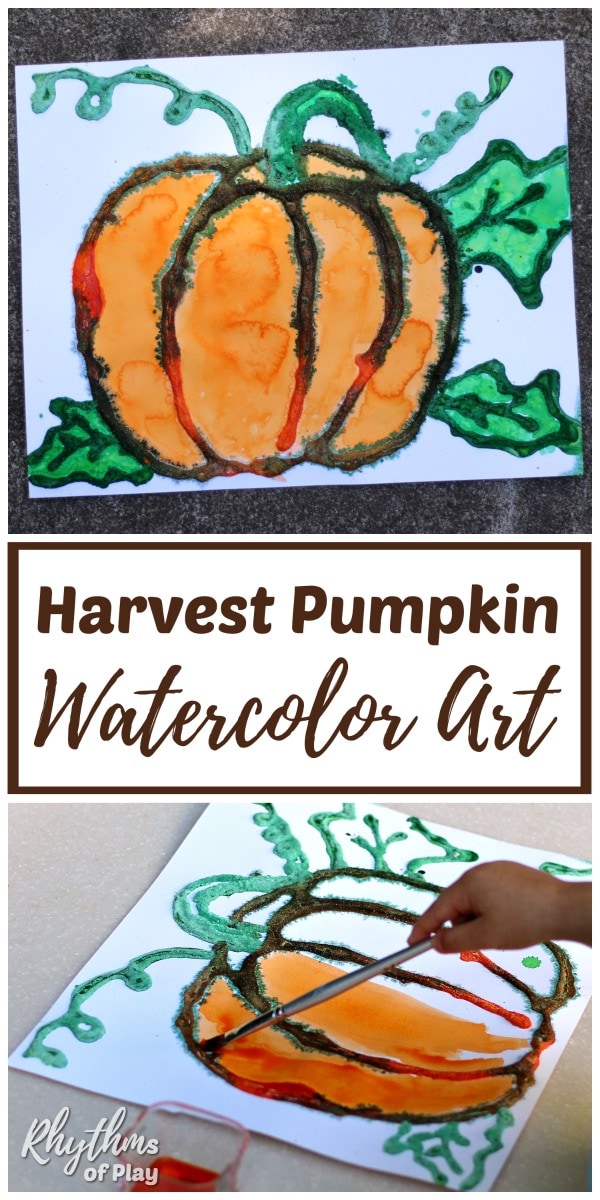
The step-by-step photo tutorial below demonstrates how to create pumpkin art with watercolors using the raised salt painting method. In the photos, you can see that my daughter painted the pumpkin orange first, and then added green to the leaves and stem. Because she used a lot of paint, and the lines of salt and glue were touching, the green bled into the orange. Once the pumpkin outline was dry, my daughter used orange liquid watercolor paint to paint the pumpkin and green to paint the leaves, completing the project. The finished project looks like a harvest pumpkin or gourd sitting in a pumpkin patch.
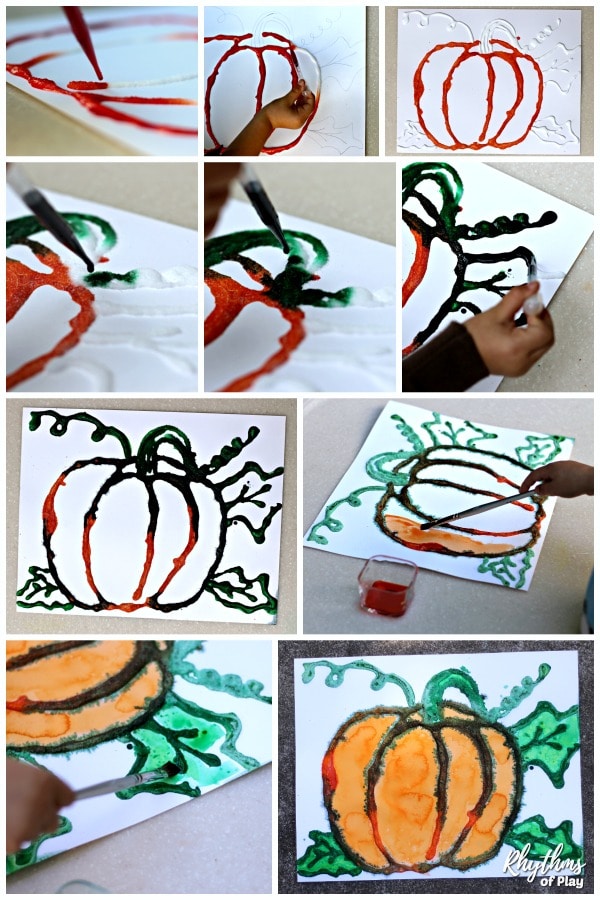
Fall Harvest Pumpkin Watercolor Art Project
This harvest pumpkin watercolor art project is an excellent idea for both kids and adults. Engaging in this creative fall art project nurtures artistic expression and fosters a deeper connection to the rich traditions of the fall harvest season.
Children, preschool and up, can enjoy the salt painting technique used to create this raised salt watercolor fall decoration. Painting a harvested pumpkin using this raised salt art process can be a therapeutic and meditative practice that enhances mindfulness and appreciation for the beauty in seasonal transitions.
You might also enjoy this gorgeous collection of fall nature crafts (which contains pumpkin carving and decorating ideas) and this collection of the best fall art projects for kids.
For more ideas, check out this list of fun fall activities with a printable bucket list.
Learn more about Nell Regan Kartychok, author and photographer of this watercolor pumpkin art activity HERE, and Rhythms of Play HERE!
More pumpkin Ideas:
- Halloween Pumpkin Salt Painting
- Pumpkin Patch Field Trip Ideas (Includes our favorite pumpkin books!)
- Glow in the Dark Halloween Pumpkin Sensory Bottle
- Decorate Play-Doh Pumpkins
Halloween Ideas:
- Halloween Art Projects
- Top 10 DIY Halloween Lanterns
- Tissue Paper Ghost Craft
- 13 Healthy Treats and Fun Alternatives for Halloween
- DIY Halloween Porch Decorations
- Spider Egg Sac Halloween Decorations
- Giant DIY Spider Web
- Halloween Spider Door Decorations
- Spider Crafts


Tried this salt art with a group of 6-9 year olds. Enjoyed by all until it was time to pick up their projects to take home. Salt and glue flaked off everywhere! We were all saddened by the final results. this is a failure in my book!
Hi Bobby,
I’m so sorry that you consider this project to be a failure. As mentioned in many of our salt painting posts, salt paintings don’t last.
Creating them is about the process, not the product, and they can not be taken home or displayed. I apologize for not making that clear enough in this post.
Did children have fun creating pumpkin salt art? If yes, then I would say it was a success!