
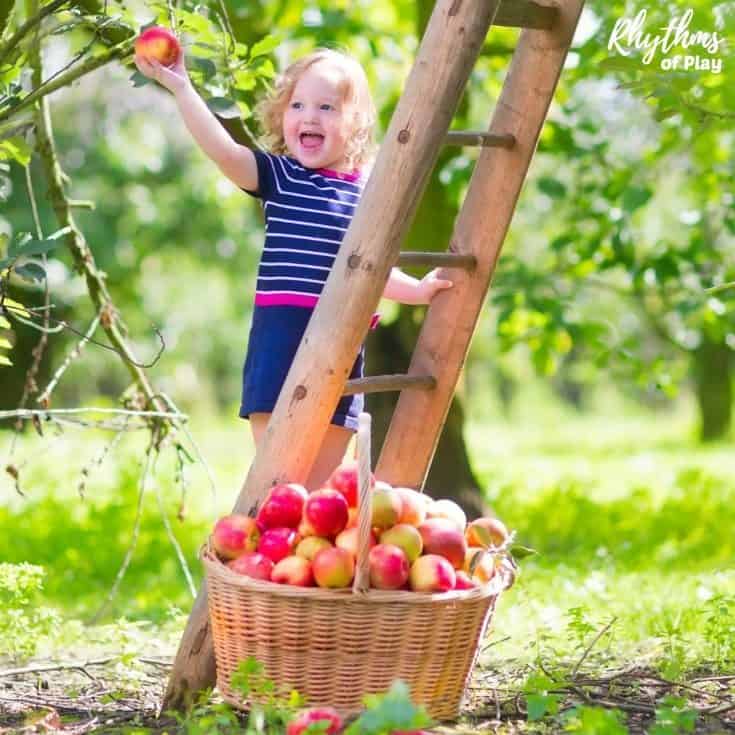
Visiting an orchard to pick apples is a fun and educational fall activity suitable for all ages, making it perfect for school field trips, homeschool learning adventures, and weekend family fun!
This informative apple orchard field trip guide includes apple-picking activities, crafts, books, recipes, and everything you need to know about harvesting apples with your children, students, or the whole family. Picking apples is a fall tradition that combines education with the joys of harvest season and the pleasure of spending time outdoors.
As the angle of sunlight changes and the air turns crisp in early autumn, many apple orchards open their gates to visitors eager to pick fresh apples straight from the tree. Plan a class field trip, a homeschool learning adventure, or make a plan to spend time with your family on the weekend by visiting an apple orchard to go apple-picking!
Although my family has a few apple trees on our property, we also enjoy visiting an apple orchard to pick apples in the fall as part of our daughter’s homeschool education. Join us! This informative guide covers how to plan your visit, what children can learn, what to notice while you’re there, and activities to continue learning at home. First published in the fall of 2015 as a fun outdoor activity idea for Get Outside and Connect, this post is regularly updated to enhance its content.
Update: Sadly, we lost our family’s apple trees and much more in the 2018 Camp Fire, which devastated the town of Paradise, California. The fire destroyed my mother’s and brother’s homes, our family property, our Fuji apple trees and fig trees, our organic permaculture garden, and many irreplaceable family treasures. We never had the chance to harvest those apples that year. It was heartbreaking, but we had our lives, each other, and so much to be grateful for. I shared more about what happened and what remained here on Instagram.

Why Visit an Apple Orchard with Kids?
Visiting an orchard offers children a hands-on way to learn where food comes from while enjoying time outdoors. Instead of seeing apples neatly stacked at the grocery store, children can walk among the trees, pick ripe fruit from the branches, and experience the sights, sounds, smells, and tastes of an orchard during harvest season. This educational experience can help children and adults of all ages appreciate the work involved in growing and harvesting food, support local farmers, and promote sustainable agriculture.
Apple picking also offers many opportunities to learn through observation and experience. Children can compare different apple varieties, notice differences in color, size, shape, smell, and taste, and discover how apples grow. A trip to the orchard can spark questions about apple trees, pollination, insects, soil, weather, farming, and the life cycle of a fruit tree.
An orchard is also a wonderful place to experience the rhythm of the season. Apples may be available at grocery stores year-round, but on the tree, they follow a natural cycle. Apple trees blossom in spring, fruit grows and ripens through summer, and a wide variety is ready to harvest as summer gives way to fall. Seeing and picking ripe apples helps make this seasonal cycle real for children.
Most importantly, an apple orchard field trip doesn’t need to feel like a lesson to be educational. Children learn naturally as they explore, ask questions, help pick fruit, taste different varieties, and notice what’s happening around them. Even the simple act of selecting and tasting apples directly from the tree promotes sensory learning and a greater appreciation for the farmers who grow them.
Whether you visit with your family, homeschool group, preschool, or class, a day at the orchard is a simple way to connect children with nature, seasonal food, and the people and places that help bring food to the table. For more fall field trip ideas (and fun activities to do along with them), visit these Pumpkin Patch Field Trip Ideas and Corn Maze Ideas!

When is Apple-Picking Season?
Apple-Picking season typically begins in late summer and continues through fall, but the best time to visit an orchard depends on your location, the weather, and the apple varieties grown in your area. In many parts of the Northern Hemisphere, apples are ready for harvest from August through October, though some varieties ripen earlier or later.
Apple varieties ripen at different times. Early-season varieties may be ready in late summer, while popular fall apples such as Honeycrisp, Gala, Fuji, Pink Lady, and Granny Smith mature at different times throughout the harvest season. Because growing conditions vary from year to year, the same variety may not be ready on the same date each season. This staggered harvest can make it fun to visit an orchard more than once. An early-season trip may offer a completely different selection of apples to pick and taste than a visit several weeks later.
Before planning an apple orchard field trip, check the orchard’s website or social media page, or call ahead to find out which varieties are currently available for picking. However, please be aware that orchards may close certain areas between harvests or suspend pick-your-own activities when ripe fruit runs low. For the best experience, plan your visit around what is actually ripe rather than a specific date on the calendar. If you have a favorite apple variety, ask the orchard when they expect it to be ready for picking, then plan your visit accordingly. You might also enjoy our Fall Bucket List, which has even more autumn activities for kids.
How to Find an Apple Orchard Near You:
The easiest way to find an apple orchard near you is to search online for “apple picking near me,” “pick-your-own apples,” or “U-pick apple orchards,” along with your city, town, or region. Local tourism websites, farm directories, community groups, and farmers’ markets can also help you find nearby orchards that welcome visitors.
Keep in mind that not every orchard offers pick-your-own apples. Some farms sell freshly picked fruit at a farm stand but do not allow visitors into the orchard, while others offer U-pick apples along with activities such as hayrides, farm animals, corn mazes, cider pressing, or picnic areas. Look for an orchard that offers the type of experience you want for your family, homeschool group, or class.
Once you find an orchard you’d like to visit, check its website or social media page for current picking conditions, hours, admission fees, and available apple varieties. Harvest conditions can change quickly, so confirm the orchard is open for apple picking before you go.
If organic or low-spray growing practices are important to your family, ask the orchard about its growing and pest-management practices. You can also ask whether they use integrated pest management or other methods to reduce pesticide use. A little research before you go can help you find an orchard that fits your needs and make your apple-picking field trip more enjoyable when you arrive.
Plan Your Apple Orchard Field Trip
Once you find an apple orchard you would like to visit, take a few minutes to plan your trip before you go. Orchard hours, picking conditions, prices, and available apple varieties can change throughout the harvest season. Plan your visit so you don’t miss your favorite apple variety when it’s ripe and ready. Checking with the orchard helps ensure that you can harvest your favorite apple varieties at just the right time.
Apple farms typically charge by the pound or bag, and many also feature a farm stand with a variety of fruits and vegetables or fresh-baked goods, making it easy to pick up other fresh, wholesome foods during your visit. Visitors often receive baskets or bags and can walk through the rows of apple trees, hand-picking their fruit. But not always. A quick web search or call to the orchard can help you know what to expect and avoid disappointment when you arrive.
Questions to Ask Before You Go:
Check the orchard’s website or social media pages for the latest information. If you can’t find what you need, call or contact them directly. Find out what types of apples they grow, when their apples will be ripe for picking, and when they will open their gates to visitors.
It’s also a good idea to ask how they charge, whether the apple-picking farm offers any additional attractions, and what the cost is. Sometimes, apple orchards include a playground, pony rides, farm animals, a petting zoo, and other apple-picking activities, as well as special events such as cooking classes or educational programs.
Many orchards offer guided tours for school groups or weekend visitors. Others may provide educational signage to support a self-guided experience.
Here are a few helpful questions to ask:
- What date do you open your gates to visitors?
- Which apple varieties are available for picking?
- What are your hours, and when are the best times to visit with the smallest crowds?
- Do we need a reservation, or do we need to buy tickets in advance?
- Is there an admission fee, and how much does apple-picking cost? Do you charge by weight, or by the bag?
- Do you charge for parking?
- Are there any other additional fees?
- What other attractions or activities are available on-site? Are they included in the admission price, or is there an additional cost?
- What forms of payment do you accept?
- Are bathrooms and handwashing stations available?
- Do you provide bags or baskets for picking apples?
- Are strollers or wagons allowed? (Bags of apples can be heavy.)
- Do you have wagons available to use for free or for a small fee?
- Do you offer guided or self-guided tours? Is there an additional cost?
- Are pets allowed?
- Ask whether the branches are low enough for small children, such as toddlers and preschoolers, to pick fruit, or whether ladders will be provided.
- Can we bring food or have a picnic in the orchard?
- Is food available for purchase?
- Are there special rules for school, preschool, homeschool, or other groups?
Other Questions to Consider Before Your Visit:
If you are planning a field trip for a class or larger group, ask whether the orchard offers group tours, educational programs, demonstrations, or special rates. Some farms may offer opportunities to learn more about apple growing, harvesting, pollination, cider making, and other aspects of farm life.
It is also wise to check picking conditions shortly before you leave, especially if you have a long drive. Apples can disappear quickly on a busy harvest weekend, and weather or other conditions may affect what is available.
A little planning goes a long way. Once you know what to expect, you can spend less time figuring things out when you arrive and more time exploring the orchard with the kids.
Related: Signs of Autumn Fall Scavenger Hunt for Kids
What to Bring for Apple Picking
You don’t need much for a day of apple picking, but a few essentials can make your orchard visit more comfortable. Check with the orchard before packing, as some farms provide picking bags or baskets and have rules about what visitors can bring into the orchard.
Consider bringing:
- Comfortable, closed-toe shoes: Orchards can have uneven, dusty, muddy, or grassy ground, so wear sturdy shoes that can handle dirt.
- Weather-appropriate clothing: Wear comfortable layers you can add or remove as temperatures change throughout the day.
- Sun protection: Bring sunscreen and hats, especially for orchards with limited shade between rows.
- Water: Apple picking can involve more walking than you might expect, so bring enough water for everyone.
- Snacks or a picnic: If the orchard allows outside food, pack a few snacks or lunch and make a day of your visit.
- A basket or reusable bag: Some orchards provide containers or require you to use their picking bags, while others let you bring your own. Ask before you go. If you need to bring your own, these sturdy hand-woven market baskets work great.
- A wagon or stroller: A collapsible wagon can help carry young children, picnic supplies, and heavy bags of apples. Make sure the orchard allows wagons before bringing one.
- Wipes or hand sanitizer: These are handy when you’re exploring a working farm, especially with young children present.
- A camera or nature journal: Optional, of course, but an orchard is full of beautiful things to photograph, draw, record, and remember.
- Extra Cash: Depending on the payment method allowed, you may want to carry extra cash just in case.
If you’re visiting with young children, try not to bring more than you need. You’ll probably be carrying apples by the end of the day, and those innocent-looking apples get surprisingly heavy once you’ve enthusiastically picked a bag or two.
Apple Orchard Safety Tips for Kids
Apple orchards are wonderful places for children to explore, but remember that you are visiting a working farm. A few simple rules can help keep everyone safe and protect the trees, fruit, animals, and other visitors.
- Follow the orchard’s rules. Stay in areas open for picking, and follow signs and instructions from farm staff.
- Supervise young children. Orchards may have uneven ground, farm equipment, ladders, animals, ponds, roads, or other hazards that require extra attention.
- Make a plan in case you get separated. When you arrive, choose an easy-to-find meeting place and point out farm workers or other trusted helpers children can go to for help. Teach children to stay where they are if they realize they are lost rather than wandering around looking for you. Make sure younger children know their caregiver’s full name and, when appropriate, have a phone number.
- Walk between the trees. Fallen apples, roots, rocks, irrigation lines, and uneven ground can create tripping hazards.
- Wear sturdy, closed-toe shoes. Good footwear protects little feet and makes walking over rough or muddy ground easier.
- Leave climbing to the experts. Don’t let children climb apple trees or use orchard ladders unless the farm offers a supervised activity designed for children.
- Pick gently. Teach children to pick only from designated trees and avoid pulling, shaking, or breaking branches.
- Watch for bees and other insects. Bees, wasps, and other pollinators may be attracted to ripe or fallen fruit. Give them space and avoid swatting at them.
- Ask before eating apples from the tree. Follow the orchard’s rules about tasting fruit, and wash apples before eating them when possible.
- Keep an eye on the weather. Bring sun protection on warm days and appropriate layers for cool or changing fall weather.
- Wash hands before eating. This is especially important after touching farm animals, soil, fallen fruit, or other surfaces around the farm.
Before your visit, talk with children about how to care for an orchard. Pick only what you plan to buy, leave branches and blossoms on the trees, put trash where it belongs, and respect plants, animals, farm workers, and other visitors. These simple habits help children learn that visiting a farm isn’t only about what we can take home. It’s also about caring for the place and the living things that make the harvest possible.

How to Pick an Apple
Picking an apple from a tree may seem as simple as pulling it from the branch, but a gentle technique helps protect both the fruit and the tree. Before you begin, ask the orchard for any specific picking instructions and make sure you are picking from trees that are open for harvest.
Start by choosing an apple that looks ripe and ready to pick. Cup the apple gently in your hand, lift it slightly, then give it a gentle twist. A ripe apple will usually come off the branch with little effort. Avoid pulling or yanking the fruit straight down, which can damage the stem, break branches, or knock other apples from the tree.
Once you pick an apple, place it gently in your basket or picking bag rather than dropping or tossing it, as shown in the photo below. Apples bruise easily, and careful handling helps them stay fresh longer. Pick only the apples you plan to buy, and leave unripe fruit on the tree to continue growing.
Helping Children Pick Apples
Young children may need help reaching apples or learning how much pressure to apply. Show children how to gently lift and twist an apple to pick it rather than pulling or shaking the branch. Remind children to walk carefully between trees and to pick only apples from designated rows. When possible, choose ripe apples on low branches so children can pick independently, rather than lifting them high into a tree or letting them climb.
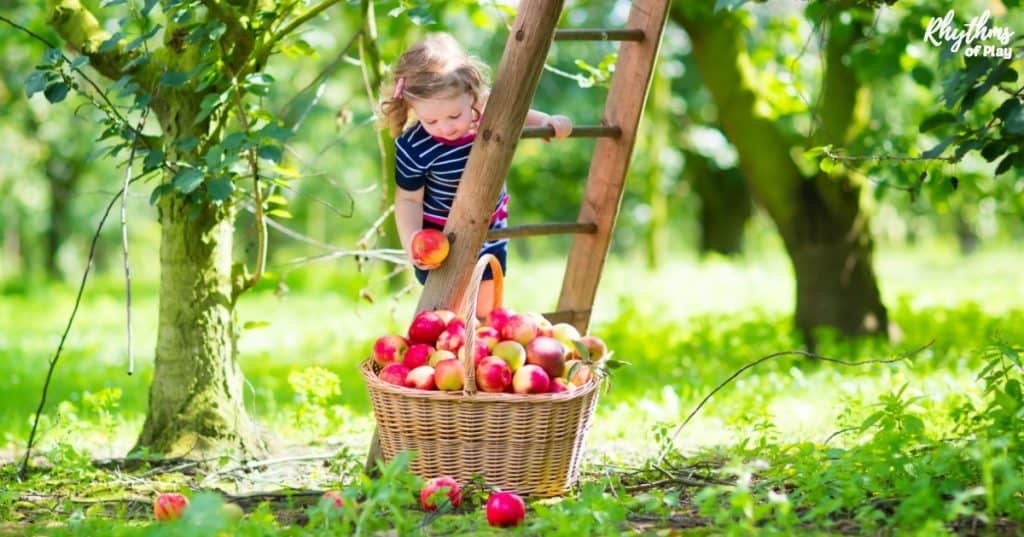
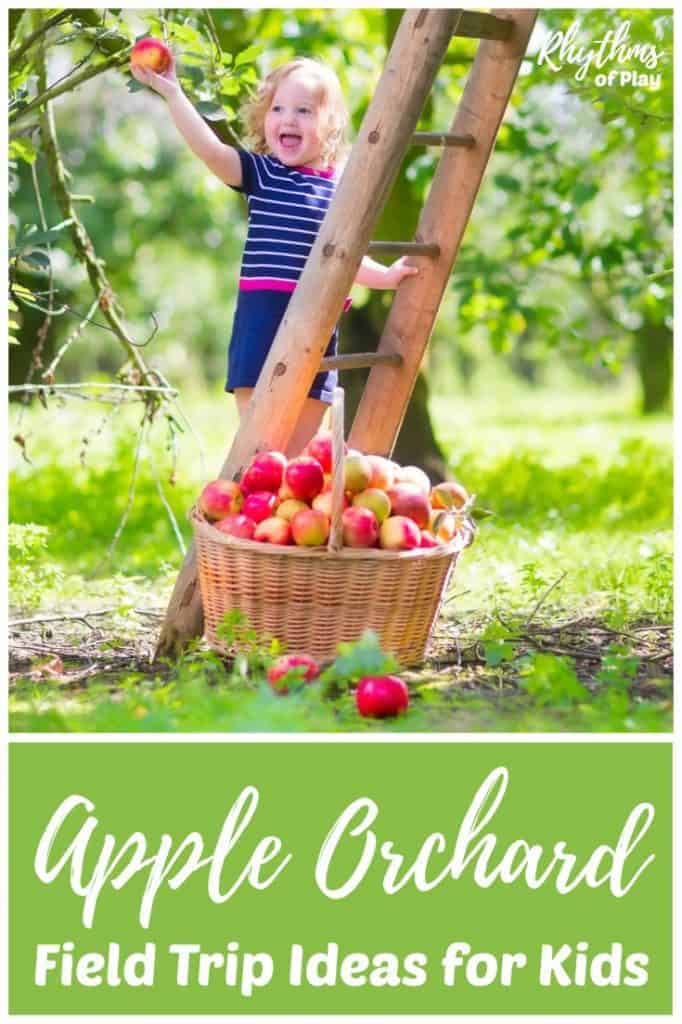
Try not to rush in and do everything for them. Picking an apple themselves gives children a chance to practice coordination, follow directions, and experience firsthand where their food comes from. Even a toddler can help choose an apple, hold the basket, or gently place the picked fruit inside. Older children can practice selecting ripe fruit and picking it carefully on their own, as shown in the photo below. With a little guidance, apple picking can become part of the learning experience for everyone, not just the reason for the trip.

Apple Picking Orchard Activities for Kids
Picking apples is just one of the many things children can do and learn at an apple orchard. Slow down and give kids time to explore, observe, ask questions, and use their senses. Instead of rushing to fill a basket, pause occasionally to notice what is happening in, around, and under the trees. You don’t need worksheets or a formal lesson plan for these apple-picking activities. The orchard itself offers plenty to explore, and sometimes what children notice on their own leads to the best learning experiences.
Try a few of these simple apple orchard activities during your visit:
- Compare apple varieties. Look for differences in color, size, shape, and markings. If the orchard allows tasting, compare the flavor, aroma, and texture of different varieties.
- Go on an apple color hunt. How many shades of red, green, yellow, pink, and gold can you find? Look closely. Even apples on the same tree may not look identical.
- Count apples. Younger children can count apples as they pick them, look for groups of two or three, or estimate how many apples are in a basket.
- Find the biggest and smallest apples. Compare size, shape, weight, and color. Older children can estimate or measure the differences.
- Look closely at an apple tree. Notice the bark, branches, leaves, stems, fruit, and roots you can see. Look for old pruning cuts, new growth, holes, moss, lichen, and other interesting details.
- Look for signs of wildlife. Search for birds, insects, spiderwebs, tracks, holes, nibbled fruit, or other signs that animals live in or visit the orchard.
- Notice the pollinators. Depending on the season, you may see bees and other insects among the trees and nearby plants. Discuss the important role pollinators play in helping apple blossoms develop into fruit.
- Explore with your senses. What can you see, hear, smell, and safely touch? Notice the scent of ripe apples, the feel of the bark, the sound of leaves in the wind, and the colors throughout the orchard.
- Search for patterns. Look at how trees are planted in rows, how branches grow, where apples appear on the tree, and how leaves and fruit are arranged.
- Notice what is beneath the trees. Look for grasses, flowers, fallen leaves, fruit, insects, fungi, or bare soil. Ask why growers might allow certain plants to grow beneath or between trees.
- Observe fallen apples. Without handling rotten fruit, observe what happens to apples after they fall. Are insects eating them? Are they beginning to break down? This can lead to conversations about decomposition, soil, and how nutrients return to the earth.
- Ask a farmer or orchard worker a question. If someone has time to talk, encourage children to ask questions they genuinely wonder about. How do they know when an apple is ripe? What happens to apples that aren’t picked? How old are the trees? Which variety is their favorite?
- Draw or record what you notice. Bring a small nature journal or sketchbook and let children draw an apple, leaf, tree, insect, or orchard scene. Older children can write observations, questions, or the names of apple varieties they discover.
- Take photographs. Let older children photograph interesting colors, patterns, insects, trees, or other discoveries. Younger children may enjoy choosing what to photograph together.
- Simply wander and wonder. Not every moment needs to be an activity. Give children time to walk among the trees, notice what captures their attention, and follow their questions.
Apple Orchard Observation and Wonder Questions
A few thoughtful questions can help children look more closely without turning your orchard visit into a quiz. Follow their curiosity and use questions that match what you find.
- Are all the apples on this tree the same size and color?
- What differences do you notice between two apple varieties?
- Why do you think some apples are growing high in the tree while others grow lower?
- Why are some apples on the ground?
- What do the leaves, bark, and branches feel like?
- What insects, birds, or other animals can you find?
- What is growing underneath and between the apple trees?
- Can you find evidence that an animal has eaten an apple?
- Where do you think the apple blossom was attached?
- Why might some apple varieties ripen before others?
- How do farmers know when apples are ready to pick?
- What do you think this orchard looks like in winter, spring, and summer?
- What had to happen before the apple in your hand could grow into being?
Don’t worry about having all the answers. Wondering together is part of the experience. If a question stumps you, write it down and look for the answer when you get home. One good question found under an apple tree can lead to an afternoon of learning. Consider bringing a nature journal along or making an entry soon after you return home from your visit.
Follow an Apple Tree Through the Seasons
An apple orchard is a wonderful place to learn how apple trees change throughout the year because children can see the trees and fruit firsthand. The ripe apple in your hand is only one part of a seasonal cycle that unfolds throughout the year.
Apple trees begin preparing for the next growing season long before apples appear. After winter dormancy, buds begin to open as spring temperatures warm. Leaves emerge, followed by apple blossoms that provide nectar and pollen for bees and other pollinators.
For an apple to develop, pollen must reach the flower’s stigma. Most apple varieties need pollen from a different compatible apple variety to produce a good crop, which is one reason orchards often grow several varieties near one another. Bees and other insects play an important role by carrying pollen between blossoms as they search for food.
After successful pollination and fertilization, the flower begins to change. The petals fall, and the ovary at the base of the blossom develops into part of the young fruit. The apple grows throughout spring and summer as the tree uses sunlight, water, air, and nutrients to support its growth.
As the apple matures, it changes in size, color, flavor, texture, and sweetness. Seeing one stage of the apple tree’s yearly cycle can help children imagine and understand what came before. After harvest, apple trees prepare for winter. Their leaves change color and fall, and the trees enter dormancy before their yearly seasonal cycle begins again.
Apple Tree Through the Seasons
Here’s a simple way to follow an established apple tree through the year:
- Winter rest: The apple tree is dormant during the cold winter months, but buds are already waiting on its branches.
- Buds open: As the weather warms in spring, buds begin to open and new leaves and flowers emerge.
- Apple blossoms bloom: The tree fills with blossoms that attract bees and other pollinators.
- Pollination: Pollinators carry pollen from flower to flower, helping apples develop.
- Tiny apples form: After pollination and fertilization, the petals fall away, and tiny apples begin to grow.
- Apples grow and ripen: The fruit grows larger through spring and summer, gradually developing its color, flavor, and sweetness.
- Apple harvest: When the apples are ripe, they are ready to pick and eat.
- Leaves fall: After harvest, the leaves change color and fall as the tree prepares to rest through winter.
- The yearly cycle begins again: After its winter rest, the tree wakes in spring, and new buds, leaves, and blossoms appear.
The Life Cycle of an Apple
When you visit an orchard in late summer or fall, ask children to imagine what the trees looked like earlier in the year: bare branches in winter, blossoms buzzing with pollinators in spring, tiny apples developing in early summer, and branches filled with ripe fruit at harvest time.
When the fruit is ripe, it is ready to harvest. You can also look at the apple in your hand for clues to its past. Find the stem where it was attached to the tree, then look at the opposite end for the remains of the flower that once grew there.
The yearly changes of an apple tree are different from its life cycle. An apple tree’s life cycle follows it from birth through growth and reproduction to the production of seeds that can start a new generation.

Here’s a simple apple life cycle for kids:
- Seed: An apple seed contains an embryo with the potential to grow into a new apple tree.
- Germination: Under the right conditions, a viable seed germinates. A root begins to grow downward, and a shoot grows upward.
- Young tree: The seedling grows and develops more roots, a stem that eventually becomes a woody trunk, branches, and leaves.
- Mature tree: Over several years, the young tree grows into a mature apple tree that can produce flowers.
- Flowers: In spring, a mature apple tree produces blossoms.
- Pollination and fertilization: Bees and other pollinators can carry pollen between compatible apple blossoms. After successful pollination and fertilization, fruit can begin to develop.
- Developing apples: The petals fall, and small apples begin to grow. The fruit gets larger and changes as it matures.
- Ripe apples: When the apples mature, they are ready to harvest. Inside each apple are seeds.
- New seeds: A viable seed can germinate and grow into another apple tree, starting a new generation.
One especially interesting discovery for older children is that an apple tree grown from a seed usually won’t produce apples identical to the apple the seed came from. Most named apple varieties are propagated by grafting rather than grown from seed.
This means the apple you pick at an orchard tells two stories at once. The tree changes with the seasons year after year, while the seeds inside its fruit hold the possibility of beginning a whole new generation of apple trees.
Explore the Parts of an Apple
After picking an apple, take a closer look at all the parts that make up the fruit. This simple hands-on activity helps children learn basic plant anatomy while encouraging them to observe something familiar in a new way.
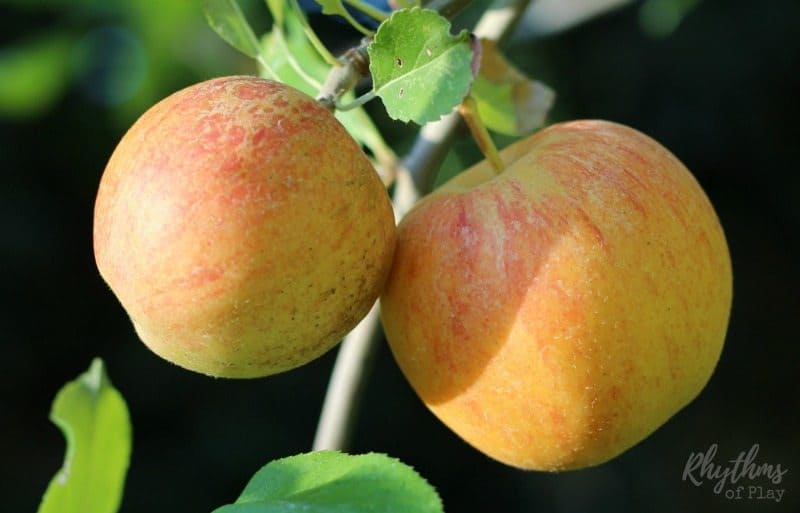
Start by examining the apple’s outside. Ask children what they notice about its color, shape, texture, and smell. Find the stem, where the apple was attached to the tree. On the opposite end, look for the calyx, the small dried remains of the apple blossom.
When you’re ready to look inside, have an adult cut the apple open. See if children can identify these basic parts:
- Skin (peel): The protective outer covering of the apple.
- Flesh: The juicy part of the apple that we usually eat.
- Core: The firmer center of the apple that surrounds the seed chambers.
- Seeds: Found inside the core. Each seed contains an embryo that can grow into a new apple tree under the right conditions.
- Stem: The part that connects the apple to the tree while it was growing.
- Calyx: The dried flower parts found at the bottom of the apple.
Apple Parts Investigation
Use the step-by-step instructions below to complete an apple investigation. The five stages shown in the Apple Parts Investigation graphic provide a simple visual guide for children to follow as they observe, explore, discover, record, and taste an apple.
You will need an apple, a cutting board, a knife (adult use only), and an optional magnifying glass, nature journal, or sheet of paper.
- Observe the whole apple. Look at its color, shape, size, and markings. Feel the skin and smell the apple. Ask children what they notice before cutting it open.
- Find the stem and calyx. Locate the stem at the top of the apple. Turn it over and find the calyx at the bottom. Remind children that the calyx is connected to the blossom the apple grew from.
- Cut the apple lengthwise. Have an adult cut the apple from the stem down through the bottom. Look closely at the skin, flesh, core, seed chambers, and seeds.
- Identify the parts. Point to each part and name it together. Older children can draw the apple and label the parts in a nature journal.
- Count the seeds. Carefully remove the seeds and count them. Notice whether every seed chamber contains a seed.
- Cut another apple crosswise. Have an adult cut a second apple, or the remaining half, horizontally through the middle instead of from top to bottom.
- Find the apple star. Look at the seed chambers in the center. They often form a five-pointed star. Count the points and compare this cross-section with the apple you cut lengthwise.
- Compare what you find. If you have more than one variety of apple, repeat the activity and compare the skin, flesh, core, seeds, color, smell, and shape of each one.
- Draw or record your observations. Children can sketch the two different apple cross-sections, label the parts, count the seeds, or write down something that surprised them.
- Taste the apple. When you’re finished exploring, taste the apple and add flavor, texture, and sound to your observations. Is it sweet, tart, crisp, soft, juicy, or somewhere in between?

Find the Star Inside an Apple
For an extra bit of apple magic, cut an apple crosswise through the middle instead of slicing it from the stem to the bottom. Look closely at the center. The seed chambers often form a five-pointed star.
Try cutting open apples from different varieties and compare what you find. Do all the stars look the same? Does every chamber contain a seed? Younger children can draw the shapes they see, while older children can label the parts or record their observations in a nature journal.
Before eating the apple, take another moment to wonder about what you’re holding. The skin protected it as it grew, the stem connected it to the tree, the calyx reminds us of the blossom it once was, and the seeds inside hold the possibility of another generation of apple trees. One ordinary apple contains a whole lot to discover.
Compare and Contrast Apple Varieties
One of the best things about visiting an apple orchard is discovering how many different kinds of apples grow there. Instead of thinking of an apple as just an apple, encourage children to look closely and notice what makes each variety unique. Compare apples from different trees. Are they the same color, size, and shape? Do some have stripes, spots, or different shades of red, green, yellow, or pink? Are some varieties already ripe while others still need time to ripen?
Read the orchard signs together to learn the names of the varieties you find. Notice whether different varieties grow on trees that look alike or whether you can spot differences in the trees, leaves, or fruit. If tasting is allowed, compare a few varieties with your senses. How does each apple smell? Is it sweet, tart, crisp, juicy, mild, or tangy? Does one make a louder crunch than another?
Ask children which variety they like best and why. There is no right answer. The goal is simply to notice differences, describe what they discover, and experience the surprising variety of apples in an orchard. If you’d like to continue the investigation after your orchard visit, choose several apple varieties to bring home. Then try the Apple Variety Taste Test and Comparison Activity in the After Your Visit section to explore their differences more closely.
Apple Learning Activities for Older Kids
Older children can take their apple orchard observations a step further by exploring the science, history, and agriculture behind what they see. Encourage them to choose questions that interest them rather than turning the field trip into a formal lesson.
A few ideas to try include:
- Investigate pollination. Find out why most apple varieties require pollen from another compatible variety to produce fruit and how bees and other pollinators help.
- Explore grafting. Learn why growers usually use grafting to propagate favorite apple varieties rather than growing new trees from seed.
- Compare apple varieties. Record differences in size, color, flavor, texture, and ripening time, and research why different varieties have distinct characteristics.
- Study orchard ecology. Look for pollinators, birds, insects, fungi, groundcover, and other living organisms that share the orchard ecosystem.
- Explore orchard management. Ask how growers prune trees, manage pests, conserve water, protect pollinators, and determine when apples are ready for harvest.
- Do some orchard math. Estimate the number of apples on a tree, calculate the cost per pound, compare the weights of different varieties, or estimate how much fruit an orchard might yield.
Let older children follow the questions that spark their curiosity. One observation at the orchard can lead to deeper learning in biology, ecology, agriculture, math, history, and even cooking when you return home.
What Can Children Learn at an Apple Orchard?
An apple orchard is a living classroom where children can learn about plants, food, farming, seasons, and the many connections that make a harvest possible. Much of this learning happens naturally as children pick apples, explore the trees, ask questions, and notice what is happening around them.
Children can learn:
- Where food comes from. Picking an apple directly from a tree helps children connect the food they eat with the plants, land, and people that produce it.
- How plants grow and change. Apple trees offer a hands-on way to explore roots, trunks, branches, leaves, flowers, fruit, and seeds.
- How seasons affect living things. Children can discover how apple trees change throughout the year, from winter dormancy and spring blossoms to growing fruit and fall harvest.
- Why pollinators matter. Apple orchards provide an excellent example of how bees and other pollinators help flowering plants reproduce and produce food.
- How living things depend on one another. Trees, flowers, insects, birds, soil organisms, people, water, sunlight, and weather are all part of the orchard ecosystem.
- How farmers care for crops. Children can learn about pruning, watering, pest management, harvesting, and the work involved in growing healthy fruit.
- How to use their senses and observation skills. Comparing apples, examining trees, listening for wildlife, and noticing colors, textures, scents, and sounds encourages children to slow down and look more closely.
- How to care for the places that provide our food. Following orchard rules, picking gently, respecting plants and wildlife, and taking only what they plan to use helps children practice responsible stewardship.
Perhaps most importantly, an orchard gives children the opportunity to learn through direct experience. An apple becomes more than something found in a lunchbox or grocery store. It becomes part of a much bigger story about seasons, ecosystems, agriculture, and our connection to the living world.
Apple Activities to Try After Your Field Trip
The learning doesn’t have to end when you leave the orchard. You can extend children’s learning at home or in the classroom with resources and simple apple activities below. Bring home a few of the apples you picked and use them for simple science experiments, art projects, taste tests, recipes, and other hands-on activities.
Following up on an orchard visit gives children a chance to explore the questions and discoveries that most interest them. They can look more closely at the apples they picked, investigate how apples grow, create apple-inspired art, prepare something delicious to eat, or learn more through books and stories.
You don’t need to complete everything on the list. Follow your child’s interests and choose one or two activities that build on what they noticed at the orchard.
Apple Variety Taste Test and Comparison Activity
If you brought home several varieties, set up an apple taste test. Compare each apple’s color, size, shape, aroma, flavor, texture, and crunch. Cut the apples open and note differences in the flesh, core, and seeds.
Children can describe each variety as sweet, tart, crisp, juicy, mild, tangy, firm, or soft. Older children can record their observations, create a rating system, conduct a blind taste test, or graph everyone’s favorite varieties.
Ask children which apple they prefer and why. You might also investigate which varieties are best for eating fresh, baking, making applesauce, or pressing into cider.
Apple Science and Learning Activities
Use the apples you picked to continue exploring the science you discovered at the orchard. Cut an apple open to investigate its parts, look for the star formed by the seed chambers, count and compare the seeds, or observe what happens when a cut apple is exposed to air.
Children can also learn more about the apple life cycle, pollination, grafting, decomposition, and how apple trees change through the seasons using the outlines provided previously. A nature journal is a great place to draw observations, record questions, and investigate what your child wondered about during the feild trip. You might also enjoy this easy apple science experiment by Fun-A-Day for “Pre-K Pages.”
Apple Crafts and ARt Activities for Kids:
Apples also make wonderful inspiration for process art and seasonal crafts. Try apple stamping, make prints with apples cut in different directions, draw or paint an apple still life, create an apple-themed nature craft, or use the colors and shapes you noticed at the orchard as inspiration for an art project.
Apple art offers another opportunity to look closely. Try a few of the apple crafts below at home or in the classroom this fall. Apple-picking crafts provide a simple way to learn and create with the fruit you pick. Before creating, notice the different shades on the skin, the shape of the stem and calyx, and the patterns revealed when you cut an apple open.
Here are a few apple craft activities you can try:
- Create an apple hedgehog by using half of an apple as the body. Using toothpicks to create a hedgehog or porcupine is a fun fine-motor activity for kids.
- Craft a clove apple pomander with the step-by-step instructions on Crafting a Green World.
- Try apple stamping art: Cut apples in half and dip them in tempera paint to make apple prints! For tips, have a look at THIS printmaking project!
- Strengthen your hands with these fun apple button crafts for kids: Craft an apple button tree (with glue) or sew an apple button tree. Alternative craft supplies are provided for the apple tree craft if you don’t want to use buttons.
- Weave an apple onto a paper plate using this fun apple craft idea from “Easy Crafts for Kids.”
- Make an apple craft with this simple nature craft activity.
- You can find a few more fall apple crafts on this list of Fall Nature Crafts.
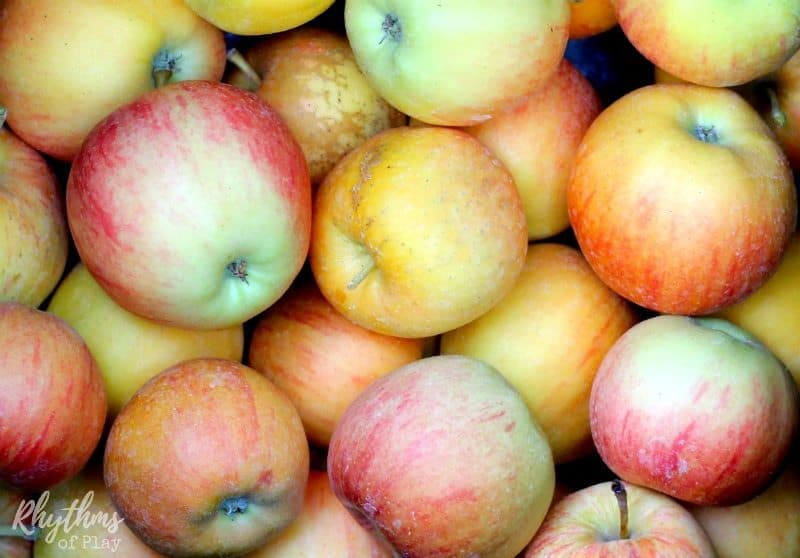
Apple Recipes to Make with Kids
If you are wondering what to do with all the apples you collect at the farm, look through the fabulous apple recipes below. Making food with the apples you pick is an excellent learning activity that provides a farm-to-fork experience for children.
Before you start cooking, invite children to help prepare the apples you picked at the orchard. An easy countertop apple peeler and corer can make peeling apples a fun, hands-on job for kids.
Peeling and coring apples is also a wonderful practical life activity. Children practice coordination, concentration, and independence while helping prepare real food for the family. Watching a long, curly apple peel spiral off the fruit is surprisingly satisfying!
Once the apples are peeled and cored, put them to good use in one of the apple recipes below. Cooking with the apples you picked completes the journey from tree to table. Make homemade applesauce, baked apples, apple crisp, apple muffins, apple pie, or another favorite family recipe.
Invite children to wash, measure, pour, stir, and help prepare the apples in age-appropriate ways. Cooking together offers practical lessons in math, science, following directions, and food preparation, and it gives everyone something delicious to enjoy at the end.
After peeling the apples, use the recipes included below the apple crafts in the following section to create something delicious for everyone to enjoy.
Apple-Picking Activity Recipe Ideas:
- Apple Pie Oatmeal Breakfast Recipe: This recipe from “Rhythms of Play” makes oatmeal that tastes just like fresh apple pie. You can even add fresh walnuts, another fall favorite! (Learn how to crack walnuts so you have two perfect halves left for crafts.)
- Apple Crisp: Move over, apple pies; there’s a much easier apple-picking recipe for kids that the whole family will enjoy! Use this delicious gluten-free fruit crisp recipe to make an apple crisp with the instructions below:
- Peel and cut apples into slices. I recommend this apple peeler and corer; it’s economical, fast, and easy to use.
- Pour 1/3 cup of orange juice over apple slices.
- Add 1 teaspoon of cinnamon and 1/4 teaspoon of nutmeg (if desired), then follow the remaining recipe instructions in “Rhythms of Play.“
- Easy Recipe for Applesauce: Learn how to make applesauce with a step-by-step cooking tutorial for kids by “Teaching 2 and 3-year-olds.”
- Slow-Cooker Apple Butter (No Sugar Added!): This simple recipe will teach you how to use the apples you pick to make delicious apple butter without sugar. Spread it on toast and more. Get DIY details on “Bakerita.”
- The Magic of Caramel Apples: Learn how to make caramel apples with “Sally’s Baking Addiction.”
Related: Low-Fat Pumpkin Cranberry Bread
Read Apple Books Together
Finish your exploration of apples with a few good books. Look for stories and nonfiction books about apple trees, orchards, harvest time, pollinators, farming, and the apple life cycle.
Books can answer the questions children bring home from the orchard and inspire entirely new ones. Pairing a real-world experience with stories and nonfiction is a simple way to help children connect what they have seen and experienced to a deeper understanding of the natural world. For more of our fall favorites, check out Autumn Stories Children LOVE!
Here’s a selection of apple books for kids, perfect for enjoying before or after a trip to an Apple farm:
- Apples for Everyone

- Apples
- How Do Apples Grow?
- Apple Picking Time
- Johnny Appleseed
- The Apple Pie Tree
- Fall Apples
- The Seasons of Arnold’s Apple Tree
- Apples and Pumpkins


You might also enjoy these Books That Teach Children Important Life Lessons.
Apple Orchard Field Trip FAQ
In summary, here a few answers to the most frequently asked questions about this apple-picking activity for kids:
When is the best time to go apple picking?
Apple-picking season usually runs from late summer through fall, but harvest times vary by location, weather, and apple variety. Check with the orchard before your visit to find out what is ripe and available for picking.
What should you bring on an apple orchard field trip?
Wear comfortable closed-toe shoes and weather-appropriate clothing, and bring water, sun protection, and any snacks you may need. Depending on the orchard, you may also want a basket or reusable bag, wagon or stroller, wipes, and a small nature journal or camera. Always check the orchard’s rules before bringing your own picking containers, food, pets, or other items.
What can children learn at an apple orchard?
Children can learn where food comes from, how apple trees grow and change through the seasons, why pollinators are important, and how farmers care for crops. An orchard also provides opportunities to explore plant parts, ecosystems, apple varieties, agriculture, and the connections between plants, animals, people, weather, and how the food we eat is grown.
How do you pick an apple without damaging the tree?
Gently cup a ripe apple in your hand, lift it slightly, and give it a gentle twist. Avoid pulling straight down, shaking branches, or yanking at the fruit. Follow the orchard’s picking instructions, since growers may have specific recommendations for their trees and apple varieties.
Is apple picking a good activity for toddlers and preschoolers?
Yes. Young children can help choose ripe apples on low branches, gently place picked fruit into a basket, count and compare apples, look for colors and shapes, and explore the orchard with their senses. Keep activities simple, supervise children closely, and allow plenty of time for them to explore at their own pace.
How can you continue learning after an apple orchard field trip?
Bring home several apples and let your child’s interests guide what comes next. Try an apple variety taste test, investigate the parts of an apple, explore the apple life cycle, make apple art and crafts, prepare an apple recipe together, or read books about apples, orchards, farming, and harvest time.
Make Memories and Learn Together at the Apple Orchard
An apple orchard field trip is about so much more than filling a basket with apples. It’s an opportunity to slow down, spend time outdoors, discover where food comes from, and experience the changing seasons together.
As children wander between the trees, they can see how apples grow, meet the people who care for the orchard, watch pollinators and other wildlife, compare different apple varieties, and experience the simple satisfaction of picking food with their own hands. Along the way, there are countless opportunities to wonder, explore, ask questions, and make discoveries together.
And the experience doesn’t have to end when you leave the orchard. Families, homeschoolers, and classrooms can bring apples home or back to school to taste and compare, investigate, create art, prepare a recipe, or read a good apple book. Sometimes the best learning begins with a real experience and continues wherever curiosity leads next.
Most of all, enjoy your time together. Pick gently, taste something delicious, notice what is growing around you, and make a few memories along the way. Children may not remember every fact they learn about apple trees or pollination, but they may remember walking between the trees with their family, classmates, or teachers, choosing an apple from a branch, laughing with friends, and sharing their discoveries with one another.
These simple shared experiences help build connection and belonging at home, in the classroom, and within our communities. And sometimes, a day spent picking apples is really about something much bigger: growing connection, one season, one discovery, and one shared memory at a time.
This post is part of the Get Outside and Connect Series. Click on the link to learn more. You might also enjoy these outdoor learning ideas and nature activities.
You may also like our Fall Bucket List, which includes several more fun and educational autumn activity ideas for kids.
Please visit our About page to learn more about Rhythms of Play. For more information about this website and the author of these apple picking activities, please visit the Rhythms of Play home page or the author page, Nell Regan Kartychok.
For more field trip ideas, check out the following Guides:

If You Liked These Apple Orchard Field Trip Ideas, you might also like:
- How to Raise a Helper
- 15 Reasons to Climb a Tree and Other Risky Play Benefits
- How to Plan Your Daily Rhythm or Routine
- 20 Rainy Day Outdoor Play Ideas
- How to Paint Rocks






Such a cute article!
Thanks, Lisa! I’m so glad that you enjoyed it!