
Use these simple positive parenting tips to help children develop the habit of doing their chores and helping out around the house without needing to yell, nag, or punish.
Use the positive parenting tips below to learn how to raise independent, intrinsically motivated children who naturally develop the habit of helping with chores and other household duties. Most of us prefer not to nag or yell, but when shoes are left by the door, toys are scattered across the floor, and no one seems to listen the first (or even the fifth) time, it can feel like the only way to get help is to push harder.
It’s easy to fall into the habit of reminding, repeating, and sometimes raising our voices just to be heard and to get through the day. But what if children didn’t need constant reminders to pitch in? What if helping came from within them, not from pressure, rewards, or consequences? Believe it or not, children are born to help, and today, there is research to prove it.
Raising Intrinsically Motivated Children
Contrary to popular belief, you don’t need to force or shame your children to help out with household duties. Children are naturally wired to contribute. From a young age, they want to feel capable, included, and valued. They want to belong.
When we give kids real opportunities to help and the guidance they need to succeed, they start to see themselves as important members of the family (or the classroom). Over time, this fosters a quiet type of motivation that doesn’t rely on stickers, threats, or timeouts.
This article examines how to foster intrinsically motivated helpers through simple positive parenting approaches. You’ll discover how to promote cooperation and build a home environment where children want to help. Not because they have to, but because it feels good to work together as a family and be part of something meaningful.
Scroll down to learn why, and how, to get kids to help with household chores, gardening, yard work, and other helpful tasks and duties! This is the first article in a series about raising helpful children by Nell Regan Kartychok, originally published on May 24, 2017. It is regularly updated to improve content and include research updates. You might also enjoy 15 Ways to Raise a Helper.
Related: Caring for the Earth: 12 Ways to Help Kids Get It
How to Raise Children Who Help with Chores:
One of our primary duties as parents is to care for our children. But of course, this does not mean we need to do everything for our children for the rest of their lives! Could you imagine!? Instead, parents are responsible for teaching their children how to take care of themselves and learn basic life skills such as completing household chores.
If we don’t teach our kids how to take care of themselves and guide them to help out around the house, how will they ever learn to do it on their own? Start encouraging, inviting, and allowing children to help with household chores when they start toddling about to ensure this does not happen.
Give your children the good start they need in life by helping them to develop strong life skills, positive habits, and simple household rhythms. If you don’t show children how to help, they will need you to continue doing everything for them for the rest of their lives. How’s that for motivation?
Related: Get Organized for Good and Help Your Children Thrive Using the Power of Rhythm
Helping is Inborn, Nurture This Natural Tendency in Your Children
Children are natural imitators. This means that they learn everything by watching us. Babies, toddlers, and preschoolers thrive when adults allow them to follow them around and imitate everything they do. But when we tell children to leave us alone while we are doing a chore, we teach them that we don’t want their help, or that they aren’t good enough to help.
Turning an eager helper away can also teach children that they don’t need to help because we keep doing everything for them. Worst of all, we don’t give them the chance to learn by watching us and copying what we do.
Is it any wonder that when we want them to help as they get older, not only do they not know how, but they no longer want to? I’d rather suffer through the early years of allowing children to help with chores than suffer because they don’t end up helping at all.
I know that allowing kids to help with chores is more of a hindrance at first. Trust me when I tell you that those long moments of helping them help you don’t last. Instead, it gets more manageable, and pretty soon, they will actually start helping with the chores.
Don’t Turn an Eager Child Away, Let them Help You:
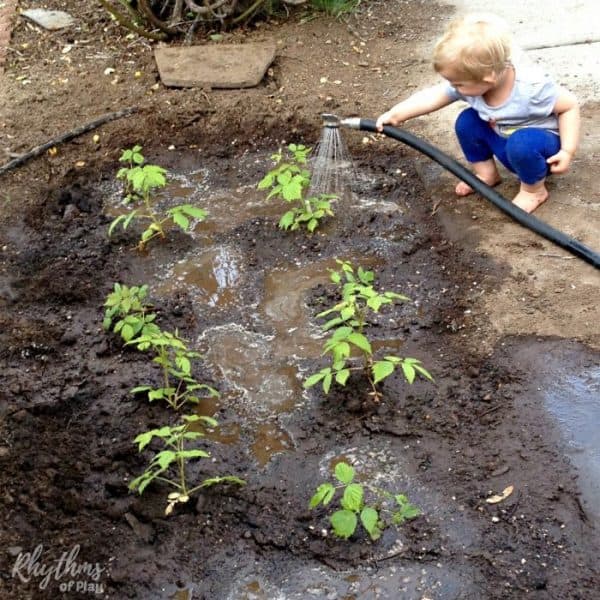
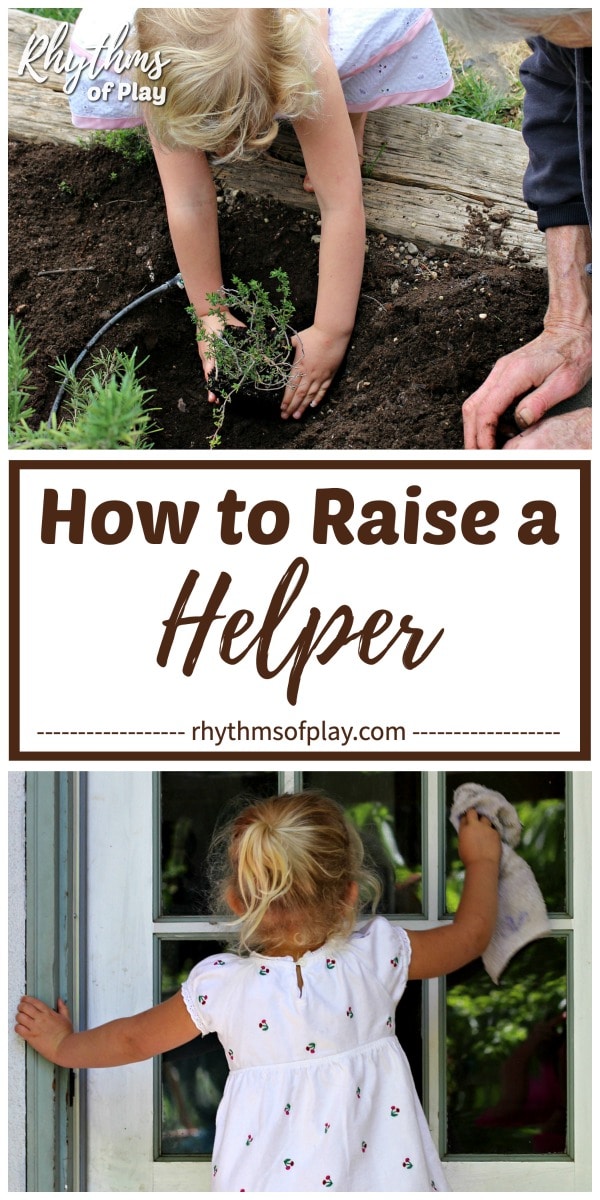
When children start copying the things you do. Or start trying, or even asking, to help you; they are telling you that they are ready to start helping. For example, as I was watering the raspberries with the sprinkler head one day (because I was too lazy to go get the proper attachment), my 18-month-old walked up to me and demanded, “I try.” After a brief moment of hesitation, I handed her the hose and took the picture below of her watering the raspberries instead.
I decided, even though I wasn’t necessarily using the correct tool, there’s no sense in turning an eager helper away. It’s best to allow kids to help you as soon as they start asking, even if you think they can’t or won’t. Or they might stop asking. Once children stop asking, getting them to help can be quite a struggle, and I’m pretty sure that is not your desired outcome.
Children are Born to Help
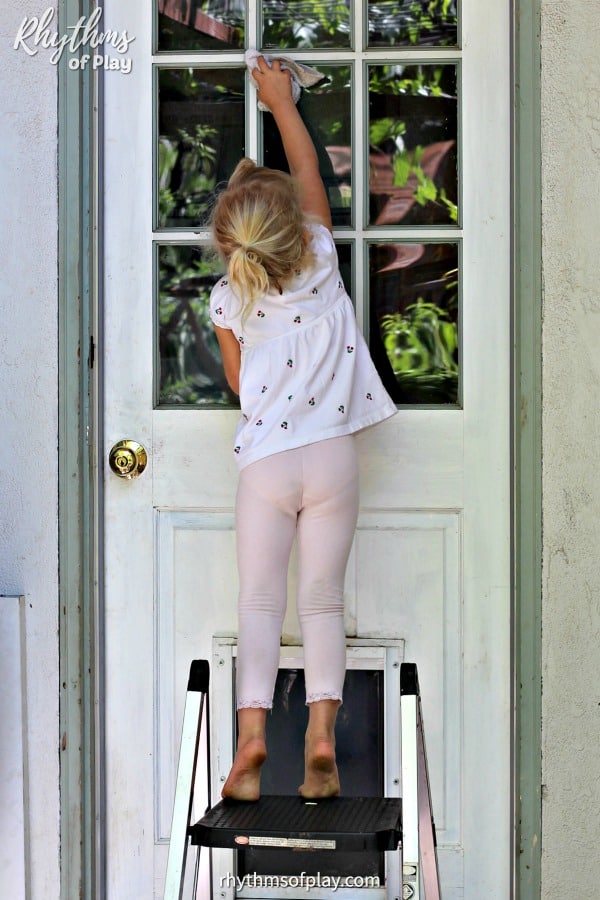
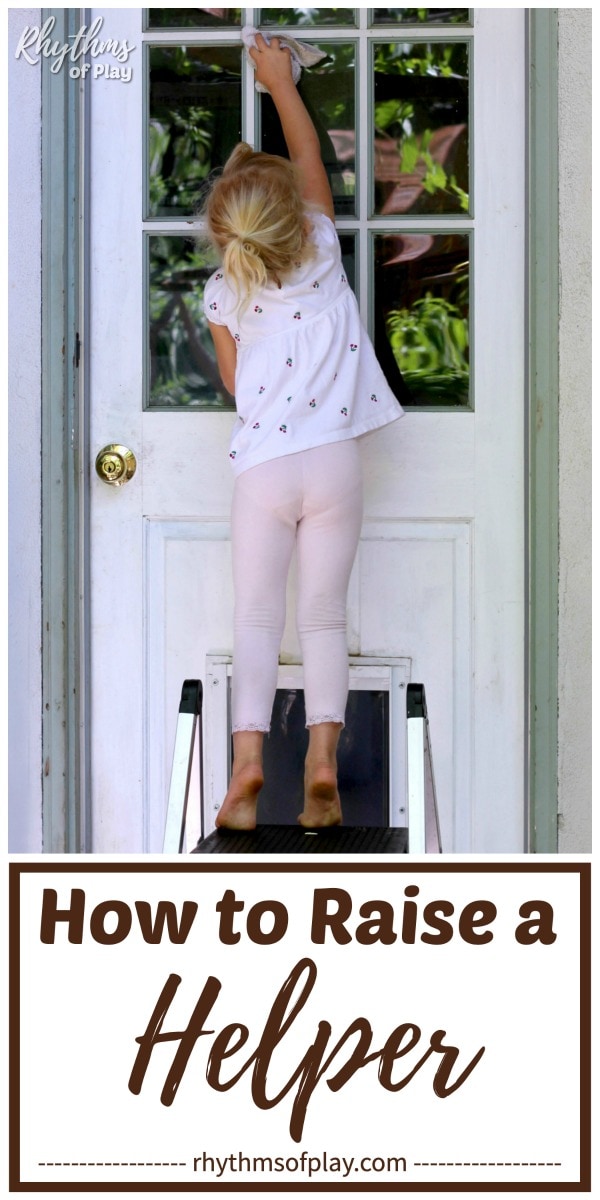
One morning, I was in the kitchen doing the dishes when my 3-year-old daughter burst in, grabbed the step stool, and ran out the back door. I watched her struggle to open as I continued to spy on her out the kitchen window. I wondered what she was up to when she ran off and came back with her cleaning kit.
My eyes widened, and a smile slowly grew upon my face as I excitedly realized, “Oh my goodness, she’s going to wash the windows!” I continued to secretly watch her out the kitchen window as she pulled the now-open stepladder up to the back door, climbed it, and began cleaning the windows.
Dumbfounded, with my dish-soaked hands dripping onto the floor, I stood there in shock for a brief moment. But then I realized this was perfectly normal, and it was partly my doing. Go me! Why? Because I never turned her away when she wanted to help. Instead, I offered her simple tasks to help me with whatever I was doing around the house, and it worked. It WORKED!
You Can Do It, Too!
It worked so beautifully in fact that it felt as if something had transpired as if by magic, and felt as though I had won the lottery. But the truth is revealed by basic behavioral science. Self-motivated behavior happens every day when you raise an intrinsically motivated helper. It was such an amazing experience for me that I felt like alerting the media to share my success, but instead, I decided to write this blog post so you can replicate these positive behaviors in your own home!
It’s Not Magic, It’s Basic Behavioral Science, and It’s Called Parenting:
Children who are raised to treat household chores as an everyday part of life, where everyone helps out, develop these habits and skills naturally. They learn them by watching the people around them, modeling or copying what they see, and your continued guidance, but only if you nurture this natural tendency.
The most amazing thing about this whole equation is that children actually enjoy helping you and want to help. Yup, you heard that right. They want to help. Children view helping as a privilege, not a punishment. If you can help them maintain this point of view, as some cultures have done since the beginning of time, you will have a helper for life!
I was so proud of my daughter the day she decided to wash the windows by the back door; I shared it with everyone around the dinner table that night. Including my mother, who, by the way, still needed to hear that allowing children to help out is a good thing.
Intrinsically Motivated Children Have Positive Role Models:
Unfortunately, when I was young, my mother screamed at my brothers and me to “Get out of my hair, and “Leave me alone,” no matter how much I tried to help her. Either that or, “The sun is still shining, why are you in my house?”
She would never allow me to come into the garden when she was working, help with dinner while she was cooking, wash the windows of her car, or anything else. Instead, she made me feel like I wasn’t worth the effort and a terrible burden on her, which isn’t the greatest thing to teach your oldest child.
Without her parenting help, I struggled to develop the strong life skills and habits to care for myself throughout my youth and into adulthood, even though she forced me to parent my three younger brothers before I even made it to 12. It was a long road, I made oodles of mistakes, and I am still a work in progress, but I wanted something different for my child. I wanted to do the unthinkable, break the mold of past conditioning in favor of something better.
Unlike me, I wanted my daughter to grow up knowing that her work was valued and that she was a worthy helper who deserved to be shown the way and work by my side whenever she wanted to. And as of this 2026 update, it has paid off immensely. It even helped heal my relationship with my mother.
Related: Books That Teach Kids Important Life Lessons
Reinforce Positive Behaviors:
The night my daughter washed the windows without being asked, I chose to reinforce my daughter’s positive behavior in front of the whole family at the dinner table. Not only did I want to reinforce my daughter’s behavior, but I also wanted to correct my mother’s mistakes.
I wanted to help my dear mama see that letting children help around the house and garden has benefits that far outweigh the drawbacks. I also wanted her to see that her granddaughter could learn from her if she was willing.
My mother developed a wealth of valuable skills throughout her lifetime. She is a true Renaissance woman, a “Jack-of-all-trades” who was ahead of her time. She firmly believes that a woman can do anything a man can and sets out to prove it. Each time she repaired the house, built something new, fixed the plumbing, turned the compost, or crawled under her Volkswagen bus, she proved her point, and I learned that she was right.
If you can do it, so can I
By watching her, I learned that a woman can do anything she sets her mind to, and I benefited immensely from that. I never would have tried out to become a lifeguard if it weren’t for the lessons my mother taught me. In 1994, I became one of the less than 10% of women employed by the Los Angeles County Fire Department as an Ocean Lifeguard. And I remained one for 20 years. Working alongside the men because my mother showed me that it could be done. But there was so much more she could have taught me.
Unfortunately, I became my mother’s witness, but not her apprentice as I had hoped. She didn’t allow me to follow in her footsteps when I was young. Nor did she offer me the guidance I so desperately craved and needed. Like every child, I wanted to help her because I wanted to feel worthy, and like I belonged. Instead, she pushed me away. I only wish she had been willing to share more of her knowledge with me before I became an adult, rather than afterwards. Most of all, I didn’t want to repeat her mistake.
So, to positively reinforce my daughter’s behavior, and to prove a point to my mother. I decided to open my big fat mouth and gush all over my daughter about how proud I was of her for making the effort to wash the windows at the dinner table that night.
I bragged to my husband about the effort she made, how helpful she was, and how grateful I was to have her help that day. As I gushed, I complimented her on her efforts, not her ability, so she would feel valued and appreciated and want to repeat these behaviors.
Healing Our Past Improves Our Future:
I’ll bet you can guess what happened in the days, weeks, and years that followed that infamous day. My daughter continued to help, over and over again, and so did my mom — finally. Better late than never, I always say. Isn’t simple psychology grand?
Fortunately, my mother heard both the compliments I paid my daughter that night and what I was saying to her. She not only began allowing her granddaughter to learn from her much more than she ever had in the past, but she also enjoyed it and thanked me for allowing her to be a part of her granddaughter’s life. At least she finally figured it out. I nearly cried that day. It was a full-circle moment of inter-generational healing that my family will forever benefit from.
My daughter was so proud of my many accolades that night at the table that her smile beamed from ear to ear. My many compliments and gratitude for her help that night and in the years that followed continue to reinforce her helpful behaviors in ways that still amaze me. Today, 10 years later, her father and I are continually in awe of how well she takes care of herself and our home, and her many accomplishments.
Helping is Inborn, Nurture This Natural Tendency in Your Children
Children are natural imitators. This means that they learn everything by watching us. Babies, toddlers, and preschoolers thrive when adults allow them to follow them around and imitate everything they do. However, when we tell children to leave us alone while we are doing a chore, as my mother did, we teach them that we don’t want their help or that they aren’t good enough to help.
Unfortunately, when we turn an eager helper away, we also teach children that they don’t need to help. How can they help, and why would they want to, when we continue to do everything for them? Is it any wonder that when we want them to help as they get older, not only do they not know how, but they no longer want to?
I promise that one day, you too will find your jaw on the floor when your child does something like take the stepladder out the back door to wash the windows without even being asked. That said, children need plenty of guidance and support as they learn to meet their commitments. So I recommend using Visual Routine Cards and Home & School Tools for Kids to help.
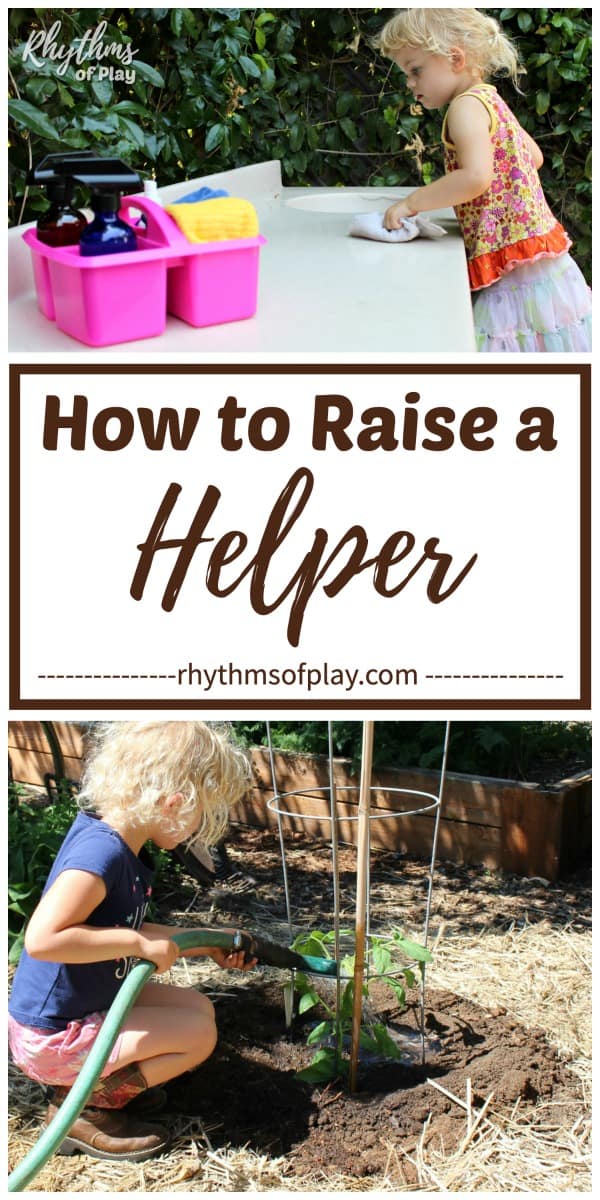
Chores for Kids:
Everyone wants to raise children who help around the house, but how do you raise them to do their chores without the need to nag or yell? In other words, how do you get this intrinsic motivation stuff to work for your kids?
The most important thing you can do to raise children who develop the habit of helping around the house is to ensure that they watch you work and allow them to “help.“
Yup, it’s that simple! Okay, you got me, maybe simple was the wrong word.
In actuality, you have to show children how to do a lot of work, which means you need to do several chores around them or in their presence to help them learn what to do, how to do it, and when to do it. Then continue to offer your guidance and support as needed.
While the concept is simple, and the way it works is innate, it’s far from easy. Parenting our children throughout their youth and into their teens takes patience, dedication, a willingness to learn from our mistakes, and a whole lot of work. Which, as it turns out, is not so easy at all. But it’s well worth the effort.
Encouraging Your Helping Hand
Showing toddlers and preschoolers how to do chores, teaching them what needs to be done, and assisting young children can be downright challenging. Sometimes it can be so painful that it makes you want to cry, run away, hide, or all three at once. Parenting is not for the faint of heart.
I know it’s much easier to do all of the household chores yourself when they are young. Please don’t. You will be doing yourself (and your child) a grave disservice in the long run if you don’t allow your children to help with chores around the house from the time they can start walking. Remember, not only is it our job to show children how to do things, but we must also give them the opportunity to try it on their own.
Allowing children to help means that most household tasks will take longer to complete when they are young. It also means that your children might make mistakes. But so will we. Fortunately, mistakes are how we learn to do better the next time. As parents, we not only model how to do household chores and other home-life skills. We also provide an example of how to recover and move on after making mistakes — especially when we get upset.
The biggest challenge for me, and most parents, teachers, and caregivers I speak to when it comes to chores and raising children, is learning to gracefully tolerate the many mistakes our children make without becoming frustrated, getting upset, or yelling.
Just Stay Calm and Carry On, Mom!
Staying calm in moments of frustration or upset can be challenging because it’s so easy to unconsciously place our judgments on our children or students. But no matter how many times you point your finger, there will always be three fingers pointed back at you.
Learning to see myself clearly in this mirror and using gentle words in moments of anger have been among my greatest challenges. It is also a personal goal I’ve come closer to mastering since I first wrote this article almost 10 years ago. But I’m not going to lie. The teenage years are challenging, especially as a homeschool parent.
However, the work my daughter and I have done together up to this point has made our relationship so much better able to handle her raging teenage hormones and my aging menopausal hormones colliding over household duties, chores, and homeschool assignments much easier.
I just keep doing the best I can, try to see my own reflection in the mirror, take responsibility for my actions, apologize when necessary, dust myself off when I fall down, strengthen my self-regulation skills, and keep on keeping on.
The Helper “Stage” is Biologically Based
Since the original publication of this article by Nell Regan Kartychok on May 24, 2017. A research study titled “Child Helpers: A Multidisciplinary Perspective,” supporting the idea that children are born to help, as suggested in this helpful series of articles, was published by David F. Lancy in February 2020.
The study also supports my theory that children thrive and experience happiness and well-being when they are allowed to help. From this perspective, you begin to understand that children don’t see helping as a punishment; they see it as a privilege and an honor. Following is the research abstract by David F Lancy:
“In most of the world’s distinct cultures, children–from toddlerhood–eagerly volunteer to help others with their chores. Laboratory research in child psychology supports the claim that the helper “stage” is biologically based. This Element examines the development of helping in varied cultural contexts, in particular, reviewing evidence for supportive environments in the ethnographic record versus an environment that extinguishes the drive to be helpful in WEIRD children. In the last section, the benefits of the helper stage are discussed, specifically the development of an ability to work and learn collaboratively.”
David F. Lancy
Now There is a Book to Prove it, Too!
In March of 2021, a book by Dr. Michaeleen Doucleff was published, which I like to think was also inspired by this article and the others in my “Raising Helpful Kids” series. It is titled “Hunt, Gather, Parent.” In this masterfully written and researched book, Doucleff shares how to raise kind, generous, and helpful children without yelling, nagging, or using timeouts. Sound familiar?
With her three-year-old daughter (the same age my daughter was when I first published the “Raising Helpful Kids” articles), she travels to live with three of the world’s oldest communities: Maya families in Mexico, Inuit families above the Arctic Circle, and Hadzabe families in Tanzania, to learn their methods firsthand. When she tries them with her own daughter, the results are impressive and support this article’s basic premise. Children are born to help, and they actually enjoy it.
Related: Outdoor Activities for Kids
Good Habits Start at Home
Showing our children how to do things around the house and garden, and encouraging them to help with household chores, is the best way to teach them to take care of themselves and motivate them to help out. Best of all, these positive life skills and habits will continue to serve them throughout their adult lives.
How to Create a Habit of Helping with the Chores
When children start helping with the chores at a young age, it can quickly become a positive habit that they can maintain for life. A “habit” is something that is done or practiced regularly. Once something becomes a habit, it becomes hard to give up. When chores become a family habit, life gets a lot easier for everyone in the household. As the saying goes, “Many hands make light work.”
Visual Routine Cards and Home & School Tools for Kids can provide the support you need to help children create these habits. These tools are designed to help children, from toddlers to teens, finish their chores and schoolwork without tears. Or, learn more about my signature program, Organizing Life with Kids!
Related: How to Change Your Life with the Power of Habit
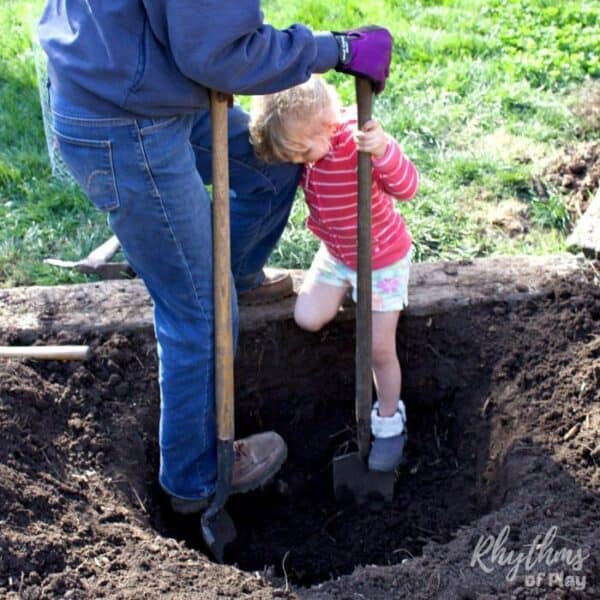
Kids Helping with Chores
Our daughter has been around us, working and helping with the chores, since she was a baby. She has been getting in the way and trying to help us, if you could call it that, since the moment she could walk, just like every other toddler out there.
Instead of turning her away, my husband and I have done our best to encourage her efforts and invite her to help with simple chores and household DIY projects. In fact, there are pictures of our little girl helping with household tasks and DIY projects all over this website.
No, it hasn’t been all butterflies and rainbows. There were many times over the years that I wished I could do it myself without her “help,” but here’s the thing. My husband and I want our daughter to feel that she is good enough to help.
We also want to encourage her efforts because we know this will motivate her to repeat them and continue helping with chores throughout her life. And so far, as of this 2026 update, it’s working awesomely into her teenage years, and our family relationships have benefited immensely as a result.
Related: 8 Reasons I Allow My Child to Go Barefoot
How to Raise Kids Who Enjoy Helping with the Chores
Raising children who consistently help without being asked doesn’t happen overnight. It also doesn’t happen by yelling louder, shaming, or forcing. It develops gradually through daily moments of connection, trust, and shared responsibility. When we shift from controlling behavior to guiding, we allow children to embrace their role as capable, contributing family members.
There will likely still be messy days. Shoes will be forgotten. Chores may go half-done. That’s part of learning. What matters most is our response. When we stay calm, model respect, and keep inviting children to help in meaningful ways, we cultivate positive life habits that last well beyond childhood.
Young children love to feel useful and want to help around the house. Showing them how to help, even when it makes it harder for us, encourages this aspect of their nature. Over time, something beautiful begins to happen. Children stop helping just to avoid consequences or earn praise.
Instead, they help because they feel valued. They notice what needs to be done. They take pride in doing their part. That’s the goal. Not perfect behavior, but willing hearts and helpful hands. Nourish children to be the helpers they were born to be! You might also enjoy the other articles in this series about raising helpful children:
- 15 Ways to Raise a Helper–learn our favorite tips and tricks to get children to help with chores!
- Tools for Raising Helpers
- How to Use Visual Routine Cards
- Positive Discipline Books for Parents and Educators
Learn more about Nell Regan Kartychok, author and photographer of “Raising Helful Kids” HERE, and Rhythms of Play HERE!
More Positive Parenting Tips
- DIY Chemical-Free Cleaning Kit for Kids
- Best Parenting Books
- Teach Kids to Use Good Manners the Easy Way
- Positive Discipline Books for Parents and Educators
Raising Intrinsically Motivated, Emotionally Healthy Children with a Growth Mindset
Some of the best photos of kids helping with chores, along with more tips for raising intrinsically motivated, emotionally healthy children with a growth mindset, are listed below:



This is one of the cutest things I’ve ever seen!
Thanks Harriette! We think she’s pretty cute too, and quite helpful… most of the time anyway 😉
My daughter has been helping since she could walk, her favorite toys are a little vacuum and a broom. Now she is 2-1/2 and has her own “jobs” (which honestly I have to help so much that I am essentially doing it myself but I frame it in such a way that she FEELS like she’s doing it herself) she waters the plants, feeds the cat and the fish, picks up her toys, gathers/throws away trash, gathers dirty laundry,moves wet clothes from washer to dryer, gets diapers for brother, carries in groceries (I make one or two very light bags for her) helps select items at grocery store and pushes the cart, as well as many other little things! She loves it and beams with pride. I make sure to give her hugs and/or hi-fives and tell thanks sooooooo much for being an awesome helper
That sounds wonderful Teri! It sounds like you are doing a magnificent job of raising a helper! I know you still have to do most of the “work” but soon you will look back and have so much gratitude for yourself, and your little helper, because you took the time to give her the tools to help herself. Isn’t that what it’s all about? Be sure you read the next article in the series “15 Ways to Raise a Helper.” It hits on a lot of what you mention above. And stay tuned… there is more to come!
Can’t wait to read the rest of the series! This is something that my husband and I are constantly working on with our 3 year old. We’re really impatient, to be totally honest, so like you said, it’s literally painful sometime letting her help. ha ha Especially with dishes. Gah! I hate doing them to begin with.
I’m so glad that you are enjoying it! I know how painful it can be, and sometimes we just have to do it on our own, but helping them learn to help us will pay off in the end. Keep up the good work mama!
I love this! My 17 month old always wants to help me unload the dishwasher by bringing me the silverware one by one. Yes it does take much longer than it would if I did it myself but if he starts doing it now it will become second nature to him. Parenting is all about doing the hard work on the front end so you don’t have to have those battles when they get older.
Exactly Melissa! So glad you find this to be true as well. It’s not always easy, is never perfect, and can get downright ugly at times but setting up helpful habits from the start is the only way to help them learn to fly 🙂
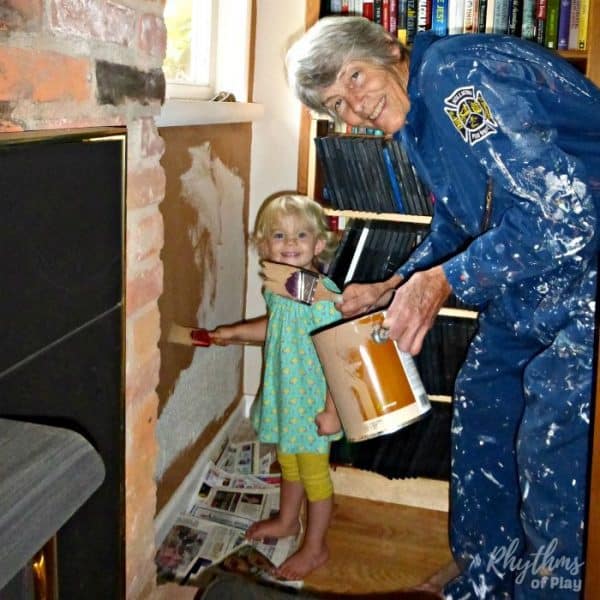
omg the pride on her face with the paintbrush how sweet!!!!
Priceless! She was so excited to help grandma paint her living room walls that day. One of my favorite pictures!