
Get outside to enjoy a calm riverbank or a creek any time of year with this list of outdoor activities for kids and adults.
Discover fun things to do at a creek, from exploring the shoreline to playing in the water, with the fun creek activities below. A creek is a small stream of water that flows through fields, woodlands, parks, and even behind houses. There is something for everyone to enjoy at the creek; even your dog will enjoy spending time creekside with the ideas below. This informative creek activity guide is one of the many fun outdoor activities featured in the ‘Get Outside and Connect‘ series.
Fun Creek Activities for All Ages:
There is something to do year-round at the creek. With so many things to discover and activities to do, the hours can fly by like minutes. From exploring local wildlife in the spring, swimming in the summer, leaf races in the fall, and skipping rocks in the winter. A creek is nature’s playground, classroom, and great place to have a picnic or stop for a moment to relax and be present, any time of year. Most of the creek activities in this informative guide are just as appropriate for a calm riverbank.

Spending Time at the Creek or By the Riverside:
Have you ever been to a creek? There’s something special about the meandering water, moss, rocks, small creatures, and plant life that you find in and near creeks that makes them magically different from any other shore.
Some of my fondest childhood memories are of playing at a local creek with my brothers and other neighborhood kids. We could spend hours playing, exploring, learning, swimming, and cooling down in the water on a hot day.
Spending time in nature has numerous benefits, including reducing stress and promoting creativity. And spending time by the creek is an excellent way to connect with nature. Playing in a creek is fun for young and old alike.
There are also numerous learning opportunities and educational activities that children, teens, and even adults can engage in. Of course, visiting a creek or a calm river shore is also a great way to pass the time or cool off on a hot summer day.
Please scroll down to learn about the benefits of spending time in these magical watery oases, as well as tips and activities for a fun day at the creek. You might also enjoy these nature activities for kids.
The Definition of a Creek:
A creek is a small, flowing body of freshwater that typically moves through a natural channel in the landscape. Creeks are naturally formed, unlike canals or ditches, which are human-made, but they are not always permanent. Some are seasonal or intermittent and can dry up depending on the amount of rainfall that sustains them.
What qualifies as a creek depends on several factors, including size and flow rate when water is present. The primary defining characteristic is its size and function as a watercourse. It is smaller than a river but larger than a brook or rill, often originating from a spring, rainfall-runoff, or as a branch or tributary of a larger stream or river.
Generally, a creek has continuous or seasonal flow, well-defined banks and a bed, and supports a freshwater ecosystem with plants, fish, and small animals. Compared to rivers, which are typically deeper, wider, and more powerful, creeks are often narrower and shallower, allowing people to walk across or wade through them.
The water in a creek typically flows downhill due to gravity, with its depth and speed varying according to the season or recent rainfall. Creeks can wind through forests, fields, valleys, meadows, and even urban areas, often feeding into larger streams, rivers, or lakes.
However, what makes a creek a creek is not an exact science. There’s no strict global measurement or cutoff that declares, “This is a creek, and this is a river.” Instead, it’s generally based on regional naming traditions and its size relative to nearby waterways. For example, in the United States, a creek typically refers to a small stream that flows into a larger river. In the UK or Australia, however, the word “creek” might describe a tidal inlet or saltwater estuary.
30 Fun, Relaxing, and Educational Creek and Calm River Activities for Kids and Adults of All Ages:
Creeks are natural playgrounds that meander through forests, meadows, and even suburban areas teeming with beauty and life. There are many ways to play in a creek, and several things you can explore and do. Whether visiting a creek in a local park, going for a swim at one down the street, or exploring one beside a hiking trail, there are countless ways to enjoy these peaceful waterways.
Spending time at one of the many spots along several different local creeks is something most people in the area where my family currently lives enjoy. From wading in the gentle current to learning about the plants and creatures that live there or enjoying an imaginative adventure, you can always find something interesting to do at the creek.
My family is fortunate to have more than one creek nearby, each with multiple unique locations along its shores to enjoy. Some spots even have picnic tables, but most of our favorites don’t. Like many others, we prefer the hidden gems. Since there are so many wonderful creek spots in our area, we have had the chance to spend a lot of time devising new and exciting creek activities to enjoy during our multiple visits.
The following is an informative guide to the various activities you can do at a creek, ranging from relaxation and recreation to learning opportunities. Whether you’re looking for fun outdoor activities for kids or exciting adventures for adults, there’s something for everyone to enjoy at the creek. Explore, play, swim, relax, and learn in nature’s water playground with these fun creek activities:

1. Skip Rocks and Stones:
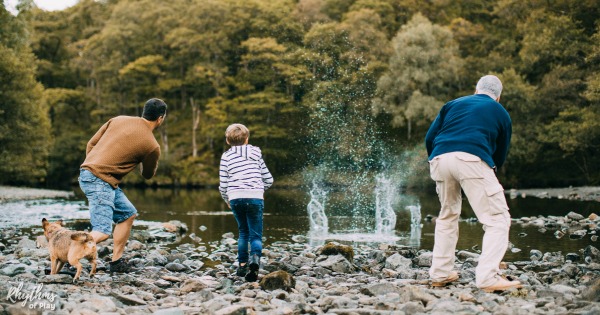
Rock skipping is a creek activity that can be enjoyed year-round, especially in areas with calm water. Skipping stones is a relaxing, almost meditative activity that can keep kids and adults of all ages busy learning and having fun. Stone skipping can also spark a bit of friendly competition among friends, family members, and fellow creek-goers.
Find a flat, smooth stone and throw it at an angle toward the water’s surface with a quick, flicking wrist motion. If you do it just right, it will skim across the water’s surface in a series of skips and jumps. Discover more information about this enjoyable outdoor activity, perfect for the creek, in How to Skip Rocks.
2. Swim, Wade in the Creek, and Play in the Water:
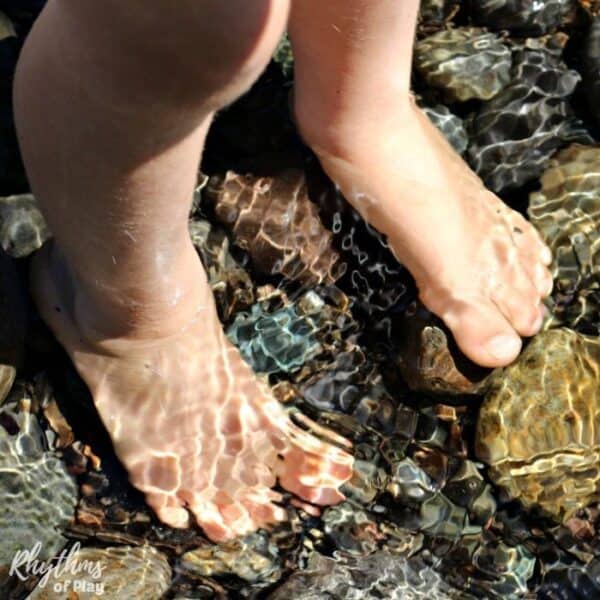
One of the simplest pleasures of creekin’ is wading in its calm, shallow waters. This is especially true during the warmer months of the year, such as late spring, summer, and early fall. The cold water is refreshing and feels great on a hot day. Best of all, many creeks have swimming holes in calm water deep enough for even teens and adults to go for a swim.
Always exercise caution around water and ensure children are supervised to keep them safe, especially toddlers, preschoolers, and other young children. There are often strong currents after it rains or during spring, when snow is melting at higher elevations in the watershed. Even on a calm day in the summer, there can be areas with strong currents that can take even strong swimmers for a ride downstream.
Related: Swimming Safety Tips from an Ocean Lifeguard Mom
Take off your shoes and go barefoot, or wear water sandals and splash around. Water shoes with good grip help protect your feet and keep you from slipping in the water, especially if the creek bottom is full of sharp or slippery rocks. Kids love splashing, exploring the creek bed, hopping between exposed rocks, and watching the water flow over their feet. You can see my daughter enjoying this creek activity in the photo below.
3. Look for Animals and Observe Wildlife:
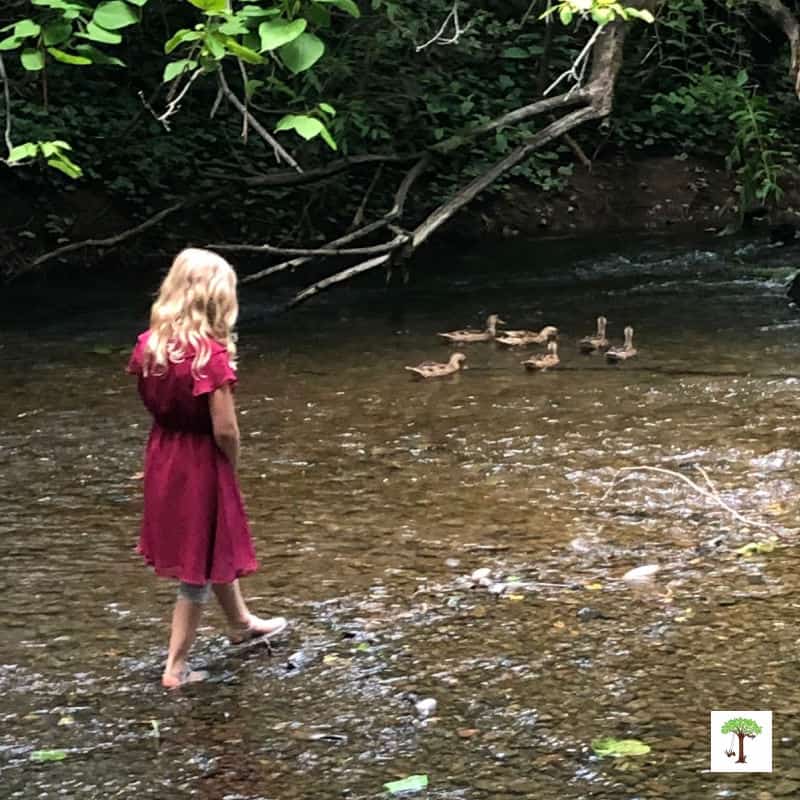
Here’s another creek activity you can do all year. Creeks are bustling ecosystems full of wildlife to observe both in the water and in the surrounding area. You might see tadpoles, frogs, tiny fish, dragonflies, butterflies, turtles, ducks, and even deer coming to drink. A creek shore is also an excellent place for birdwatching. Be quiet and move slowly, and sit still so you don’t scare away any wildlife.
Consider bringing a few nature study supplies to the creek. A pair of binoculars, a camera with a zoom lens, or even a magnifying glass, will help you get a closer look at other wildlife. Use a field guide or app to help identify the species. You might also want to bring along goggles, a mask, and a snorkel to view wildlife in the water during the summer months.
Example of Wildlife Viewing at a Creek:
In the photograph below, you can see my daughter observing a Mallard duck and its ducklings on a spring morning. They had grown accustomed to seeing us, as we often passed by on our daily walk, so they didn’t swim away. You can see an earlier photo of them I took two months prior, at the bottom of the photo collage at the top of the list of creek activities. In that photo, you will notice that Mama Duck had several more ducklings following her that day, and they were much smaller in size. Because the ducklings began diving for food after this photo was taken, my daughter and I knew the Mama Duck was relaxed in our presence.
4. Catch and Release Creek Critters:
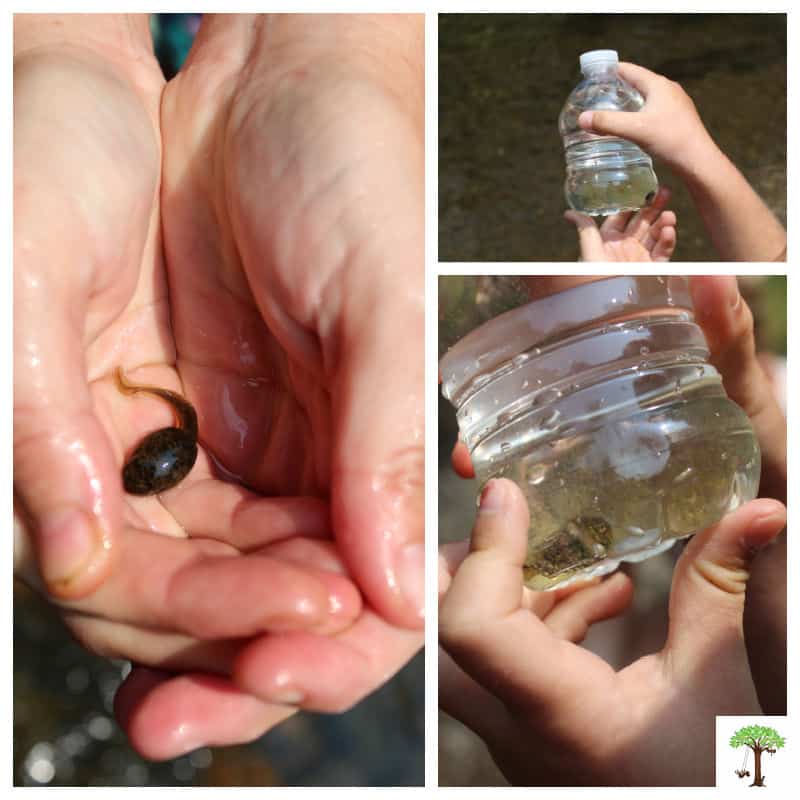
Use your bare hands (or a small net) and a bucket or a recycled water bottle with the top cut off to explore the tiny world of aquatic life in the creek. With these simple tools, you can catch small creatures, such as tadpoles (shown in the photo below), minnows (little fish), crayfish, mayfly larvae, and explore them more deeply. You may also want to bring a pair of goggles, or even a mask and snorkel, if you plan to swim for a better underwater view.
Another idea is to try to catch the insects and other invertebrates in the surrounding area, as my daughter does. I’m always amazed by what her gentle hands can capture. Look at them, learn about them, and then please gently return them to the water or let them fly away if you happen to catch a dragonfly or a butterfly.
If you try this activity, please practice creek etiquette:
- Always be kind to animals, and never take one home or keep it as a pet.
- Avoid disturbing their homes, which are often found under rocks and logs.
- When you catch them, please handle creatures gently and return them to their natural habitat as soon as possible. Small buckets or bottles of water, such as the one my daughter is holding in the photo below, can get too hot for them in a short amount of time. Most creatures can’t survive in these conditions for long, especially if it’s hot outside.
6. Have a Picnic:
Enjoy a peaceful solo meal by the water, invite a friend, or bring the whole family. Pack a snack or a simple lunch in a cooler bag and sit in a chair, at a picnic table, or on a blanket near a creek to enjoy nature on a beautiful day. If you try this activity, please avoid using disposable plastics, and remember to pack out all trash.
Having a picnic is another excellent activity to enjoy at a creek year-round, whether with family, friends, or alone. Listen to the water, watch the birds, breathe in the fresh air, and enjoy the food and company, even if only the wildlife and the serenity of the trees around you. Solo picnics at the creek are a lovely and relaxing adventure that everyone should have the chance to enjoy.
7. Swim Like a Salmon:
If there is a place to swim with a gentle current, do your best to swim like a salmon upstream against the current. Swimming against the current is excellent exercise, but it can be dangerous and exhausting, depending on the creek’s speed. If you try this gross-motor creek activity, ensure you don’t get swept away, run into anything dangerous, or become too tired to return to safety. Keep a close eye on children and be prepared to assist them if needed.
You can see my daughter in the photo below, enjoying this fun creek activity, swimming like a salmon against the current. I was standing in a spot where I could easily assist her if she needed it. Our dog is in the background, distracted by something in this picture, but usually barks at her whenever she’s not touching bottom, pretending to be her lifeguard by telling her to return to safety. It must run in the family, as my husband and I were both ocean lifeguards for 20 years. But it makes sense, without sheep, our Border Collie has become a fantastic child herder, especially when she plays in the water at the creek.

8. Engineer a Partial Dam:
Building small, partial dams in a creek is a fun and educational activity for kids and adults of all ages. Creek activities like this introduce children to the basics of engineering and water flow. If you choose to build a dam, never block off an entire waterway or stop the flow of water entirely. Please dismantle the dam before leaving and ensure that water flows properly to prevent disruption to the natural ecosystem and the well-being of its inhabitants before you leave.
In the photo above, you can see my daughter swimming like a salmon through a dam-like structure with a ditch in the middle that other local community members built to create a current to float down and swim against in a shallow section of the creek. She is touching the bottom of the creek with her hands, about to stand up and prepare to float back down again in the photo. Perhaps that’s why our dog took a moment to eat some grass; lifeguarding and herding children can be exhausting — lol!
9. Build with Rocks, Stones, and Sticks:
Stacking rocks to make little towers or building a mini-bridge with sticks and pebbles are other fun ways to pass the time at the creek. You can see my daughter putting the final touches on a rock bridge with stone arches and various-sized rocks and pebbles balanced on top of and around it, which she made at the creek one day, as shown in the photo below.
Building partial dams, stacking stones, and constructing small bridges are excellent STEAM educational activities for kids of all ages. Like partial dams, please remember to dismantle these structures when you’re finished, so animals can still access their natural habitat and remain unharmed from the risk of tumbling towers of stones and other disruptions.

10. Race leaves or Sticks:
Racing leaves or sticks downstream is another creek activity kids can enjoy year-round, especially when the water is flowing quickly. Put a leaf or stick in the water and either time how long it takes to reach a certain point downstream, or place another leaf or stick in the water to race alongside it.
Children of all ages love racing leaves and sticks downstream and compete with each other to determine a winner year-round. Not only is racing sticks and leaves fun for everyone, but it is also an excellent creek activity for teaching children about current, the speed of the water in different spots and at various times of the year, and water flow patterns at the creek. Knowing these details can help children navigate the creek waters safely, especially if they decide to try tubing.
11. Go Tubing
If the creek is broad and deep enough and has a steady current, tubing can be a fun and enjoyable way to float downstream. Bodyboards are also great for floating on or riding down a creek. Even if you only go fifty to one hundred yards or so through a section of fast-moving water before hitting an eddy or a shallow section of water. If that’s the case, scramble up the shore and walk upstream to do it over and over again. If you decide to go tubing down a creek, always check the safety conditions first, ensure that young children are wearing life jackets, and have a plan or escape route in place in case someone floats away.
12. Relax on a Raft:
It can also be fun to relax on an inflatable raft or tube and enjoy floating in the creek without going anywhere. This creek activity is best suited for an area with no current. Close your eyes, soak up the sun (or enjoy a shady spot by the creek), listen to the soothing sounds of the water, and let any stress melt away with the gentle rocking of the calm water. Just be sure to stay aware so the current doesn’t take you away along with it.
5. Take Photographs of Nature and Wildlife:
The natural light, reflections on water, interesting rock formations, and wildlife make creeks excellent locations for nature photography. Use a phone or camera to photograph flowers, bugs, animals, beautiful rocks, reflections on the water, and the surrounding area. Whether using a smartphone, a DSLR, or a tiny point-and-shoot camera, you’ll find an endless supply of subjects and beautiful shots to capture year-round.
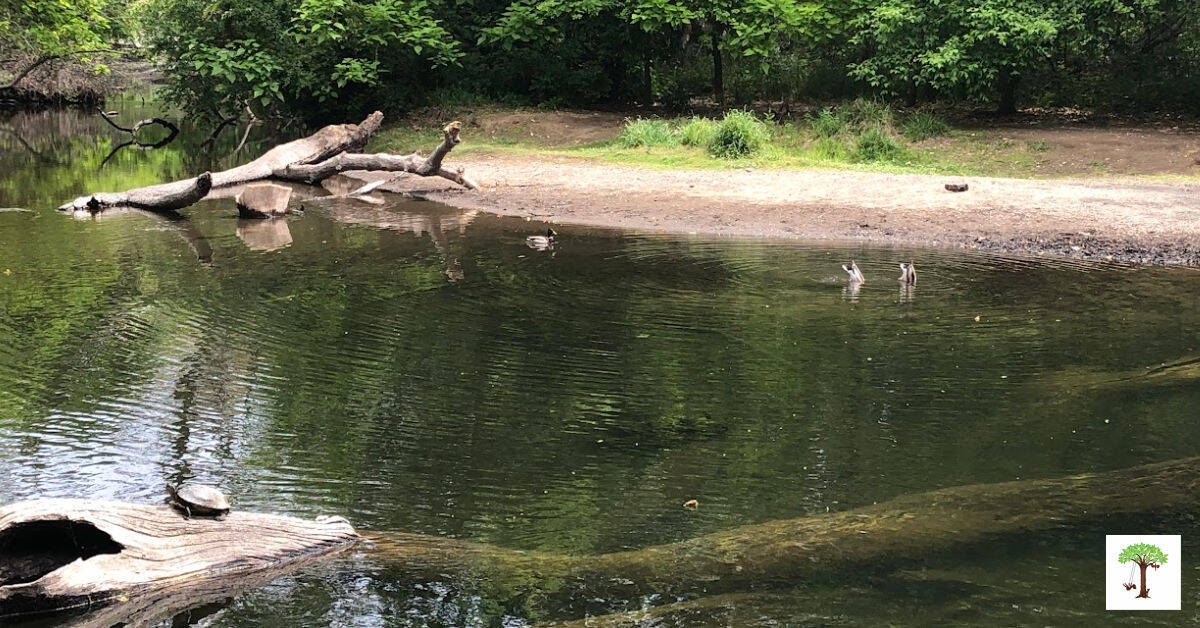
I’ve taken some of my favorite nature photos at the creek with both of these types of cameras, some of which are featured in this article. The image below features a turtle on a log in the bottom-left corner, and Mallard ducks diving for food in the background near the shore within a beautiful creek oasis. One of my daughter’s favorite childhood swimming holes. Heavenly, isn’t it?
13. Climb Something fun:
Often, creeks have something fun to climb on in or out of the water. Boulders, fallen logs, and trees are often found along a creek shore, making an excellent natural jungle gym for kids. My daughter loves climbing things, such as trees and boulders, or even up the rocky sides of a craggy creek, so she always manages to find something to scramble around on at the creek.
The log with the turtle on it, along with the other portion of the fallen tree in the background of the photo above, are some of her favorite things to climb at the creek in nature’s playground. After I took the photograph, she climbed up on the log to get a closer look at the turtle. Like the ducks, it had seen her before and learned that my daughter won’t hurt it, so it didn’t try to swim away.
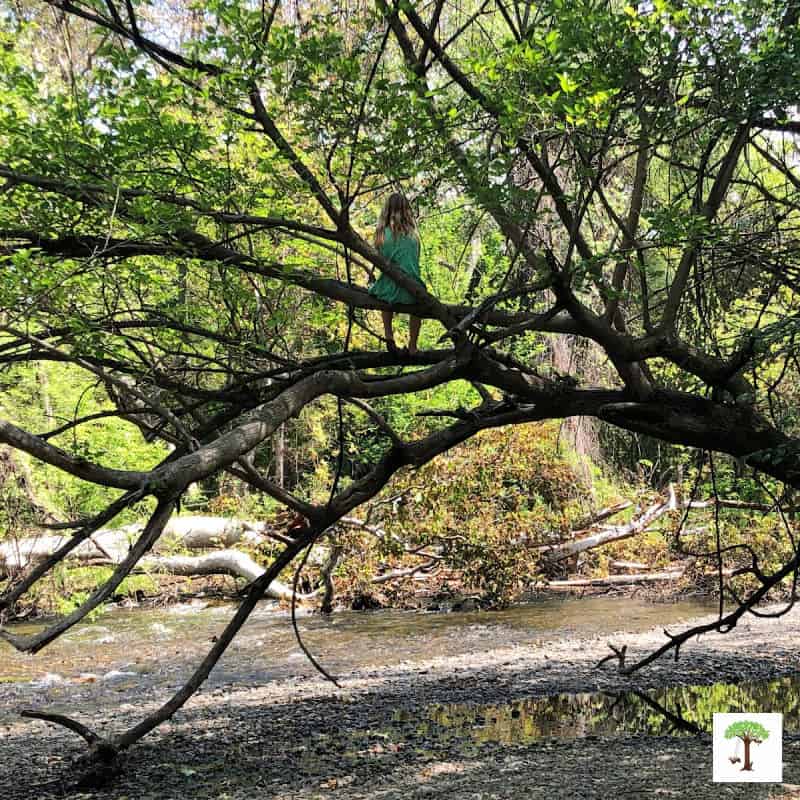
Please supervise children if they attempt this creek activity, as it can be dangerous, especially if they are little daredevils like mine. In the photo below, my daughter is enjoying one of her favorite “sit spots” in a tree by the creek in the spring that she had to climb to reach. Read my tips about climbing trees to learn more about how to climb a tree and some of the benefits of climbing and other risky play activities. You can also see her climbing up a log in the video below. Discover more information about enjoying time in a sit spot in this article about outdoor nature activities for kids.
14. Jump and Make a Splash:
Often, there is something to jump off into the creek, into deep enough water. It’s not always possible. Whether or not you can jump depends on the creek’s depth and whether there’s something like a log, rock, or short ledge to jump off and make a splash. The jumping zone must be clear of debris, such as branches, logs, and boulders, and free of any objects that could harm a person if they were to touch the bottom upon entry. This activity can be dangerous, so please supervise children, conduct a safety check, and exercise caution if you choose to participate.
One of my family’s favorite locations to jump and make a splash was where a tree trunk got lodged over a deep swimming area in the creek. We called it “Jumping Log Beach,” and many other community members of all ages enjoyed swimming at this location, climbing the tree, and jumping into the creek from it as much as we did.
Unfortunately, a season of heavy rainfall combined with several years of heavy wildfire damage up the creek caused a significant amount of swift-running water with heavy amounts of burned wood and debris, which dislodged the log and carried it downstream after about 20 years of jumping fun. Although it’s no longer there, we still have plenty of pictures, videos, and memories of it. You can see my daughter, at the age of seven, jumping off it to make a splash from two different spots in the video below.
15. Enjoy an Educational Exploration:
Spend a day learning at the creek. Creeks offer hands-on educational opportunities for children and adults of all ages. A few are discussed in other creek activities covered in this handy guide. Students of all ages and grade levels, including college and lifelong learners like myself, can learn about geology, biology, environmental science, and other related subjects.
Look for different rock types, study erosion patterns, learn about the water cycle, or test the water’s pH. Educational creek activities are perfect for homeschoolers, forest schools, outdoor groups, nature clubs, after-school programs, science projects, class field trips, and summer camps.
16. Allow time for Imaginative Play Adventures:
Children can spend hours in imaginative play along the shore of a creek. One day, I saw two boys spend hours playing a game involving a log they imagined as a pirate ship, and speaking so loudly to each other about their grand adventures that everyone nearby could hear. I’ve also witnessed my daughter and her friends create elaborate pretend-play scenarios over the years, from making pretend food beside the creek to pretending to be different animals doing various things in or around it.
Children can also spend hours playing at the creek, fully engaged in imaginative play within a pretend world of their own, like my daughter is in the photo below. When my daughter was young (from three to nine years old), our daily dog walk took us along a trail by a creek. I set aside a few hours every day for our nature walk, allowing her the time she needed to dawdle and do whatever caught her attention. She would spend hours lost in her imagination, and that was exactly where she belonged. Get them outside, and let them play.

17. Play with Water Toys:
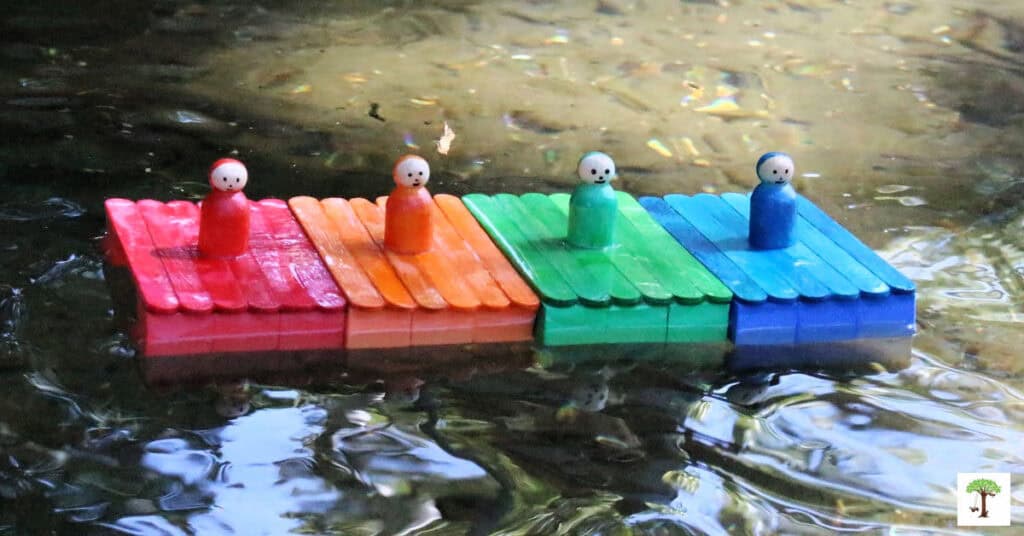
Toys such as toy boats, swimming fish, water soakers, balls, inner tubes, rafts, and other floatable items make great water toys at the creek. Make a popsicle-stick boat, or bring along some of your kids’ favorite bath, pool, or beach toys, such as a shovel and bucket.
If you bring toys to the creek, please ensure you take everything home and leave the area as you found it. Any toys lost or left behind in the creek become litter that harms the waterway and the surrounding environment. Please do your part to keep nature as you found it.
18. Throw a Stick for a Dog:
Most dogs love to run after a stick and jump into the creek to go for a swim, or chase down a stick thrown for them. Some will even bring you one with a look of excitement and anticipation, hoping you get the hint. Look for a good-sized stick that floats and toss it into the water. Then have your dog fetch it for hours of creekside fun. Our dog loves this activity!
19. Go Fishing:
If the creek contains fish, such as trout or bass, it can be an excellent spot for catch-and-release fishing. Check local regulations before you cast a line. It’s exciting for children of all ages to catch a fish, but it’s even more fun to let it go and swim away.
20. Make a Mud Pie or Sand Food:
This isn’t always possible, depending on where the creek’s water flows and the surrounding environment. My daughter loves making sand or mud pies, cakes, and all sorts of other mud food by herself or with her friends at the creek.
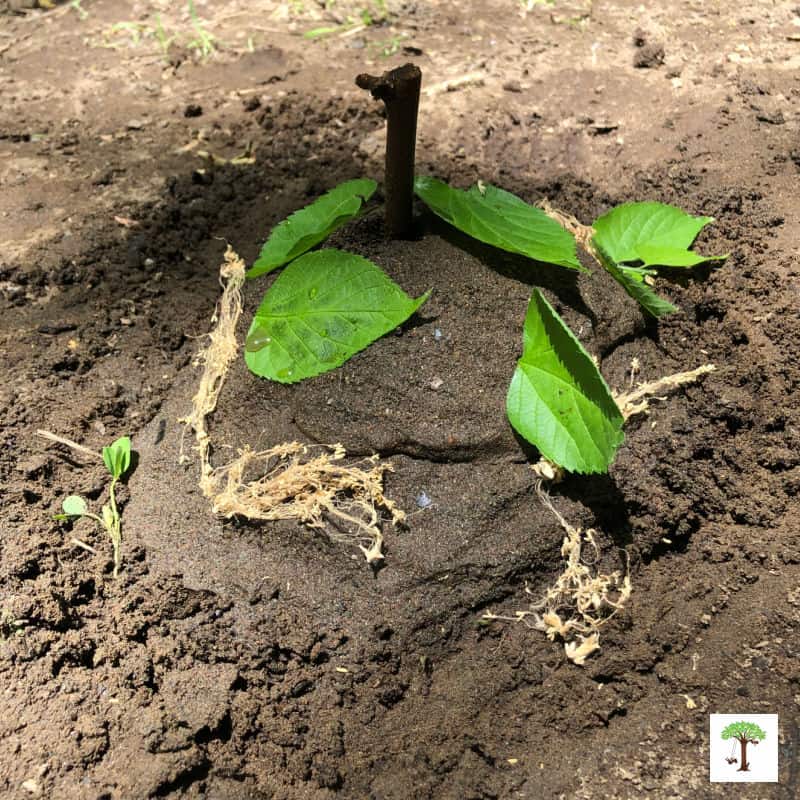
After creating a basic structure, she decorates it with natural craft supplies, such as sticks, leaves, and pebbles. She made a mud pie cake one day that she decided looked more like a gnome home or a fairy house once she was finished. You can see this magical mud-and-sand creation, complete with natural decorations, in the photo below. Read about making mud pies for more information.
21. Build a Fairy House or Gnome Home:
Make a house for a fairy or a place for a gnome to call home with natural materials at the creek. My daughter has made several of these adorable creations. Use your imagination with the natural supplies you have available to build something unique, like the fairy house my daughter made in the photo above. Mud, sand, sticks, rocks, leaves, flowers, pebbles, and many other natural materials can be used to construct something magical and unique for a fairy or a gnome. You might also enjoy learning how to make a fairy garden.
22. Explore the Shoreline:
Go on a shoreline exploration to spark curiosity, observe nature, study the landscape, and create memories with family, friends, or outdoor classmates. There is always something interesting to investigate along the shoreline of creeks and other waterways.
23. Collect Natural Items for Nature Crafts:
Collect natural items around the creek to make nature arts and crafts. Grasses and pine needles can be used to weave baskets, and acorn caps can be made into lovely necklaces and ornaments with a marble sitting inside. Almost anything you can find in abundance, such as rocks and leaves, can be made into a mandala.
One day, my daughter and I found numerous freshwater shells in the creek and brought them home to make these adorable owl crafts. Gather a few craft supplies, but please don’t take too much or strip any one area of its natural resources.
24. Make a Nature Mandala on the Shore:
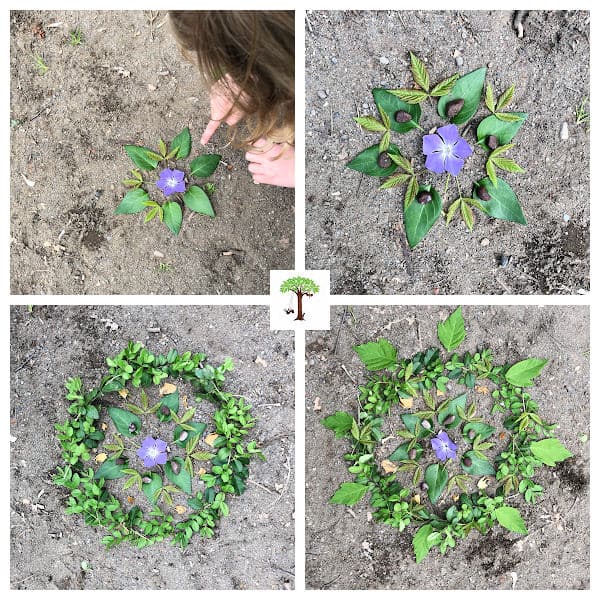
Collect a few natural items to make a mandala along the shore of a creek. My daughter created the nature mandala in the photo below, beside a creek, and left it there for others to enjoy. Mandalas made of stones or rocks are also fun to design at a creek. For more information about this form of art, read this post on making nature mandalas.
25. Enjoy a scavenger Hunt:
Observe a few things at the creek and challenge participants to find them and point them out to you. Make a quick list of anything you see, or call them out one by one, and encourage children to find them.
Natural items to hunt for can include a stone to skip, a tadpole, a flying bug, a little fish, someone swimming, a floating stick, a plant growing in the water, a feather, algae, or anything else that catches your eye. Alternatively, you can gather a few natural treasures and challenge participants to identify and collect the matching items. Read these tips for designing a nature scavenger hunt for more ideas.
26. Relax, Listen, and Connect with the Natural World:
Sit quietly and listen to the soothing sounds of the water, birds, and wind through the trees to relax and connect with the natural world. Spending time in nature offers numerous benefits for our physical, mental, and emotional well-being, including boosting our mood and alleviating stress. Listening to the sounds of nature at a creek increases this effect exponentially. Close your eyes, breathe deeply, and allow a sense of peace to wash over you.
27. Write in a Nature Journal:
Bring a notebook or journal to write down what you see, hear, and feel at the creek. You can write a story or a poem, list the plants and animals you see, or write about a specific discovery, experience, or feelings at the creek. For more information, read these tips about making and keeping a Nature Journal.

28. Draw or Paint What You See at or in the Creek:
Bring a sketchbook, colored pencils in a pencil case or a portable watercolor set, and let the creek inspire you. Draw or paint anything you observe that catches your interest or fancy. Many people enjoy using their nature journals for this purpose.
Use your art supplies to draw frogs, plants, leaves, rocks, birds, a flowing creek, the surrounding area, or anything else you find interesting. Sketching or painting things you see in the natural world is a great way to hone your observation skills, practice mindfulness, and learn more about the subject matter you are drawing or painting.
29. Sit in Meditation:
The sound of running water is naturally calming, making creeks an ideal place for mindfulness exercises, such as meditation. Find a comfortable spot to sit, breathe deeply, and allow your thoughts to flow downstream, drifting away like the creek water.
30. Be a Creek and Natural Waterway Protector:
Follow the guidelines below to care for the Earth and protect our natural resources for generations to come:
- Use chemical-free, reef-safe sunscreen: The chemicals in spray sunscreens are particularly harmful to the environment. Creek water eventually ends up in the ocean. The chemicals in most sunscreens can harm the ecology of our waterways and their aquatic inhabitants. Please choose a reef-safe option to limit damage to watery worlds.
- Don’t use soap or other chemicals near the water: These can harm waterways and their local inhabitants far and wide. Remember, all water leads to the sea.
- Be gentle with animals and plants: Harming them in and around the creek can devastate the local ecosystem. Please be mindful.
- Please don’t leave anything behind: Collect everything you bring with you and pack it out, including towels, clothes, toys, and especially plastics and hazardous trash, such as diapers.
- Pick up litter for proper disposal: Keep the creek clean and enjoyable for everyone by collecting any litter you see and disposing of it properly. I like to bring a recycled bag for this purpose to pack out my trash and any other litter I see.
Fun Things to Do at a Creek: Activities for Kids and Adults
My family has spent many days enjoying creeks near and far during the spring, summer, fall, and even winter. As you can see from the list of creek activities above, there is always something to do at the creek, no matter the time of year. Creeks may be small, but they are mighty in the experiences they provide.
From playful splashing to peaceful reflection to educational activities, these freshwater havens invite all of us — young and old — to slow down and connect with nature. Whether you’re seeking adventure or tranquility, there’s something for everyone to do at the creek.
Get the kids outside to play in a creek with these water activities and fun things to do along the shore. If you don’t know of a creek near you, call your local parks and recreation department. They will most likely be able to point you in the right direction. You might also enjoy the nature and outdoor activities listed below.
When you visit, please respect Mother Nature’s playground and the environment. Leave no trace, avoid disturbing wildlife, and refrain from using soaps or chemicals, including sunscreens, near or in the water, as they can damage our precious waterways. Remember, every water source eventually ends up in the ocean, and it’s up to us to keep our oceans healthy. Thank you for being a part of the change you wish to see in the world.
Please visit our About page to learn more about Rhythms of Play. For more information about this website and the author and photographer of this list of creek activities for kids and adults, please visit the home page for Rhythms of Play or the author page, Nell Regan Kartychok.







Leave a Comment