
Nature study materials make getting outside to learn more fun for children of all ages!
Gather a few nature study materials listed below for your little naturalists to use in their explorations into the natural world. When we surround children with nature and give them the right tools, they can’t help but apply the scientific method. They begin to ask questions, observe, experiment, and learn — naturally!
Whether you homeschool or send your children to school, this list of nature study resources makes it fun and easy for children to study the natural world at home or in the classroom. A few useful tools can motivate children to get outside, play, learn, and have fun. For activity ideas, please visit Outdoor Learning and Nature Activities for Kids.
What is Nature Study?
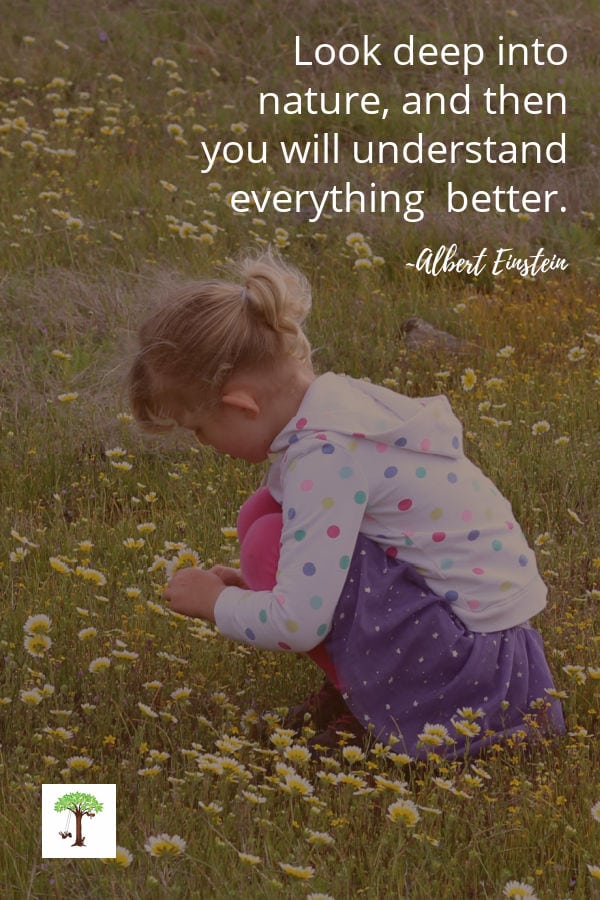
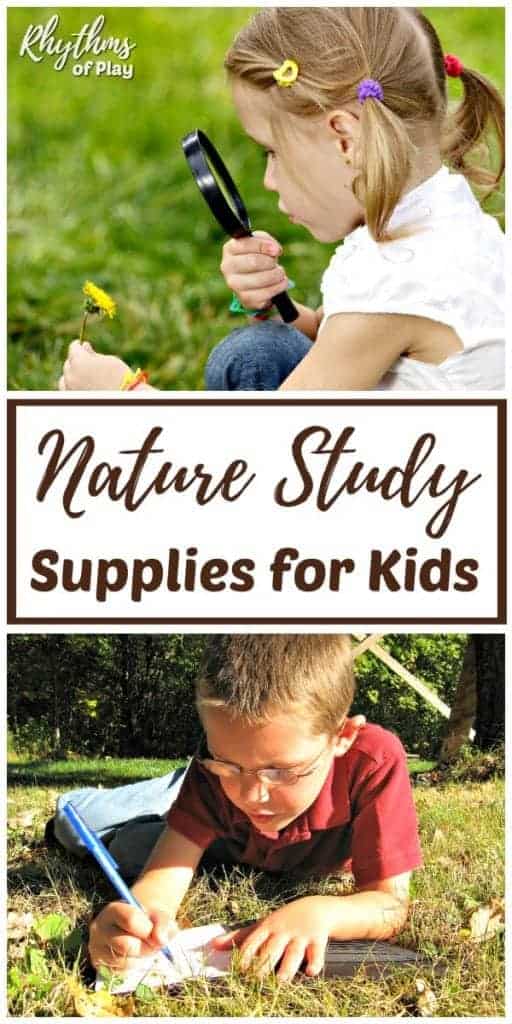
Nature study is the practice of slowing down, looking closely, and learning about the natural world through direct experience. Instead of reading about a bird, flower, rock, insect, tree, or cloud in a book, children go outside to observe them firsthand. They notice what they look like, how they feel, whether they have a scent, where they live, and how they change through direct observation. As they keep observing, curiosity sparks, investigation begins, and questions arise that might lead to further study and deeper understanding.
At its heart, nature study begins very simply. A child might watch ants carry food, compare leaves from different trees, listen for bird calls, examine a feather with a magnifying glass, sketch a wildflower, track the moon’s phases, or record the first signs of a new season. These everyday observations help children learn to recognize patterns and understand how plants, animals, weather, seasons, and habitats are connected. Learn more about Nature Study for Kids.
Benefits of Nature Study Supplies for Kids:
Nature study supplies give children simple tools to slow down, look closely, and learn more about the natural world. A magnifying glass can turn an ordinary leaf into a landscape of veins and tiny hairs. Binoculars bring a distant bird into view. A nature journal gives children a place to draw, write, wonder, and record their discoveries. These tools help children notice details they might otherwise overlook.
Most importantly, nature study helps children learn that nature is not separate from their lives. They are part of it. The more opportunities children have to observe, explore, wonder, and learn from the living world around them, the better they can understand their place within it and learn to care for it. Studying nature is a great way for kids to learn more about the world around them. Here are several benefits of nature study supplies for kids:
Help Kids Engage in Child-Led Educational Activities
Nature study is naturally child-led. Children can follow their curiosity and investigate whatever captures their attention. Parents and teachers do not need to know the answer to every question. In fact, it’s better to encourage children to find their own answers to the questions they ask.
Besides, wondering together and then attempting to figure out or find the answer is part of the fun. Using a field guide, nature journal, binoculars, magnifying glass, microscope, or other nature study supplies can help children explore their questions and take a closer look.
Unlike a formal science lesson, nature study does not always require a set outcome. It can happen during a walk around the neighborhood, an afternoon in the backyard, a trip to the beach, or even a few quiet minutes watching birds from a window. Over time, these small experiences build knowledge, curiosity, observation skills, and a deeper connection to the natural world.

Encourages Scientific Thinking:
Nature exploration tools also foster hands-on learning and scientific thinking. Children naturally ask questions when they investigate on their own. Why is this rock sparkly? What made those tracks? Why are there tiny holes in this leaf? Field guides, microscopes, specimen viewers, measuring tools, and identification cards help children look for clues, compare what they find, and answer their own questions. This makes science something they do, not just something they read about.
Strengthens Observation Skills:
Nature study supplies can also strengthen observation, focus, and attention to detail. When children sketch a flower, watch a bird through binoculars, measure rainfall, or examine tree bark with a magnifying glass, they practice staying with one thing long enough to truly see it. Over time, regular nature study can help children recognize patterns, seasonal changes, animal behavior, weather, plant growth, and other rhythms in the natural world.
Inspires Creativity:
The right supplies can also inspire creativity and open-ended exploration. A nature journal might become a sketchbook, weather log, collection of questions, map, field notebook, or a record of seasonal discoveries. There is no single way to use most nature study tools. Children can follow their interests and use the same supplies in different ways as they grow.
Develop Connection with Nature:
Nature study tools can also help children develop a deeper connection with nature. The supplies themselves are not the point. They are invitations to look more closely, stay curious, and spend more time outdoors. A child does not need a backpack full of special equipment to study nature. A simple magnifying glass, notebook, pencil, and a curious mind can be more than enough to turn an ordinary walk outdoors into an opportunity for wonder, discovery, and learning.
Helps Kids Become Stewards of Earth:
Nature study can also help children become thoughtful stewards of the Earth. When children spend time observing plants, animals, weather, and seasonal changes, they begin to understand that all living things are connected and that their choices matter. A child who watches a caterpillar become a butterfly, discovers insects beneath a log, or learns why birds need healthy habitats has a reason to care for those places and creatures.
As children grow, they continue exploring, wondering, and learning in the natural world through these hands-on investigations inspired by their own curiosity. Later, they can carry what they have learned into their families, schools, communities, and future work. As they share their observations, questions, discoveries, and wisdom with others, they just might help us find better ways to protect habitats, support wildlife, conserve resources, and care for the Earth. The knowledge we help children build today can become part of the wisdom they use to create a healthier future for all life.
The Best Nature Study Supplies for Kids
Give your little naturalist the gift of nature study supplies and materials that help them follow their natural interests (pun intended). All kidding aside, studying nature is a great way for kids of all ages, from toddlers to teens, to learn about the world around them.
1. Nature Field Guides for Kids:
As a small child, I remember pouring over field guides to study nature even before I learned to read. I can recall looking at the pictures of birds, insects, wildflowers, trees, and other beautiful nature pictures and diagrams with keen interest.
One of my first favorite nature study books as a child was Tom Brown’s Field Guide to the Forgotten Wilderness. It helps young readers see the surprising abundance of natural beauty outside the front door in urban and suburban backyards and local parks.
If you are looking for a few excellent nature study books and field guides with a little bit of everything in one book, check out Nature Anatomy and Handbook of Nature Study . Another fantastic resource for those of us in North America is the Wildlife Guide, with over 1,000 species of plants and animals to ogle by Reader’s Digest.
Many fantastic field guides cater to kids (and adults) of all ages. The first nature study books listed in each category are great for preschoolers and kindergarteners, while school-aged children and teens will prefer the field guides with a bit more substance towards the bottom of each list.
I know there is a vast array of nature study books and field guides to choose from, and I hope this list makes it easier to find the ones that best fit your children’s needs. Look at each one and choose the one you think would work best at home or in the classroom.

Bird Nature Study Guides for Kids:
Look at our Birding guide to see more of our favorite bird books for kids and fun ways to learn more about them.
Insect Nature Study Field Guides for Kids:


Rock and Mineral Nature Study Guides for Kids:
- My Book of Rocks and Minerals
- Rocks & Minerals

- You can also try Sorting and Classifying Rocks.

Wildflower Field Guides for Kids:
- Wildflowers, Blooms & Blossoms
- Botany in a Day: The Patterns Method of Plant Identification
- Peterson First Guide to Wildflowers: A simplified Peterson First Guide for beginners identifying common wildflowers across northeastern and north-central North America.
- You might also enjoy crafting with flowers that are legal and safe to pick and touch.


Tree Field Study Guides for Kids:
- The Tree Book for Kids and Their Grown-Ups
- Nature All Around: Trees
- The Sibley Guide to Trees
- National Audubon Society Trees of North America
- Learn How to Plant a Tree for Arbor Day, Earth Day, or any day, with our informative guide!

Animal Books and Animal Tracking Field Study Guides for Kids:
- Tracks, Scats, and Signs
- Animal Tracks
- The Clue is in the Poop
- Pocket Guide to Animal Tracks
- Tom Brown’s Field Guide to Nature Observation


Wild Foraging Plant Identification Guides
One of our favorite nature study activities is wild foraging for edible plants. Wild foraging is an important survival skill to share with children, especially the little naturalists who like to wander the great outdoors. In addition to using the field guides listed below, my family also likes to play Wildcraft . This herbal adventure game can help children identify and use edible plants and natural medicine.
- Wild Foraging with Kids
- Tom Brown’s Guide to Wild Edible and Medicinal Plants
- Edible Wild Plant Identification Guide
- Nature’s Garden: A Guide to Identifying, Harvesting, and Preparing Wild Edible Plants
- You might also enjoy our informative guide to Berry Picking and Wild Foraging with Kids.


Wilderness Survival Guides for Children:

- Tom Brown’s Field Guide to Nature and Survival for Children
- Tom Brown’s Guide to Wilderness Survival
- BushCraft
- The Lost Art of Reading Nature’s Signs


2. Magnifying Glass for Kids:
Motivate kids to get outside and explore the natural world in greater detail with a magnifying glass. A good magnifying glass is essential for taking a closer look at specimens of interest, such as rocks, flowers, and insects. My daughter loves this magnifying glass for kids. Its shatterproof glass lens makes it easy to study nature up close.
3. Binoculars for Kids
Binoculars are great for observing the natural world around you and getting closer to things you’re interested in, like birds, from a distance. My husband and I are retired professional ocean lifeguards, so we know an excellent pair of children’s binoculars when we see them. Our daughter loves her binos for backyard birdwatching and likes to take them with her on explorations into the great outdoors.
4. Compass for Kids
Reading and using a compass is a necessary skill for budding nature explorers. As parents, we want to know our children can always find their way home after exploring nature. Here’s a simple, inexpensive compass that is perfect for kids
 . We also recommend giving young explorers a book to help them learn how to navigate with a compass
 .
.
5. Nature Notebook or Journal
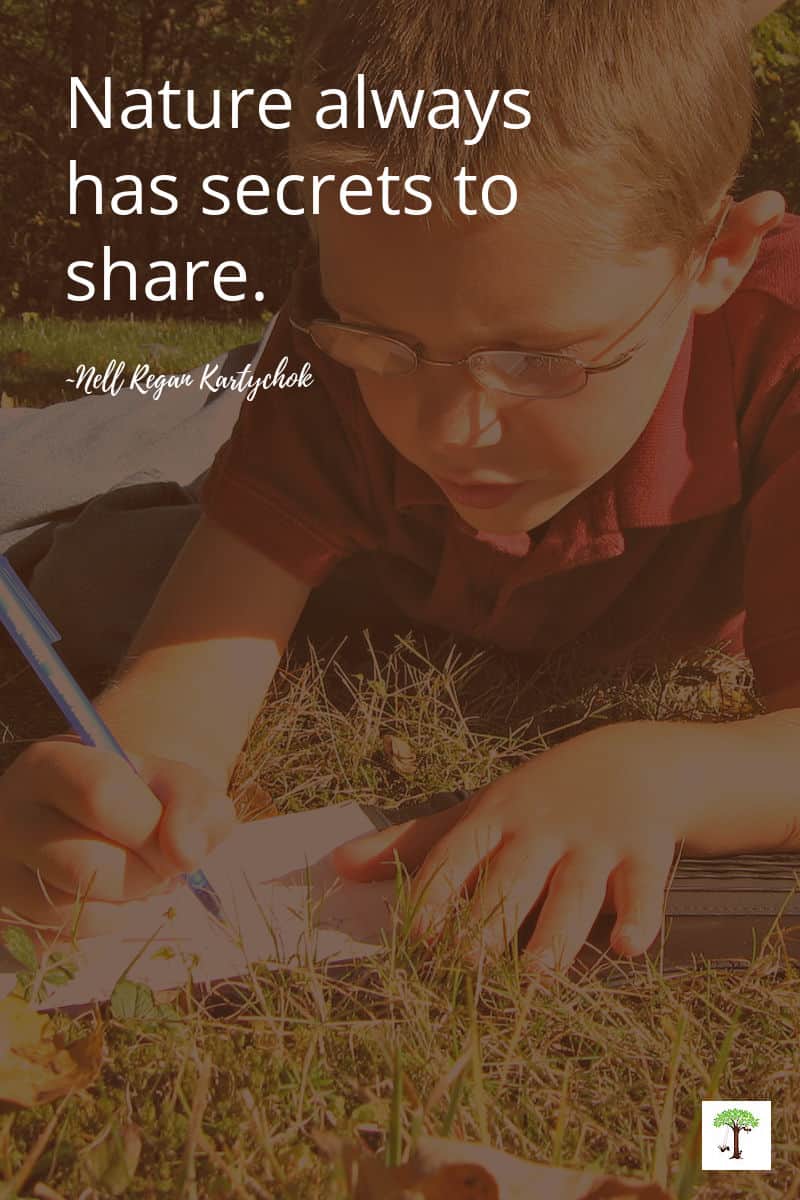
A Nature Notebook or Journal is a great place for children and adults to record and document their thoughts, feelings, ideas, observations, experiences, and relationships with the natural world. My daughter and I like to use our nature journals to write about the outdoor activities we try. We also like to use them for nature study, drawing, and creating art.
6. Measuring Tape
A measuring tape is essential equipment for any nature explorer. I can’t tell you how many times we have pulled ours out to measure something and noted it in our nature journals. My family has found that a soft measuring tape is the easiest for children to use outdoors.
7. Art Supplies for Nature Drawing
Nature study drawing is an excellent creative outlet for young and old alike. There is nothing quite as intimate as sitting down to sketch or paint something of interest in your nature journal. This is especially true for young explorers who have not yet learned to read and write. Because they can use their creativity to color their experiences instead! Best of all, nature journals become works of art you can cherish for many years when you include the best art supplies:
Best Kids’ Art Supplies for Nature Journaling:
- Beeswax Stick Crayons. You have never used a crayon until you have experienced the smooth, vibrant quality of beeswax crayons. We keep these in our field bag, ready to go. Beeswax crayons are also available in block form and in smaller and larger sets.
- Giant Lacquer-Free Triangular Colored Pencils. We use these colored pencils with children because they are big, sturdy, have beautiful color and texture, and are easy for preschoolers and kindergarteners to hold. Designed in partnership with Waldorf Education, they’re made of non-lacquered wood and have a triangular shape, making them easier for young naturalists to draw and color with. My family also uses Prismacolor Colored pencils. These Woodless pencils are really great for shading, but they are extremely fragile and best for older nature explorers.
- Assorted Watercolors Field Sketch Set with Brush
 . This portable watercolor set includes a water brush, making it easy to create nature art outdoors in the field.
 - The Laws Guide to Nature Drawing and Journaling – This nature art instruction book by John Muir Laws is a fantastic how-to guide for becoming a better artist and a more attentive naturalist. In it, Laws provides clear, practical advice for every step of the nature study drawing process for artists at every level, from the basics to advanced techniques.
- You might also enjoy this list of the Best Art Supplies for Kids and Why Young Artists Should Use Them.
 . This portable watercolor set includes a water brush, making it easy to create nature art outdoors in the field.
8. Camera
A camera is essential for capturing exciting photos of interesting discoveries and memories. I recommend giving your child an old digital camera or cell phone that you no longer use. If you don’t have one, consider this camera:
- Waterproof Digital Camera. This camera is more expensive, but it’s waterproof, shock-resistant, and dirt-, dust-, and sand-proof. It is perfect for nature explorers of all ages and can take quite a beating.

9. Bags, baskets, and other containers to carry nature study specimens
I am a big fan of using an egg carton or a bead organizer for collecting samples and natural specimens. Bead organizers are sturdier, reusable, and ensure brittle materials remain safe from getting smashed.
My family also carries a few other collection devices for things that just don’t fit or otherwise won’t work in smaller collection-sorting containers. In this case, a pencil box in a nature study backpack and pencil cases in a nature journal also work well.
Plastic bottles from the recycling bin also work as collection containers if they have a wide enough mouth to collect and study natural materials. For more ideas, please visit this excellent collection of nature-inspired sensory bottles.
10. Nature Field Bag or Backpack for Kids
A bag or backpack to carry all your nature study supplies, water, and food is essential on longer trips and nature outings. Here are a few of our favorite outdoor packs for kids:
- Hydration backpack for hiking and nature study excursions.
- Durable, packable, lightweight backpack.
A Few More Nature Study Materials to Consider
Below are a few other nature study materials to consider throwing in your field bag or backpack the next time your naturalist heads out into the great outdoors on an adventure into the wilderness.
- Small flashlight or a headlamp for kids to see at night and in dark places.
- Tweezers for grabbing and manipulating small natural objects and their parts.
- Folding Scissors for cutting anything needed on the go.
- Chemical-free sunblock stick or sunblock lotion for kids for sun safety.
- Sun hat for kids to provide shade and protect from sun exposure.
- Gloves for manipulating or handling anything unsafe to touch with bare hands.
- Basic first aid kit to use when needed in the great outdoors.
- Swiss Army knife or small wood whittling knife for nature explorers taught and trusted to handle and use knives safely.
 or a
or a 


And, of course, please don’t forget a portable stainless steel water bottle and a snack or lunch if you plan to go further than your backyard. You’ll be surprised how long children can stay out there exploring the great outdoors. You might also enjoy reading Barefoot Benefits: 10 Reasons Walking Barefoot is Good for You!
Nature Study for Kids (and Their Parents and Educators)
Young explorers will likely need a few nature study materials to begin their explorations. My daughter and I don’t like to leave home without them, even when we think we are only going out for a few minutes. You just never know when your little naturalist might run into something in nature to explore and learn in more depth. Nature study materials allow children of all ages to do just that! You might also enjoy making Nature Crafts with young children and teens.
Explore, Wonder, and Learn with Nature Study Supplies for Kids
The best nature study supplies encourage children to slow down, look more closely, and wonder about what they find. A magnifying glass, a pair of binoculars, a nature journal, a field guide, or a simple collection container can open the door to hours of observation and discovery. Children do not need every tool on this list to get started. Begin with a few supplies that match their age and interests, then add more as their curiosity grows.
Most importantly, remember that the tools support the experience, not become it. Nature itself is the best teacher. Encourage children to ask questions, follow their interests, make drawings and notes, compare what they find, and return to favorite places throughout the seasons. There is always something new to notice.
These small experiences can grow into something much bigger. The child who learns to recognize the birds in the backyard, watches a seed grow into a flower, or discovers an entire community of worms beneath a fallen log begins to understand that the natural world is alive, interconnected, and worth caring for.
Grab a few nature study supplies and head outside together. Follow your child’s curiosity, share what you know, and be willing to wonder when you don’t have the answer. The knowledge, connection, and respect for nature children develop today can help them become the curious thinkers, creative problem-solvers, and caring stewards our precious Earth so desperately needs.
Please visit our About page to learn more about Rhythms of Play. For more information about this website and the author of “Nature Study Supplies for Kids“, please visit the Home page for Rhythms of Play or the author page, Nell Regan Kartychok.




Such a great list! I’m a newbie to the Top Ten List Family but I love it! You have a great site and this list is wonderful!
Thank you, I’m so glad you like it 🙂
Thanks! I scheduled sharing this later this week on facebook.com/littlequiverblog I♥advocating Natural Play! THX♥
Thanks for sharing Patty-Jean, always appreciated! I too love advocating natural play. 😉
My kids love bringing their magnifying glasses and clipboards out with them when we go for a ramble in the woods. It makes them feel like proper little explorers and getting hands on with nature is a great way to learn.
I can just see your kids happily rambling about in the woods with their magnifying glasses and clipboards – haha! They are such cute little scientists aren’t they? I agree that getting hands on in nature is a great way to learn, and it’s fun too!
I love this list so much! Definitely would not have thought of a magnifying glass – I bet my son would love that. Keeping it in mind!
My kids tote all of this to their grandparent’s house out in the woods. They go on nature walks, and their Grandpa (who was a senior biologist for the DNR) teaches them all kinds of stuff. So grateful he can do that because I am clueless!
That’s wonderful that your kids have their grandpa to study nature with. It takes a village you know 😉
I love this post! Such great ideas and resources. Thanks for sharing.
Glad you like it!
This is a fantastic resource. Thank you!
You’re welcome Amber!
This is a great list. I’ve never been very good at making nature study happen, but I’m pinning this to share because there are some good suggestions. 🙂
Thanks Leah! I hope that you have found the time to make nature study happen!
WOW! What a thorough list! Exactly what I was looking for and so much more. Thank you for taking the time to compile this 🙂
Thanks for the vote of approval, Nichole. So glad we could help you find the nature study supplies that you need for your little naturalists. 🙂