
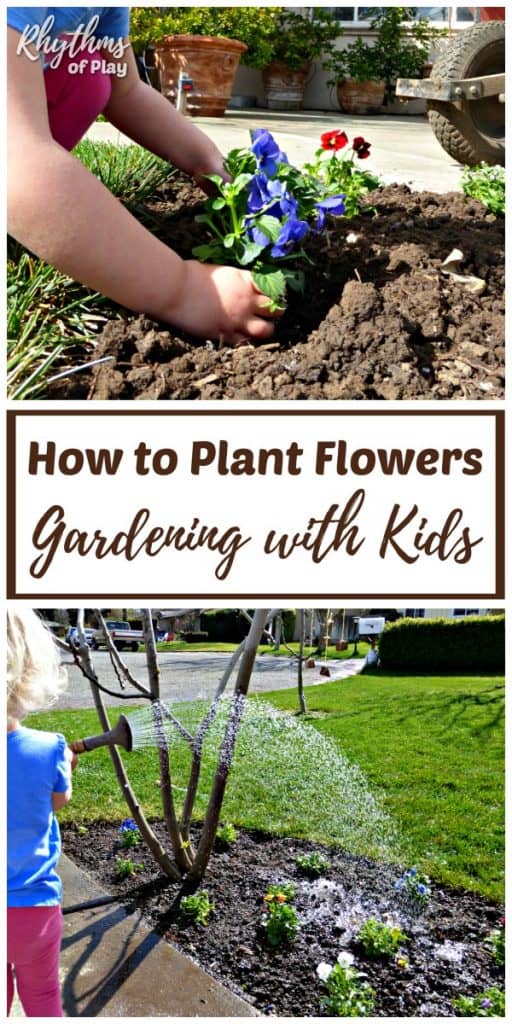
With the step-by-step spring flower DIY tutorial, you can learn what you need to plant flowers, how to prepare a garden bed, and how to plant flowers in the ground.
Learn how to plant flowers organically with the DIY gardening tool for gardeners from beginner to advanced. This flower gardening how-to also includes easy tips for parents (and teachers) who want to teach children how to garden.
Gardening with kids is a great way to connect with your children, teach them the basics of plant care, and sow the seeds of early learning. Use the step-by-step DIY organic gardening tutorial below to teach children how to plant flowers in your yard or garden this spring. You might also enjoy Growing Sunflowers and learning to make a Fairy Garden.
When do you plant flowers?
The best time to plant flowers is in the early spring after the last frost, before it gets too hot and sunny, so it will vary based on the region in which you live. The best time to plant flowers in most temperate locations is sometime around the Spring Equinox at the end of March. However, in cooler climates, plants will often need to wait until late May, especially if the ground is still frozen. Ultimately, the timing of planting flowers depends on your location.
What do you need to plant flowers?
You will need gardening tools, flowers, potting soil, containers, pots, or a garden bed to plant in. The exact supplies you need will depend on where you want to plant your flowers, the type of flowers you are planting, and whether you use organic soil amendments instead of synthetic fertilizers.
Best Gardening Tools and Supplies to Plant Flowers:
- Wheelbarrow or garden cart
 (optional)
 - Garden rake
- Hand trowel(s)
- Digging fork, a hand cultivator, or an electric tiller
- Shovel
- Gardening Tools for Kids (optional)
- Soft jersey gardening gloves for kids
- Garden tool set with a tote for kids

- Children’s wheelbarrow (our daughter LOVES hers!)
 (optional)


 (our daughter LOVES hers!)
Organic Soil Amendments for Flowers:
Dirt is dead while the soil is alive and rich in nutrients. It is essential to amend the soil so it has enough nutrients to grow beautiful flowers. Miracle-Gro is not organic. It is a synthetic fertilizer made with chemicals that my family chooses not to use.
Instead, my late mother (a master organic permaculture gardener and instructor) taught us to use organic soil amendments to grow both our flowers and our food. Fortunately, before she passed away, she helped me create this gardening tutorial for you to use these healthier choices, too. This will help us all avoid putting those nasty chemicals into the soils and waterways where our food grows and thrives, and help us care for the Earth.
You can pick up the following organic gardening supplies with the Amazon affiliate links provided (Rhythms of Play will earn a small commission at no additional cost) or at your favorite local nursery. They are as easy to use as chemical fertilizers and are much better for your plants’ health and the well-being of planet Earth. You might also enjoy this list of Green Living Tips: 12 easy ways to reduce climate change.
- Fresh organic compost (this can be purchased if you don’t compost at home)
- Bone meal
- Blood meal
- Soil pH tester
- Sulfur pellets or granules can be used when the soil is too alkaline (high pH). You need to address the pH of your soil because plants cannot take up the nutrients they need unless the soil is within the proper range. If the soil is too alkaline, your flowers will not grow well.


 can be used when the soil is too alkaline (high pH). You need to address the pH of your soil because plants cannot take up the nutrients they need unless the soil is within the proper range. If the soil is too alkaline, your flowers will not grow well.
Choose Your Favorite Flowers:
- Start by planting flower seeds in advance, or choose flowers from your favorite local nursery.
Best Way to Plant Flowers Step-by-Step Tutorial:
My daughter and I are fortunate enough to have an excellent model for learning about organic gardening. My mother has an amazing organic permaculture garden with over thirty varieties of fruit trees and bushes, and several raised garden beds for various herbs and vegetables.
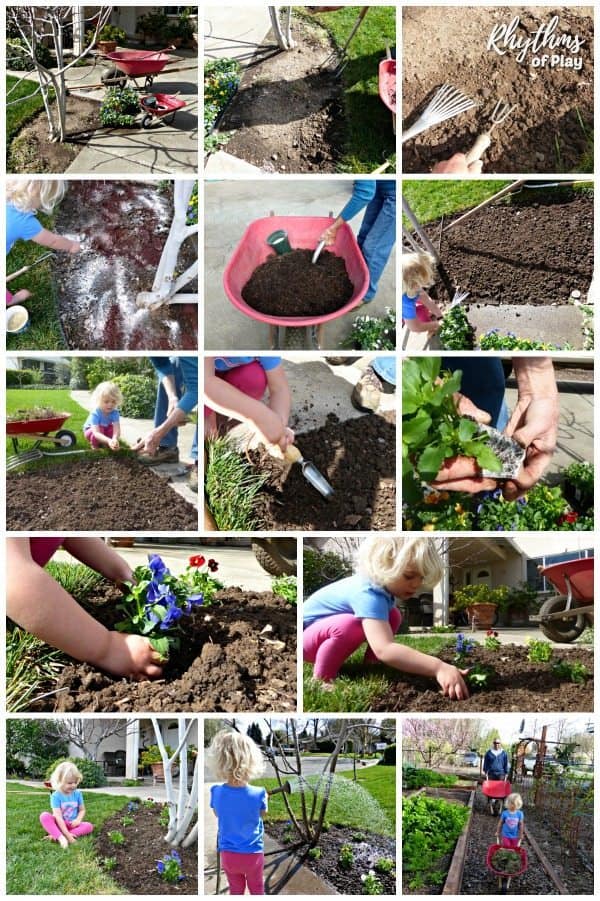
Help children learn to plant flowers with the step-by-step spring flower-gardening DIY tutorial she helped us put together. Step-by-step written directions are below the photo tutorial. You might also enjoy this list of Flower Art Projects for kids and adults.
1. Gather gardening tools and supplies needed to plant flowers:
- First, decide on the type of flowers you want and where you will plant them.
- Next, get the organic gardening supplies you need at your local nursery. If you don’t have a garden bed, purchase a few gardening containers or flower pots.
- Use the organic gardening supply list we have provided above.
- You can also ask a knowledgeable staff member at your local nursery for help.
 or
or 2. Prepare the soil to plant flowers:
- Next, pull up and remove any weeds.
- Then, use a hand cultivator, digging fork, cultivating tool, or soil tiller to prepare the ground for planting by mixing and turning the top 6-18″ of soil.
- The exact digging depth will depend on the type and size of flowers that you are planting.
- Please read the instructions for each type of flower on the varieties you purchase or ask the staff at your local nursery for help.
 ,
,  ,
,  , or
, or  to prepare the ground for planting by mixing and turning the top 6-18″ of soil.
How we prepared our garden bed to plant flowers with the help of a toddler:
- My mother used the digging fork, I used the hand cultivator, and my daughter “helped” with a leaf rake. After we modeled the work, she picked up a leaf rake to join us.
- Of course, a leaf rake is not an effective tool for cultivating a garden bed. However, imitative action was essential for her when she was two. Because using an actual cultivator would have been too challenging for a toddler.
- In other words, if children experience success as helpers, they will be more likely to continue to help.
- Most importantly, invite children to watch you work and help. Once they do, encourage their efforts and thank them for helping.
- For more tips, check out 15 Ways to Raise a Helper.
3. Add soil amendments to the flower bed or each container you will be planting flowers:
- We added a generous sprinkling of bone meal, blood meal, and sulfur pellets to the soil in our garden bed.
- Ask your local nursery or garden center for help when unsure of what your soil might need.
 ,
,  , and
, and  to the soil in our garden bed.
4. Mix compost or organic gardening soil into the flower bed or container:
- Next, add a generous amount of compost and organic gardening soil to your flower bed (or container), and use a garden rake or a cultivator to mix it in.
- Make room and allow your children to help. They might push you out of the way. Make it look fun, and they will take away your tools screeching, “I want to do it,” like my daughter did—lol!
- Tools are magical objects for children. If you want your children to help out more around the house and garden, give them the tools they need, and you will have a helper for life.
 to your flower bed (or container), and use a
  or a cultivator to mix it in.
5. Break up large dirt clods before planting flowers:
- Give this job to the kids. Playing in the dirt is a great sensory activity for developing children. Most children love to break up the large clumps of dirt in a flower bed with their hands before planting.
6. Place each flower in the ground to plant it:
Follow the step-by-step flower planting tutorial below to help you get started:
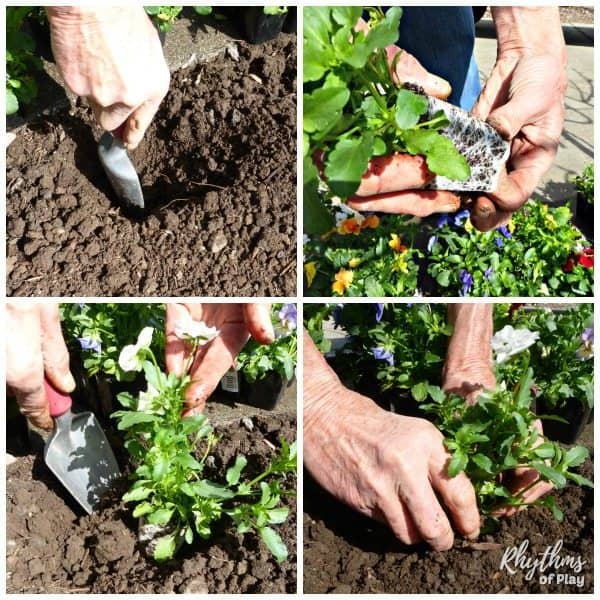
Best way to plant flowers in the ground:
- Dig a small hole with a gardening trowel.
- Loosen the root ball of the plant.
- Place the plant in the hole.
- Cover the root ball with dirt and tuck it in. To tuck the flower in, gently press the plant down into the earth.
- Repeat until you are finished planting flowers.
- Please look at the step-by-step photo tutorial below, which features my mother’s experienced master gardening hands (may she rest in peace). You will see each step included in the instructions above in action.
Invite children to help plant the flowers:
- I felt like a proud mama when my daughter grabbed a trowel and began digging a hole after she watched my mother plant the first flower. Her grandmother made it look so fun that she couldn’t wait to get her hands on the trowel.
- I was blown away by how delicately she handled each flower, gently sweeping the dirt around each root ball. Then she excitedly pointed out that she planted five flowers “all by herself!”
7. Water the freshly planted flowers:
- Water the flowers to finish planting them. This is a great job for the kids, as they love to help with watering!
- But don’t tell your children to water the flowers because that’s often the quickest way to lose your little helper. Instead, start watering the flowers as if you intend to do it yourself, and I’ll bet your kids will come to steal the hose away from you as quickly as mine do. I could barely turn the water on before my daughter screamed, “I want to do it!” Shhh–It’ll be our little secret. 😉
8. Clean up the gardening tools and supplies:
- First, put any pulled weeds lying around in your green bin,
- Next, clean the gardening tools and put them away.
- And be sure to teach children that planting is not finished until all gardening tools are cleaned and put away. Good gardening habits start young!
Gardening with Kids: The Best Way to Teach Children How to Garden:
Young children are naturally imitative creatures. This means they learn best by watching others rather than being told what to do. So, the best way to teach children how to garden is to allow them to watch you and invite them to help. When appropriate, of course.
Young children love to imitate the “real work” they see the adults around them doing, and gardening is no exception. In other words, do your best to be a role model, showing them how the “work” is done while making room for your children to help. But no pushing or cajoling, or they might never want to join you. So allow your child to join in the work when they are ready.
Make it look fun and exciting, and your child may jump in front of you, saying, “I want to do it,” just like my 2-year-old daughter does. Your child may also decide to wander off and do their own thing instead of helping, which is also okay.
Open the space so they can join whenever they want. If your child decides to help, encourage their efforts and thank them. For more positive parenting tips, check out How to Raise a Helper.
My daughter is finally reaching the age where she helps us with most DIY projects from start to finish. The best part is that she’s learning to share the work and enjoy the fruits of her labor with the rest of us because she wants to, not because she has to.
If you are curious, her favorite gardening project is her fairy garden. Click on the link to learn how to make your own! Throughout the photographs in this article, you can see her helping plant flowers. Gardening with kids is an excellent outdoor activity for kids of all ages. Plant the seeds of early learning in your garden today!

Organic Flower Gardening Tips:
We hope you’ve enjoyed learning how to plant organic flowers with your children with the organic gardening tips above. You may also enjoy learning how to plant a tree or this collection of fun spring activities for kids.
Learn more about Rhythms of Play HERE!



Looks so lovely! I am jealous of your nice weather and cannot wait to start our garden:)
It’s always fun to have little helpers!
Bless her. I tried planting some mint with Little Man yesterday and although he was interested he wasn’t bothered about getting involved. He was happy to watch, discover some bugs and chat to me about it, as always doing his own thing. It sounds like your little one is very keen. What a sweetie. Thanks for sharing at the Outdoor Play Party 🙂
Hi Leila! My little one did her own thing and watched a lot before she actually started helping. Hey may surprise you one day 🙂