
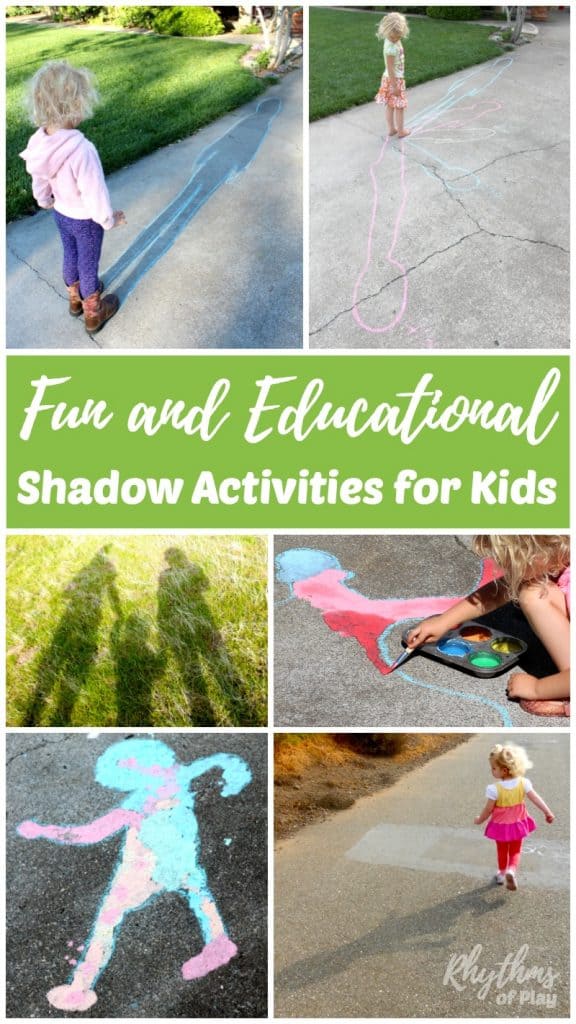
Here’s a list of fun educational shadow activities and science experiments for kids. There are several fun ways to play with shadows to learn about the science of light and shadow, both outdoors and indoors.
Shadow activities and experiments can help children learn what a shadow is and how shadows form through experience. There are several fun ways children of all ages can learn about the magic of shadows and light. Below, you will find educational, artistic, and science-based activities to help kids from toddlers and preschoolers to teens learn and play with shadows using both natural and artificial light. These creative activities and hands-on learning approaches teach introductory physics and fundamental scientific observation skills while nurturing creativity and curiosity.
This informative post includes fun and educational indoor and outdoor shadow activities for toddlers, preschoolers, kindergartners, and elementary-aged kids. However, even older children, teens, and adults can enjoy some of these simple shadow play ideas. Shadow activities include things you can do indoors or outdoors to play with shadows, learn more about them, create art with them, or enjoy passing the time messing around with them any day of the year.
These activities are perfect for Groundhog Day on February 2 or year-round fun at home or in the classroom. Of course, summer break is also a great time to play and learn with shadows. First published on January 31, 2015, this post is regularly updated and occasionally republished to improve the content and add more fun shadow activities you can try at home or school. You might also enjoy this list of outdoor activities for kids.
Related: Kids’ Books That Teach Important Life Lessons
What is a shadow, and how are shadows formed?
This post contains interactive indoor and outdoor shadow activities for toddlers, preschoolers, kindergartners, and elementary-aged kids. These activities are perfect for Groundhog Day and year-round fun at home or in the classroom! However, before I share a list of shadow activities and experiments. Let’s start with how to define, make, and explain them to children in a way that even a preschooler can understand:
Definition of a Shadow:
A shadow is a dark shape that appears when an object, person, animal or plant blocks light from a source like the sun or a lamp. Because light usually travels in straight lines, it cannot pass through solid objects, so the blocked light creates a shape on the ground, wall or other surfaces. This shape mirrors the outline of whatever is blocking the light and can change in size or position depending on the light source and it’s position.
How do you make a shadow?
A shadow is made when an object, plant, animal, or person blocks light. That said, the thing blocking the light must be translucent or opaque for a shadow to form. Because light can pass through transparent objects, such as a window, it does not create a shadow. Conversely, when an opaque object blocks a light source, or a translucent object partially blocks a light source, it creates a darker or lighter shadow respectively. Light travels in straight lines away from its source. This means that shadows fall away from the light and form in the direction opposite to the light source. Three things must be present for a shadow to form, as described below:
Three things are needed to make a shadow:
- A source of light (natural, like the sun, or artificial, such as a light bulb).
- An object to block it (person, animal, plant, geographic landmark, structure, etc.)
- A surface behind the object for the shadow to fall upon (wall, screen, ground, floor, grass, sidewalk, playground, paper, canvas, etc.)
Natural and Artificial Sources of Light Make Shadows:
The sun is a natural light source, while a lamp or flashlight is an artificial light source that also casts a shadow when an object blocks it.
Size and Shape of Shadows:
The size and shape of a shadow depend on the size and position of the light source relative to the object blocking it. Several factors contribute to the size of the shadow, including the object’s size, the angle of the light projected onto it (such as the sun’s position in the sky), the distance of the light source from the object, and the distance and angle of the surface onto which the shadow is projected.
Encourage kids of all ages to experiment with different shapes and types of objects at various distances and angles from artificial and natural light rays to make shadows. For example, have them go into a dark room with a flashlight to show them how the size of the shadow changes when they move closer or farther away from the light. It gets bigger when they get closer, and smaller when they move further away.
How to Describe, Define or Explain Shadows to Kids:
To explain shadows to kids, keep it simple and playful, esspecially when instructing preschoolers. Explain that shadows occur when a bright light, such as the sun, lamp, or flashlight, shines on us or part of us, and whe block the light. Since light can’t go through us, it creates a dark shape on the ground or wall. That dark shape is the shadow, and it looks like us because its created by our shape. It’s a dark copy of us, or companion, that goes with us everywhere in the sunshine.
The Best Way to Explain Shadows to A Child
Instead of explaining shadows to children in boring or lofty scientific terms they don’t yet understand, I recommend helping them learn what shadows are by demonstrating and engaging them in hands-on shadow activities, playful games, and simple scientific experiements such as those listed below.
For example, have young children such as toddlers, preschoolers and kindergarteners block the light indoors with their hands to create shadow puppets. Alternatively, ask them to run, move, play, dance, and jump outside on a sunny day, and encourage them to watch their shadow move as they do. You might say, “See? When you move, your shadow moves with you.”
Show children that shadows get longer or shorter at different times of the day by making a human sundial, or that they dissapear when it’s cloudy or dark. Making it hands-on and fun shows children of all ages that shadows are just light playing a game with shapes. For several more creative and educational shadow activities for preschoolers to teens, try the fun play ideas and experiements below to help children of all ages learn about shadows!
Related: Outdoor Activities for Kids
13 Educational Shadow Play Activities and Science Experiments for Kids:
This list of educational shadow activities and science experiments makes learning about shadows and how they are formed fun. Try the shadow play ideas and experiments described below as a hands-on way for kids to learn more about the sun, shadows, and the science of light. These fun shadow activity ideas are great for Groundhog Day and year-round learning fun. You might also enjoy this list of rainy-day activities.
1. Play with your shadow:
There are so many fun ways to play and learn with your shadow. A child’s imagination is an endless source of inspiration. Create a new way to play with your shadow, or try one of the fun shadow activity ideas in the following sections. Have a tea party, play games with your shadow, or invite some friends to play shadow tag! Step-by-step instructions for each of these playful shadow activities are included below:
2. Have a Tea Party with Your Shadow:
Have a tea party with your shadow! Having tea with your shadow is a simple form of imaginative play, perfect for young children, such as preschoolers and kindergarteners, to begin to understand shadows and develop their creativity. Invite children to enjoy this imaginative experience solo, with you, or with a friend or two. I recommend encouraging young children (and even older kids, teens, and adults) to try this activity alone for a meditative, self-regulating experience. However, having a shadow tea party with friends can be fun too. Follow the directions below to try this creative shadow activity:
How to Have a Tea Party with Your Shadow:
1. Find the Light:
- Your shadow needs light to come to life. Choose a sunny spot outdoors or a well-lit room with a strong lamp.
- The late afternoon sun works beautifully, casting long, expressive shadows.
2. Set the Scene:
- Lay out a small table or blanket.
- Arrange teacups, a teapot, and some pretend or real treats (cookies, sugar cubes, maybe even imaginary crumpets).
- Set one seat for you and one facing your shadow.
- If others join you in this imaginative play activity, set a place for each of them.
3. Invite Your Shadow to Join You for Tea:
- Sit where the light can cast your shadow across from you.
- Begin by politely greeting your shadow (or shadows).
4. Enjoy the Party:
- Pour tea for both of you.
- Ask your shadow how the day has been and engage in conversation, or sit quietly with your shadow and enjoy tea.
- If you choose to talk to your shadow, you can answer on its behalf if you like or smile at its quiet, peaceful presence.
- Toast to invisible things: the wind, the moon, the silence between thoughts, or whatever suits your fancy.
5. Be Present:
- Enjoy the moment.
- If you are enjoying a shadow tea party with others, ask them to enjoy the silence with your shadows at some point during the party.
- Your shadow mirrors you but asks nothing of you.
- It’s a quiet companion—a reflection of yourself, always there but often unnoticed.
- See yourself in your shadow, and honor the light of awareness.
3. How to Play Shadow Tag:
Shadow tag is a simple game best played outdoors on a sunny day. Like many other tag games, the main idea is to step on another player’s shadow to “tag” them.
- Start by selecting the player that will be “It” or the “tagger.”
- Before starting play, define the game’s boundaries.
- If someone runs out of bounds when running away from the “tagger,” they become the “tagger.
- Also, decide if there will be a “base” or place where players can be temporarily safe from “tagging” if they need a minute to rest, and where this “base” will be.
- On the word go!, all players run around trying to keep their shadow from getting tagged by the person that is “It,” while the player that is “It” does their best to step on another player’s shadow to “tag” them.
- When another player is tagged by “It” or the “tagger,” that player then becomes “It.”
- Continue to play until the players decide to end the game of shadow tag.
4. Chasing Shadow Play:
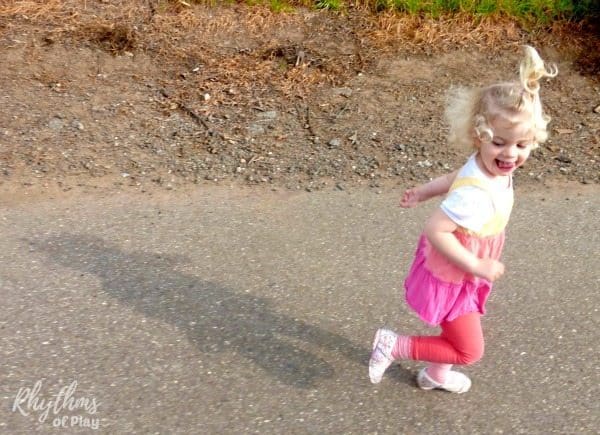
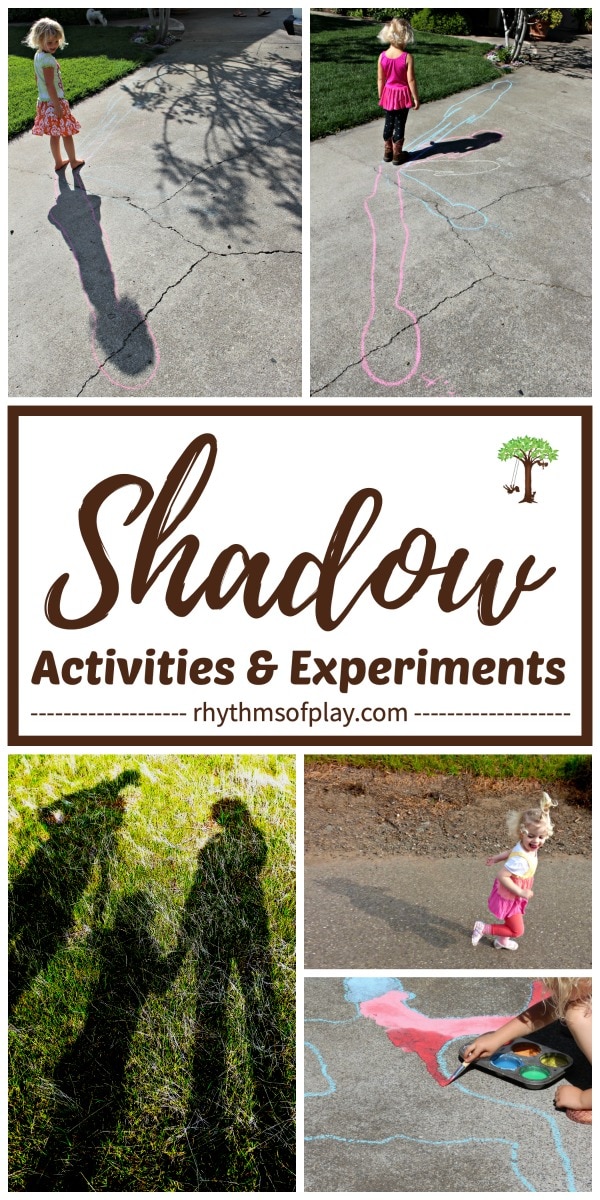
My daughter’s favorite playtime activity with her shadow is to be chased by it. Whenever she notices her shadow following her on our daily walks, she shrieks joyfully and tries to run away from it as if it were chasing her. She continually looks over her shoulder at it as she runs, chirping with excitement and giggling with joy–Oh, to be a kid again! Look how cute she is, attempting to escape her shadow in the photo below. This game is most fun for younger children. To play, encourage them to try to get away from their shadow. You’d be surprised how silly and fun this simple shadow game can be.
Related: Best Board Games for Kids and Families
5. Dance with your shadow:
Put on some fun music in a sunny outdoor area where children can see their shadows and dance with them. Feel free to add shaker eggs and other musical instruments of your choice.
You can add more fun by turning the music on and off and having your kids or students freeze when it stops. Children will have difficulty not giggling at their silly, frozen shadows. You might also enjoy this list of kids’ music that won’t drive you nuts!
6. Experiment with Shadows:
Blocking light from different sources with various objects at different angles will create different shadows, helping children learn about the science of shadows. Encourage children to experiment and have fun as they play and learn with shadows. Invite children to try any of the simple shadow experiments listed below.
- Play with natural versus artificial light sources.
- Experiment with casting shadows on a surface — wall, floor, driveway, table, etc.
- See what happens when you move objects at different angles.
- Experiment with the distance and angle of the surface that shadows are projected upon relative to the light source.
- For example, how does a shadow change when projected on a wall or the floor with the light directly behind it?
- Experiment with the difference between translucent, transparent, and opaque objects and the types of shadows they produce.
- Describe and explain the differences between shadows produced by opaque, transparent, and translucent objects.
Related: Science Experiment with Watercolors
7. Human Sundial Shadow Science Experiment:
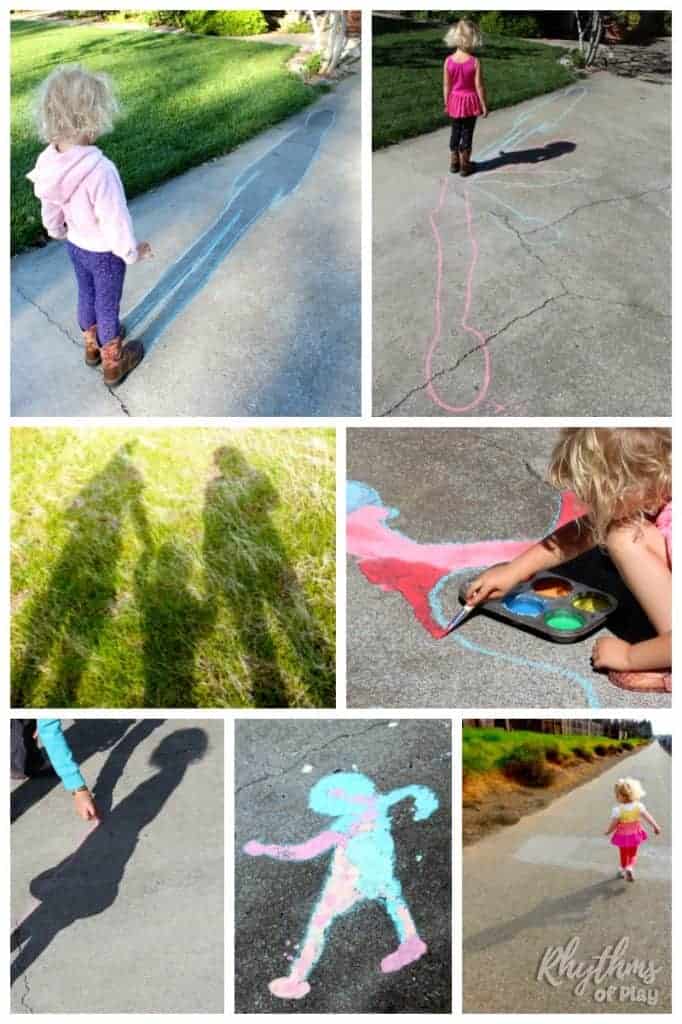
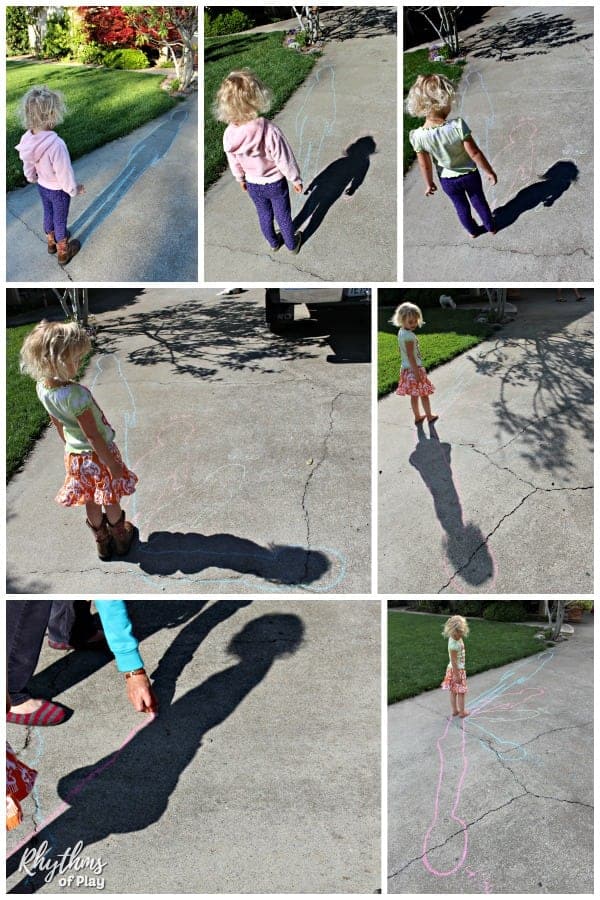
This shadow experiment is an educational activity that helps kids learn about the science of shadows. It’s fun to trace a person’s shadow throughout the day and observe how it changes depending on the time of day and the sun’s position in the sky, as shown in the photograph below. Alternatively, you can trace the shadow of an object, such as a Lego tower or a stick, to see how the object’s shadow changes throughout the day.
Making human sundials is a fun science activity for elementary school students and a fantastic homeschool lesson. Please visit the step-by-step instructions for this Human Sundial Shadow Science Experiment to learn how to conduct shadow science experiments with children at home or in the classroom. You can see the human sundial we made in the photo tutorial below:
8. Create Shadow Art:
Making art with shadows is another fun shadow activity for kids. Shadow art can be done indoors with artificial light or outdoors in sunlight. There are two primary ways to create shadow art:
One way is to trace or draw shadows. You can trace your own shadow on the driveway or sidewalk, or use paper to trace the outlines of other objects. For example, you can trace the outlines of toys in different positions, or of plant life such as trees, leaves, or flowers. Shadow tracing is a fun art activity for kids of all ages.
Another creative way is to make sculptures that cast realistic shadows on a wall, table, or surface. Shadow sculptures are fun to make with random objects, pieces of wood, paper, Legos, and even junk! You can use anything with a bit of creativity to cast artistic shadows upon a wall, floor, or another surface. Some of the shadow art in the video below will blow your mind!
9. Indoor Shadow Art Instructions:
- Choose a light source to cast shadows upon objects, etc.
- Find an object, or objects, to block the light and create shadows with them.
- Either create art with shadows similar to the sculptures shown in the video or trace and color the shadows to make art.
Shadow Art Supplies for Tracing and Coloring Shadows:
Use any or all of the following to draw or color shadows of various objects and living things to create shadow art. Look at this list of art supplies for my favorite recommendations, or visit The Rhythms of Play Amazon Store.
- Drawing paper, watercolor paper, or poster board
- Crayons
- Colored pencils
- Markers
- Pastels
- Charcoal
- Sidewalk chalk
- Chalk paint
- Tempura paint
- Watercolor paint
- Acrylic Paint
10. Outdoor Shadow Art Instructions:
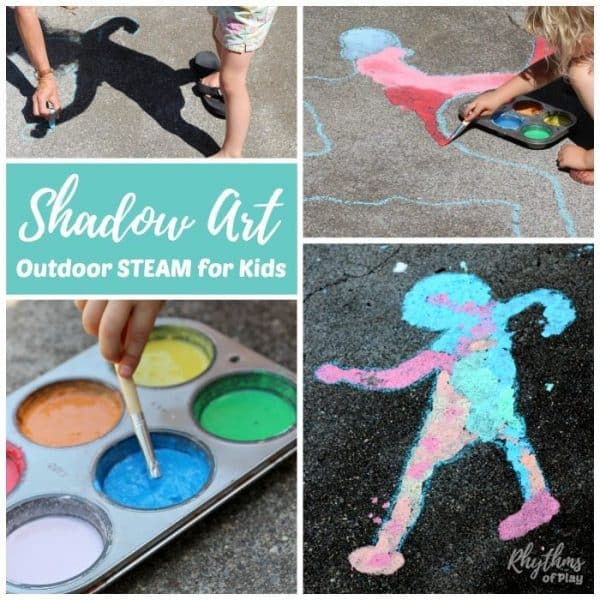
Bring art supplies outside to an area where the sun shines and look for shadows to trace, shade, or paint, such as a driveway, sidewalk, patio, or playground. Place a piece of paper under the shadow, choose your artistic medium, and get creative! Or, try this Shadow Art outdoor STEAM activity for kids. The photo below shows some shadow art my daughter and I made with our homemade chalk paint recipe:
11. Make Shadow Puppets:
Making shadow puppets is another form of shadow art that makes experimenting with blocking light and creating shadows fun for kids. You can create a shadow puppet theater and host a puppet show at home or in the classroom. You can even invite family, friends, or students from another classroom to watch the puppet shadow show.
Start by casting a ray of light onto a surface, such as a wall, screen, or curtain. Then invite the kiddos to block light with their hands and arms to create animals and other fun shapes on the surface, putting on a show. Simple shadow puppets you can make with your hands include a dog, a bunny, and a bird. The video below shows how to make shadow animals with your hands—watch it with the kids!
12. Take Pictures of Your Shadow Antics:
This shadow activity has always been a hit with my daughter; my husband and I enjoy it just as much. You can see some of our shadow fun in the photo of our family below. Taking pictures of your shadow can be tricky, and sometimes it’s hard to find a way to do so without the camera showing in the photo.
In the image below, I held a point-and-shoot camera at my chest to hide it. Today, you can do the same thing with a cell phone. It can also be challenging to take pictures of other people’s shadows without finding some part of your shadow in the frame, but it is sure fun to try!
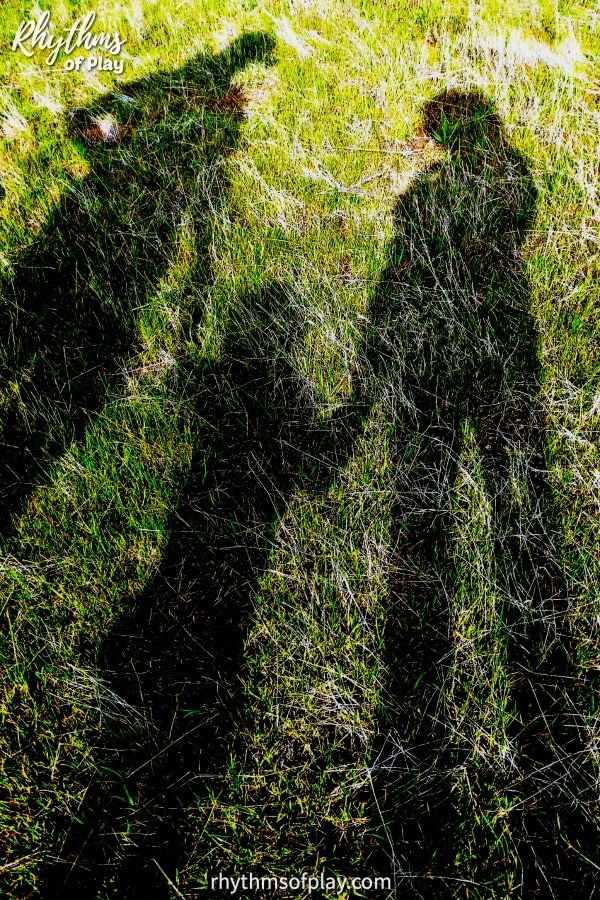
Update: Today, one of my favorite things is looking back at the pictures of my shadow in various places outside over the years. Most moms get left out of the picture when outdoors with the kids, so my shadow pictures have become some of my most cherished selfies.
Over the years, photographing my shadow has become a tradition whenever I find myself outdoors with a camera. Each shadow photo has a unique quality that a picture of an actual person can’t quite replicate, and I love them all. My shadow portrait selfies have become my signature as a photographer because one of my shadows often lurks in each group of pictures I take, wherever I go.
I also love the shadow pictures I take with family and friends outside. However, I have become partial to my selfie shadow portrait photobombs within the groups of nature or family pictures that I take. They have a slightly different artistic and emotional element that regular photos of people don’t have. You can see a few of my favorite selfie shadow portraits in the photo collage below:

13. Combine Shadow Portraits with Sidewalk Chalk Art:
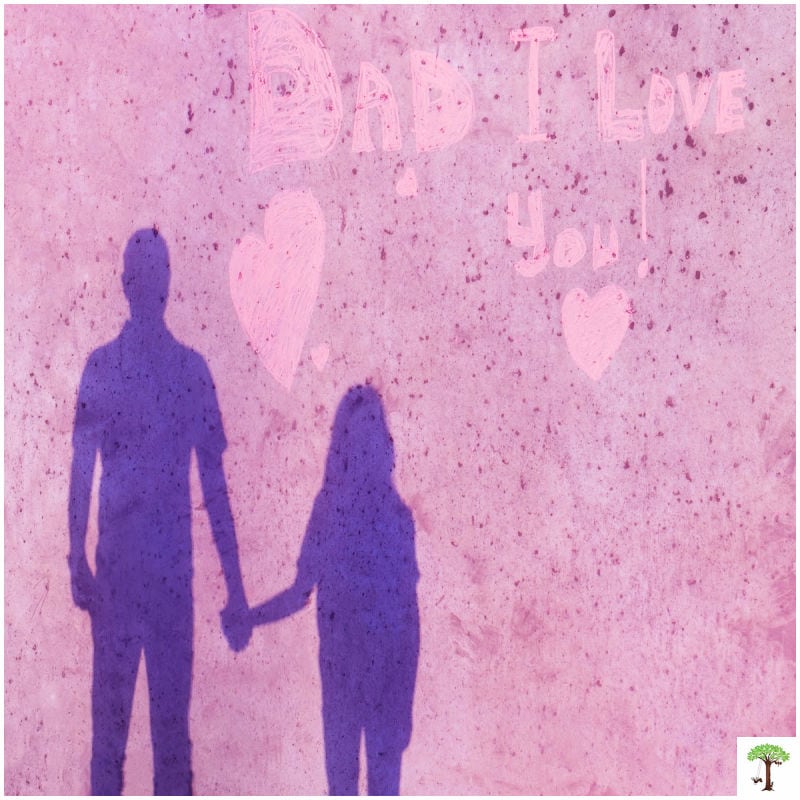
Another creative and educational shadow activity is to create sidewalk chalk art on a driveway or sidewalk, then take a photo of your shadow (or someone else’s) projecting onto or within the art. You can use sidewalk chalk or chalk paint to make the art (or a combination of both, as shown in the photo below), then take a picture with a shadow (or shadows) cast somewhere within the art.
Other examples of art you can make to photograph with your shadow are a big head of hair with your shadow wearing it, several trees with shadows playing among them, a sandcastle with shadows pretending that they are building it, etc. The limit to the different characters and scenes you could create to photograph your shadow or other people’s shadows within is the limits of your imagination! Hang or display the sidewalk chalk art and photos you make, give them to others, and create unique family portraits.
Shadow Science for Kids:
The educational activities and shadow science experiments for kids listed above are hands-on ways to learn about shadows, the sun, and the science of light. These activities are perfect for Groundhog Day on February 2 or year-round fun. You might also enjoy learning about Imbolc, another holiday with the same date.
Learn more about Nell Regan Kartychok, the author and photographer of these fun and educational shadow activities, and Rhythms of Play HERE!
More Educational Activities and Science Experiments for Kids:
- Sorting and Classifying Rocks
- Coin Sorting Montessori Sensorial Activity
- Experiment with Watercolor Resist
- Rock Balancing and Stone Stacking
- Rainbow Rainy Day Art
- Magnet Fishing: Cool Science for Kids





What fun ideas! Shadows are such a fun topic to cover and being able to get outside and play makes it even more so. Thanks for sharing!
Thanks! My daughter loves playing with her shadow so we are always coming up with fun new ideas. So glad you like them! 🙂
I love the shadow art pictures. My youngest likes jumping on my shadow when I’m walking along. I’ll give these ideas a go with her.
Oh, thanks for reminding me Debbie… Shadow tag is another fun game!
I think these shadow activities are a great way to teach children to understand the rules of reflection. The theory of reflection of light can help them in excelling in many games such as caroms. Thanks for sharing the pictures of this interesting activity. The kids look really cute in these pictures.
I agree Sachin, these shadow activities are a great way to understand some of the rules of reflection. So glad you like it!