

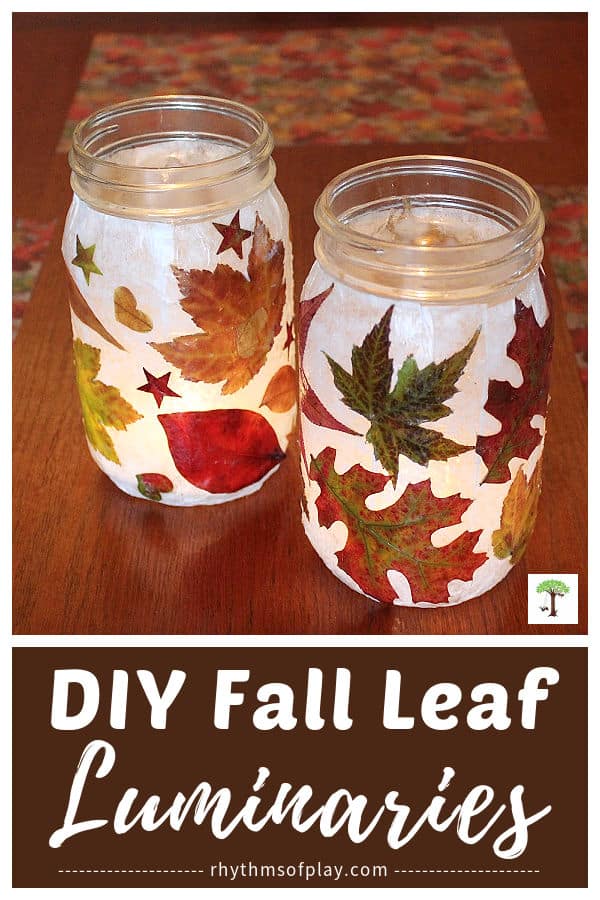
Make glowing leaf lanterns with mason jars and real or faux autumn leaves. Includes a video tutorial and free printable instructions.
Turn colorful autumn leaves into glowing DIY leaf lanterns with mason jars, tissue paper, and glue. This tutorial includes step-by-step instructions and a video to help you make your own fall luminaries with natural or faux fabric leaves. Jump to Supplies, Video & Instructions.
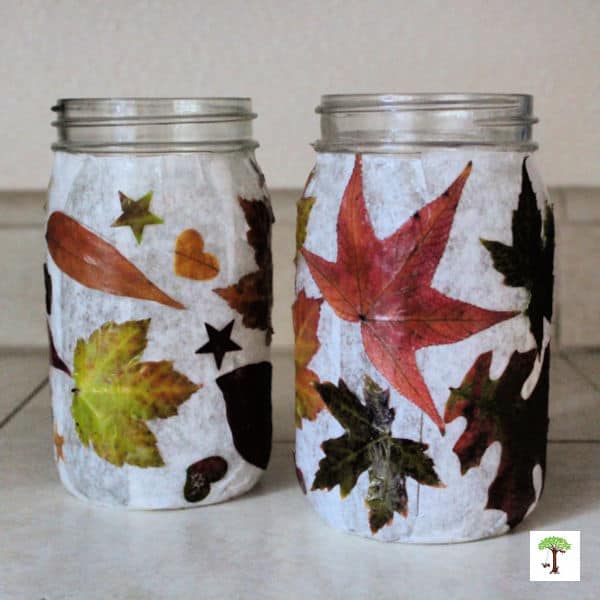
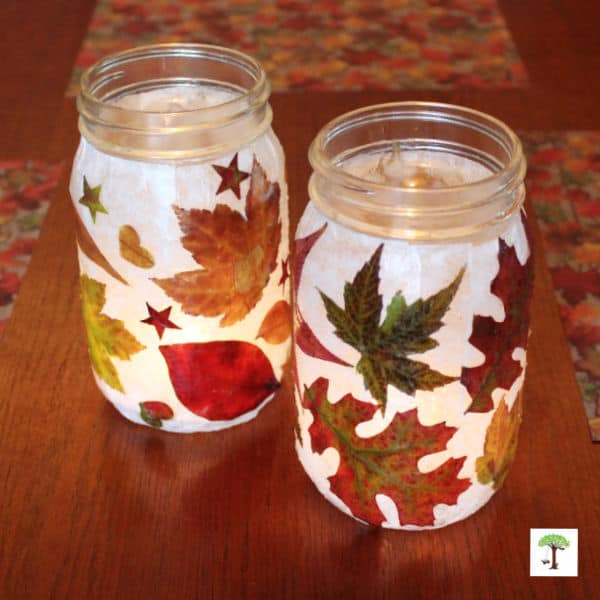
My daughter and I love making these lanterns with freshly fallen leaves we find on our daily outdoor adventures. In the photograph below, her lantern is on the left, decorated with whole leaves and leaves cut into stars and hearts. Mine is on the right, with the leaves left whole to show off their natural shapes.
Keep your design simple, or try a turkey leaf lantern for Thanksgiving. For another variation, cut leaves or paper into heart shapes to bring a little warmth to your home during the darker days of late autumn and early winter.
Our family brings these lanterns out of storage every autumn. The leaf colors have softened over the years, but we still enjoy their beauty and the memories of making them together. If you’re gathering leaves for this project, you might also find these tips for pressing and preserving leaves helpful.
Gather your supplies and follow the tutorial below—or explore more nature crafts to make with your autumn finds.
Easy Fall Leaf Lantern Craft
A layer of tissue paper gives these leaf lanterns their soft glow, while the autumn leaves add color, texture, and natural patterns. When illuminated, the overlapping materials create a lovely stained-glass effect.
This is a fun project to make with kids, friends, or family during a fall gathering. For younger children, prepare the tissue-covered jars ahead of time, let them dry, then invite everyone to add leaves. Each person can choose their own colors and arrangement, making every lantern a little different.
Display your finished lanterns on a shelf or autumn table, give them as handmade gifts, or add handles and battery-operated lights for a lantern walk. See Step 12 for lighting options and candle precautions.
You can also leave out the lights and use your leaf jar to collect thankful thoughts. Invite family members to add notes throughout the season, then read them together over a meal. Explore these Thanksgiving gratitude activities and crafts for more ways to enjoy this tradition.
Before you begin, read the instructions and watch the video to learn how to apply the tissue paper to the leaves. If you have extra leaves, save a few for fall leaf watercolor painting.
How to make a Leaf Lantern:
This project tutorial teaches how to make leaf lanterns and luminaries with gorgeous, fresh, fallen autumn leaves or faux fabric leaves—a DIY project for kids and adults. As the leaves turn rich shades of red, orange, and gold, gather a collection of freshly fallen leaves that are still soft and pliable. These recently fallen leaves are ideal for crafting, as brittle leaves tend to fall apart.
Once you’ve gathered leaves, clean and press them until slightly flattened. Next, add strips of white tissue paper to decorate glass jars or votives, then apply a thin coat of Mod Podge or another clear, drying glue.
Finally, glue the autumn leaves onto the tissue paper layer. The result is a warm, glowing lantern that captures the spirit of fall. Gather the recommended supplies below, then scroll down for complete step-by-step instructions for making DIY leaf lantern crafts.
Free Printable Instructions
Prefer to keep the instructions beside you while you craft? Get the free leaf lantern craft printable summary from the Rhythms of Play Learning Center Library. This one-page PDF includes a supply checklist, preparation and drying times, all 12 steps, and quick troubleshooting tips.
Print a copy for home or classroom use, and follow along with the photos and video in this post whenever you need a closer look.
How Long Does It Take?
Allow about 20–30 minutes to decorate one lantern, plus at least a few hours or overnight to press the leaves, and overnight to a full day for the finished lantern to dry. If using fabric leaves, skip the pressing time.
Leaf Lantern Craft Supply List:
Time needed: Allow about 20-30 minutes to decorate one lantern, plus at least a few hours (or overnight) to press the leaves, and overnight to a full day for the finished lantern to dry. If using fabric leaves, skip the pressing time.
- Autumn leaves: Freshly fallen leaves that are still soft and flexible, or faux fabric fall leaves.
- Leaf press or heavy books and absorbent paper: Use to flatten and dry natural leaves. Skip this supply if using fabric leaves.
- Clean, dry, wide-mouth mason jars: The lanterns pictured use 32-ounce jars. Choose jars large enough to display your leaves.
- Tissue paper: White gift-wrapping tissue paper creates a soft glow and lets the leaf colors stand out. You can also experiment with colored tissue paper.
- Scissors: For cutting tissue paper into strips and, if desired, trimming leaves into shapes.
- Mod Podge or white craft glue: I used Mod Podge without adding water to make the lanterns pictured. Another option is slightly watered-down white glue that dries clear. If the glue is not too thick or viscous, you won’t need to add water.
- Foam brush or dedicated glue brush: For applying glue beneath and over the tissue paper and leaves.
- Small reusable container: For holding glue while you work. A clean, reused plastic container with a lid, such as a yogurt or cream cheese tub, works well.
- Battery-operated LED candle or fairy lights: To illuminate the finished lantern. Choose flameless lights such as battery-operated tea-light candles or a string of fairy lights for lanterns children will carry or hold. For beeswax tealight or votive candle options and precautions, see Step 12.
- Optional mason jar handle: Choose a handle that fits your jar’s size and style if you plan to hang or carry it with a battery-operated candle.
To prepare natural leaves: Have water, a little dish soap, and a towel on hand to clean and dry them before pressing.
DIY Leaf Lantern Video Tutorial:
Watch how to layer tissue paper and autumn leaves onto a mason jar to create a glowing leaf lantern. Then gather your supplies and follow the written instructions below to make your own. A step-by-step photo collage you can refer to as you work appears in Step 7.
Before you begin: Clean, pat dry, and gently press your natural leaves so they’re ready to curve around the jar. This preparation step isn’t shown in the video, but you’ll find the directions in Step 2. Skip it if you’re using fabric leaves.
DIY Fall Leaf Lantern Step-By-Step Instructions:
Follow the steps below to turn a plain glass jar into a glowing autumn leaf lantern. Decorate with whole leaves to highlight their natural shapes, or try a turkey design or heart-shaped leaves for a seasonal variation.
Make your lanterns for an autumn table, a handmade gift, or a holiday celebration. If you’re preparing for a fall lantern walk or crafting with children, read the make-ahead tips below before you begin. They also make festive decorations for Halloween, Thanksgiving, the winter solstice, or Christmas.
If you’re crafting with children, read the make-ahead tips below before you begin.
Making Leaf Lanterns with Kids: Prepare Ahead
You can divide this leaf lantern craft into two sessions. First, cover the jars with tissue paper and let the glue dry. Then invite children to arrange and glue the autumn leaves onto the prepared jars.
This is a helpful option for younger children or a group craft activity. Prepare the tissue-covered jars ahead of time so everyone can start decorating with leaves.
Once the leaves are in place, check whether they need a little more glue underneath or over the top. Let the finished lanterns dry completely before adding lights.
1. Gather autumn leaves:
- Head outside to collect freshly fallen leaves in your favorite autumn colors. Choose soft, flexible leaves rather than dry, brittle ones so they can curve around the jar without cracking. Gather a variety of sizes to arrange on your lantern.
- Turn your leaf hunt into an outdoor adventure for kids and adults with these fall leaf activities.
- Prefer faux leaves? Use thin fabric autumn leaves instead of natural ones. Remove any plastic stems or veins that prevent them from lying flat against the jar.
- Save leftover natural leaves for leaf crowns, watercolor art, homemade sewing cards, or other fall nature crafts.
2. Clean and press the leaves:
Clean and gently flatten natural leaves before adding them to your lantern. Skip this step if you’re using fabric leaves.
- Clean the leaves: Gently rinse away dirt and debris. If needed, wash with a small amount of dish soap, then rinse thoroughly.
- Pat dry: Gently blot moisture from both sides with a towel.
- Press flat: Place the leaves in a leaf press and follow its instructions, or arrange them in a single layer between sheets of absorbent paper. Set a large, heavy book on top to flatten them.
- Check before crafting: Leave the leaves for several hours, then check that their surfaces are dry and they lie mostly flat. Choose leaves that are still flexible enough to curve around the jar without cracking.
For more tips, learn how to collect, press, and preserve fall leaves.
3. Wash and Dry your Mason jar:
- Choose a mason jar, glass votive holder, or recycled glass bottle large enough to display your leaves. Check for chips or cracks before using it.
- Remove any labels and adhesive residue, then thoroughly wash, rinse, and dry the glass so the tissue paper and glue adhere well.
- I recommend a wide-mouth mason jar because the opening makes it easier to hold while decorating and to insert or remove your lights.
- Use battery-operated lights in recycled jars and bottles. Heat-resistant or tempered glass alone does not mean a container is suitable for burning candles. See Step 12 for candle guidance.
4. Cut strips of tissue paper:
- Cut white gift-wrapping tissue paper into strips about 1½–2½ inches wide. Use tissue paper for gifts, not toilet tissue.
- Make each strip approximately 2–3 inches longer than the height of your jar. It should reach from just below the threaded rim, down the side, and around the bottom to slightly past the center of the base or bottom of the jar. Check one strip against your jar before cutting the rest. For the 32-ounce mason jar shown in the photographs, I used 8½-inch-long tissue-paper strips.
- White tissue paper softens the light and creates a glowing backdrop that highlights the colors and shapes of the leaves. Colored tissue paper is another option, although it will change how the leaf colors appear.
I recommend keeping this tissue-paper layer rather than gluing the leaves directly to the glass—it helps create the lantern’s lovely stained-glass effect.
5. Brush glue onto the Mason jar:
- Pour a little Mod Podge or clear-drying white craft glue into a clean, reusable container. A washed yogurt or cream cheese tub with a lid works well.
- If the glue is too thick to spread easily, mix in a little water. I used Mod Podge for the lanterns in the photographs and video tutorial without adding water.
- If your hand fits comfortably inside the jar, use your non-dominant hand to support it while you brush, as I demonstrated in the video tutorial.
- Use a foam brush or dedicated glue brush to apply a thin, even layer of glue in long strokes, starting just below the threaded rim and working down the sides. Coat the bottom of the jar, too, so you can wrap the tissue-paper strips underneath.
- Work in small sections so the glue stays wet as you add the tissue paper in the next step.
6. Apply the tissue-paper strips:
- Place a strip of tissue paper onto the wet glue, starting just below the jar’s threaded rim. Gently smooth it down the side with your brush.
- Fold the extra tissue paper around the bottom so it extends slightly past the base’s center. Brush a little glue over it to hold it in place.
- Add the next strip beside the first, slightly overlapping the edges to avoid gaps. Keep the overlaps narrow so the tissue-paper layer lets plenty of light through.
- Continue around the jar, brushing on more glue as needed, until you cover the sides and bottom. Leave the threaded rim and opening uncovered.
- Handle the wet tissue paper gently—it tears easily. Small wrinkles are fine and add texture to your lantern.
7. Gently brush glue over the tissue paper:
- Brush glue over the tissue paper strips to cover the entire jar.
- Refer to the photo tutorial below or video above to see each step in the process.
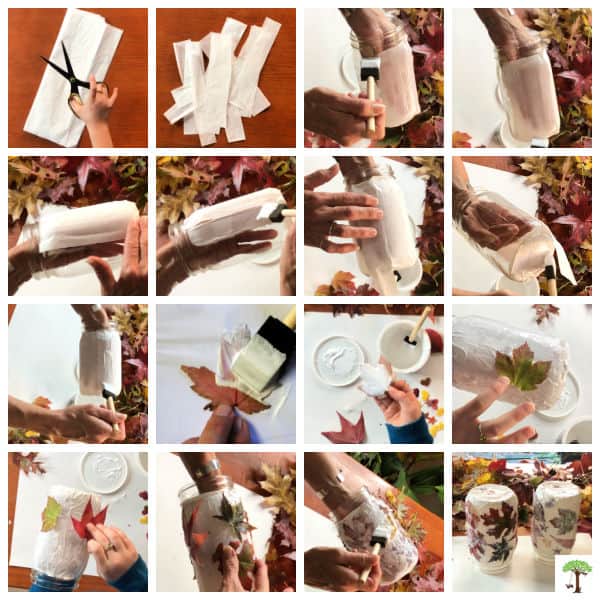
8. Arrange and glue the leaves onto the jar:
- Place each leaf on the glue-coated tissue paper and gently press it against the jar’s curve. Leave some space between the leaves so the soft glow shines through, or overlap them slightly for a layered design.
- If a leaf doesn’t stick, brush a little glue onto its underside before placing it on the jar. Gently smooth it from the center toward the edges to help it lie flat.
- Use whole leaves, or cut them into hearts and stars as my daughter did. See our heart leaf lantern tutorial for tips on cutting leaf shapes.
9. Brush glue over the leaves:
- Gently brush a thin, even coat of glue over each leaf, working from the center toward the edges.
- If an edge lifts, brush a little glue underneath and gently press it back against the jar. Secure the leaf tips and edges before setting the lantern aside to dry.
10. Let the leaf lantern dry upside down:
- Carefully remove your hand from the jar and set it upside down on its uncovered rim, leaving the glued sides and bottom exposed to dry.
- Check occasionally while the glue is still wet. Gently press down any lifting leaf edges and smooth out air bubbles with your glue brush.
- Let the glue dry completely before turning the lantern upright, attaching a handle, or adding lights. Follow the drying instructions on your glue’s label.
11. Optional: Add a hanger or handle to the Lantern Craft:
Once the glue is completely dry, add a handle if you’d like to hang your leaf lantern or carry it on a fall lantern walk or Advent spiral walk.
Choose one of these options:
- Mason jar handle: Attach a stainless steel handle designed to fit your jar, following the manufacturer’s instructions.
- Twine handle: Tie twine snugly around the jar’s neck, just below the threaded rim. Attach a separate length of twine at two opposite points to form a carrying loop.
- Fingerknitted yarn handle: Tie a fingerknitted strand snugly around the jar’s neck, just below the threaded rim. Leave a long end, loop it over the top, and tie it securely to the opposite side to form a handle.
If desired, apply a little craft glue beneath the twine or fingerknitted yarn wrapped around the jar’s neck to help hold it in place, and let it dry completely. Tie the handle securely so it can support the jar’s weight without relying on glue.
Check that the handle cannot slip over the rim and that all knots are secure. Test it by lifting the lantern just above a soft surface before hanging or carrying it. Glass jars are heavy, so adults should help children carry them.
Use only battery-operated lights when hanging or carrying your lantern.
12. Add a candle or fairy lights to add a warm glow to the leaf luminary:
- Battery-operated lights: Place a flameless tealight, votive, or small string of LED fairy lights inside the dry lantern. Always choose this option for lanterns children will carry, or that you plan to hang, hold, or take on a lantern walk.
- Real candles: I enjoy using beeswax tealights in my leaf lanterns. If you choose a burning candle, remember that the tissue paper, leaves, and glue are combustible, and a mason jar isn’t necessarily designed for candles. Heat-resistant glass and sand on the bottom do not eliminate these risks. Never leave a burning candle unattended, and keep it away from children and pets.
If you use a real candle: The tissue paper, leaves, and glue used to decorate these lanterns are combustible, and a mason jar isn’t necessarily designed for candle use. Battery-operated lights are the lower-risk choice. Always use flameless lights for lanterns children will carry or that you plan to hang or hold.
If you choose to use a real candle, add a shallow layer of sand to the bottom of the jar before placing the candle inside. The sand can catch wax drips and make cleanup easier, but it does not make the decorated lantern fireproof or prevent glass from breaking. Let the candle, wax, and jar cool completely before cleaning.
Never leave a burning candle unattended. Place it on a stable, heat-resistant surface, away from children, pets, and anything that can catch fire.
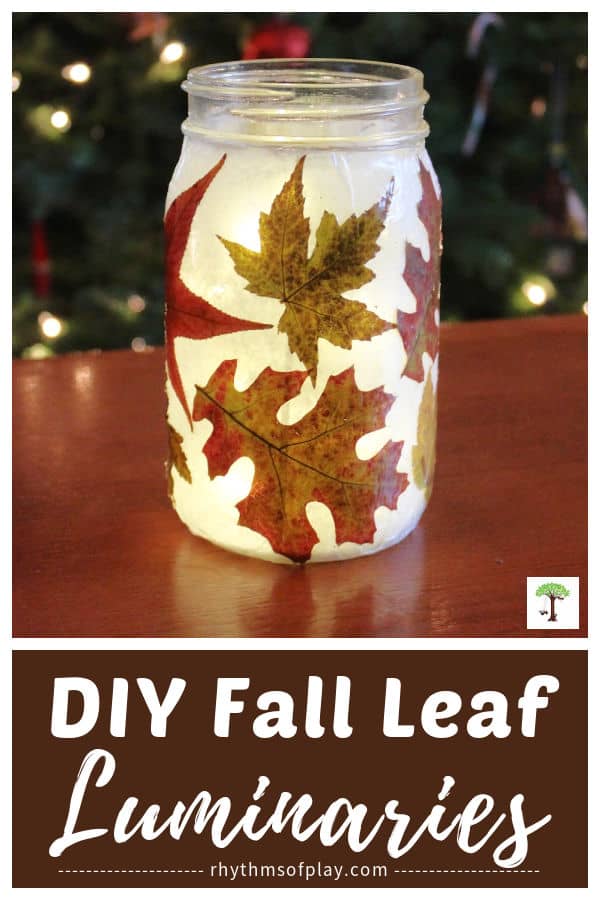
The photograph below features a leaf lantern with fairy lights inside. Doesn’t it glow magically?
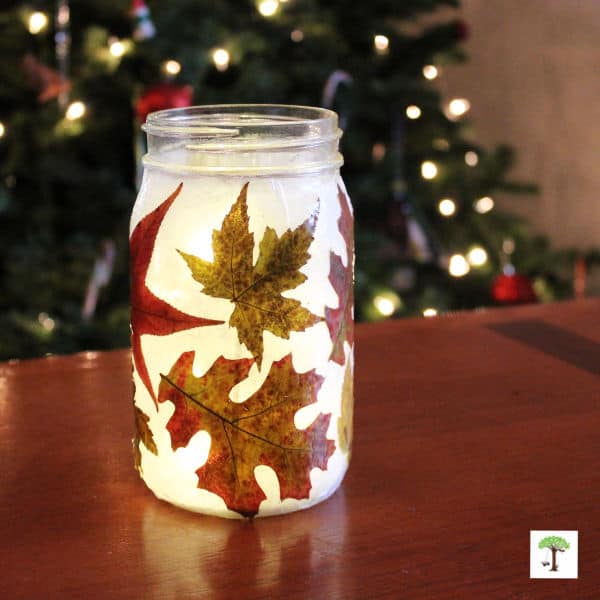
DIY Leaf Lantern Troubleshooting Tips
A curled leaf or a small tear in the tissue paper doesn’t mean you need to start over. These are usually easy to fix with a gentle touch and a little extra glue. Here are a few tips to help you achieve the desired result: a beautiful autumn leaf luminary.
Leaves won’t stick, or the edges curl up
Gently press the leaves back against the jar with your fingers while the glue is still wet. Add a little more glue underneath any lifting edges as needed, then press them down again.
The glue still looks cloudy
Use a clear-drying glue, such as Mod Podge or clear-drying white craft glue. Give it more time to dry, as it can look milky when wet, especially where you apply it thickly. Once fully dry, the glue should become mostly transparent, though thicker areas may retain a slight haze.
The tissue paper tears
Handle wet tissue paper gently, as it rips easily. If it tears, reposition it carefully with your fingers. You can also let the jar dry, then glue a small piece of tissue paper over the gap. Let the patch dry completely before using your lantern.
How to Clean and Store Leaf Lanterns
With gentle care, you can bring your leaf lanterns out to enjoy each autumn, as our family does.
- Dust gently: Use a soft, dry cloth to remove dust, taking care around leaf tips and edges.
- Hand-wash only when needed: I gently wash mine by hand, taking care not to crack or break the leaves. Avoid soaking or scrubbing, and never put them in the dishwasher. Let them dry completely before storing.
- Store away from heat: Keep the lanterns in a covered cabinet. If desired, wrap each one loosely in tissue paper for extra protection. If you put them away in a box, cover them with a more protective wrapping, such as bubble wrap, and keep them upright for best results.
- Store metal handles separately: Twine and fingerknitted handles can remain attached.
Enjoy Your Fall Leaf Luminaries and Autumn Lanterns
These leaf lanterns bring a little autumn beauty indoors, whether they’re glowing on the table or catching daylight on a shelf. Display them as centerpieces for a fall wedding, Thanksgiving, or Christmas, or enjoy them all season long.
Add battery-operated lights, take your lanterns on a fall lantern walk, or use them to illuminate an Advent spiral as you celebrate the winter solstice.
Turn Your Leaf Lantern into a Gratitude Jar
Without a candle or lights inside, your decorated jar can hold thankful thoughts instead. Invite everyone to write something they’re grateful for on a small piece of paper, fold it, and tuck it into the jar. Read the notes together at the dinner table for a simple way to connect with family and friends. Find more ideas in these gratitude crafts and activities.
Share a Little Autumn Light
Leaf luminaries are among my favorite fall crafts to make with my daughter, and they make lovely handmade gifts, too. Give one to your holiday host or someone preparing a special meal as a small thank-you. For more inspiration, explore these homemade gifts kids can make.
I hope you and your little nature lovers enjoy making these lanterns as much as we do. If you’d like to try another design, arrange leaves into a turkey or decorate your jar with heart-shaped leaves.
Happy fall crafting!
Learn more about Rhythms of Play on our About page, or meet the creator and author, Nell Regan Kartychok.
More Fall Leaf Crafts for Kids and Adults:
- Sewing with Fall Leaf Lacing Cards
- Leaf Baby Book Inspired Art Project
- Fall Leaves Watercolor Painting
- How to Make Marbled Clay Leaves
- Fall Leaf Crown Crafts





Can you do the tissue layer first and let it dry- to make this easier to do with younger kids?
Hi Rachel, great question. Yes, you can do the tissue layer first and let it dry before allowing children to glue the leaves to the jar. You can also apply more glue, or remove a little, as needed once the children are finished making their leaf lanterns. Happy leaf lantern crafting!