

Invite children preschool age and up to sort coins with this Montessori-inspired sensorial activity for kids.
Inspired by Montessori sensorial activities for young children, this coin-sorting activity can stimulate learning and encourage preschoolers, kindergarteners, and young elementary students to focus their attention and develop their senses as they learn to observe, compare, and sort money. While doing this money activity, children can not only understand the differences between the size, color, and shape of coins but also how they sound.
Please don’t offer this money-sorting activity to kids who are still mouthing objects. Money is dirty and presents a choking hazard; therefore, coin activities are best for older kids and preschoolers aged three and up. First published on May 31, 2015, this coin sorting activity is regularly updated and occasionally republished to improve the content. You might also enjoy cutting a banana, another excellent Montessori activity for kids.

What is Montessori?
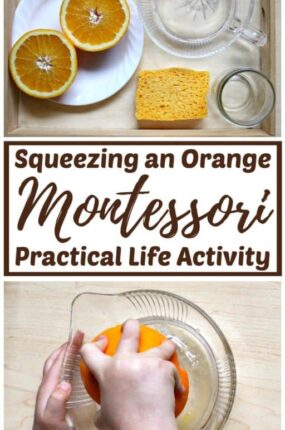
Maria Montessori was an Italian physician and educator who developed the Montessori Method. This educational approach emphasizes hands-on learning, self-directed activity, independent work, and collaborative play. This money-sorting activity is inspired by the sensorial learning activities and teaching ideas she designed for young children. You might also enjoy Montessori practical life activities, like squeezing orange juice.
Purpose of Montessori Activities:
Montessori activities are designed to help children develop practical, cognitive, and social-emotional skills. She believed that children learn best when allowed to explore and engage with the world around them in a prepared environment that supports their natural development.
Montessori activities are often categorized into five primary areas: practical life activities, sensorial activities, mathematics, language, and cultural studies. Each activity focuses on a specific developmental milestone. Her approach has been widely adopted in schools around the world.
I designed this coin-sorting activity as a sensorial activity. However, because of its structure and contents (money), it also acts as a precursor to language and mathematics, as do many of the activities designed by Maria Montessori for young children. For example, Montessori activities are always done from top to bottom and left to right to help prepare the child for reading, writing, and other formal learning activities. You might also enjoy this Flower Arranging Montessori practical life activity.
Montessori Sensorial Activities:
Maria Montessori believed that children learn about their environment and begin understanding it by developing their sensory system. She noticed toddlers, preschoolers, and kindergarteners thrive when encouraged to participate in various sensory experiences.
So, she designed sensorial activities to help children refine their senses—sight, sound, touch, taste, and smell—and develop their ability to observe and classify the world around them. While this money-sorting activity stimulates the senses of sound, touch, sight, and even smell, please don’t allow your children or students to taste the coins. Money is dirty and presents a choking hazard for kids of all ages.
How is Sorting Coins a Sensorial Activity?
Coin sorting is a sensorial activity inspired by Montessori activities for children. Although Maria Montessori did not create this activity, the theories behind her sensorial activities inspired me to make it for my daughter. Sorting coins is a sensory activity because it encourages children to focus attention on each coin’s sensory characteristics, including the differences in how each one looks, sounds, and feels.
Listening to my daughter sorting the coins was like listening to music. Soon, it became easy for her to discern the difference between a penny, a dime, a quarter, and a nickel, not only because of the differences in their sizes, colors, and shapes but because of the different sounds they make. The same experience can happen to other children at home or in the classroom without “teaching” necessary, just as other Montessori activities are designed to work.
As young children sort money, they notice subtle differences in visual appearance, texture, weight, dimension, color, relative size, sound, and smell. I recommend using glass bowls or mason jars to increase the auditory component of this coin-sorting sensory activity. Use glass bowls or mason jars the same size to eliminate sound variance for anything but the coins. Without glass, this coin-sorting activity wouldn’t be as educational. Wooden or plastic bowls can not produce the sounds that coins dropping into glass can.
This simple sensory activity taught my daughter several differences and similarities between the coins. Best of all, she thoroughly enjoyed it and asked to do it again another day. So, I am sharing this fun coin-sorting activity with you. This money-sorting activity is perfect for Montessori schools and homeschoolers implementing the Montessori method at home. My daughter sorted coins from the United States to complete this simple sensory activity. However, coins from another country can be easily substituted.
Related: Magnet Fishing: Cool Science for Kids
Coin-Sorting Sensorial Activity:
Observing, comparing, and sorting coins can help prepare children for the beginnings of logic, reason, and abstract thought. When children work with sensorial materials like coins or money, there is a “control of error” where they can check their work without a teacher. This “control of error” can thus help children learn to work independently and develop problem-solving skills.
Sorting money can also help children make purposeful decisions based on the sensory information they perceive about each coin. In addition, this decision-making activity can help establish new nerve pathways in the brain.
Related: Calm Down Sensory Bottles 101
Coin Sorting Activity Materials:
- Wooden tray and/or activity mat (placemats make great activity mats).
- These items are optional but recommended for Montessori activities.
- Apron for kids (optional but recommended for Montessori activities).
- Glass bowls, mason jars, or other containers for sorting.
- I recommend using glass bowls or jars for the rich sound experience they provide.
- Please ensure they are the same size to control the error of sound variance caused by anything other than the coins.
- Pennies
- Nickels
- Dimes
- Quarters
- If you are not using US currency, please substitute the coins in your country.
- Coin wrappers with sorting tubes or a 5-in-one change organizer to roll the coins in wrappers when you are through with the money sorting activity (optional).
Prepare Coin Sorting Activity for Kids:
- Wash the coins so they are safe for your child to handle. Money is dirty!
- Place a bowl filled with all the coins in the middle of the tray or activity mat.
- Put four bowls around the center bowl filled with all of the coins.
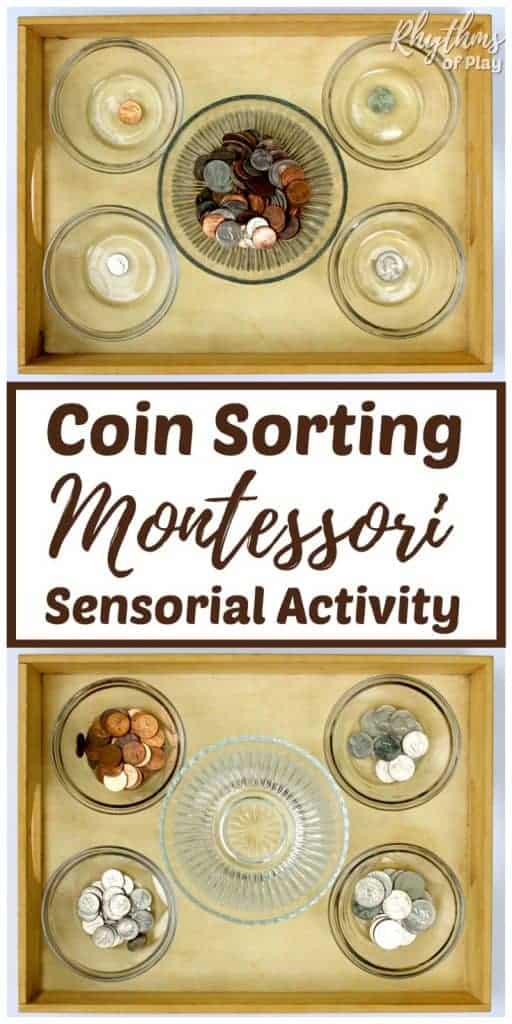
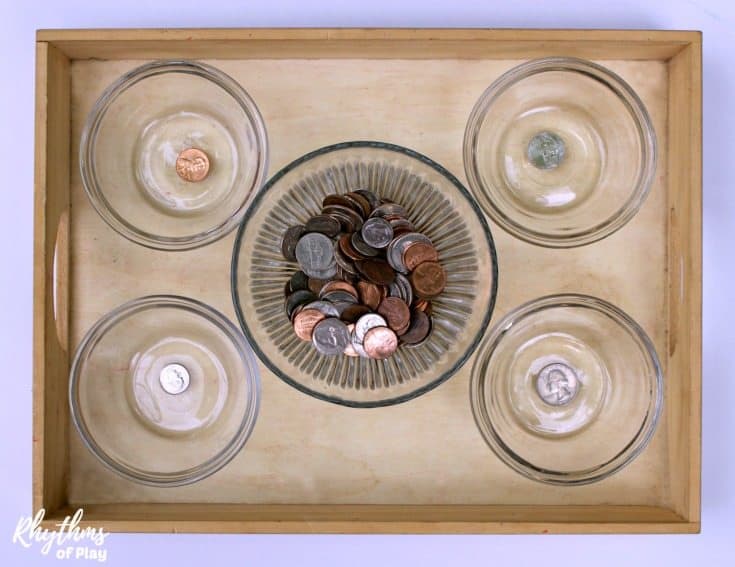
- Drop a penny in the top left bowl, a nickel in the top right bowl, a dime in the bottom left bowl, and a quarter in the bottom right bowl, as shown in the photograph below.
- Please have your child put on their apron.
- This step is optional but recommended by Montessori to signal that it is time to do work.
Related: Cutting a Banana Montessori Practical Life Activity
Present Coin Sorting Materials:
If this is the first time your child has ever tried sorting coins, you will need to demonstrate each step in the activity first:
- Show the child exactly what you expect them to do by silently and deliberately showing them how to sort coins by placing pennies in the bowl for pennies, nickels in the bowl for nickels, etc., for 30 seconds to a minute.
- When finished, place all the coins back into their starting position, as shown in the photograph below:
Instructing This Montessori Activity:
As mentioned above, Montessori activities are always done from top to bottom and left to right to prepare the child for reading and writing. So, please put the coins in the bowls in the order listed and shown in the photo above.
Another good way to set up this money-sorting activity would be to have the big bowl of coins at the top with four little bowls below it or with the big bowl of money on the left with four little bowls on the right.
Ensure you always place the money in the little bowls from smallest to biggest denomination, from top to bottom, or left to right. Doing so will help young children forge nerve connections that prepare them for academics. In addition, working top to bottom and left to right in the early years will make reading and math much easier!
Related: Outdoor Learning Activities for Kids
Invite Children to Sort Coins with the Step-by-STep Instructions Below:
Follow the steps below to complete this coin-sorting activity inspired by Montessori Sensorial learning exercises:
- Place the coin sorting materials before the child and invite them to sort coins.
- As they work, ask children to notice similarities or differences in the coin’s sound, size, shape, color, texture, weight, and designs or pictures.
- This coin sorting activity is complete when each coin in the center bowl is sorted into the bowls in the four corners of the tray (or activity mat), with pennies in the upper left, nickels in the upper right, dimes in the lower left, and quarters in the lower right.
- The coins are shown in their starting position in the upper left photo below and their finishing positions in the bottom right corner of the picture below.

If the Child Can Not Complete the Coin Sorting Activity:
If the child is not ready or unable to do the activity, take their apron off, remove the materials from the table, and try again later. Please gently do this while ensuring the child knows they did not do anything ‘bad’ or ‘wrong.’
When they are ready, children will do the coin-sorting activity as instructed, so it is best to peacefully take the tray away without fuss and tell the child they can try it again later. In other words, it is best to remove the activity and give it another try in the future if the child is messing around instead of doing the money-sorting activity as instructed.
Related: 15 Ways to Raise a Helper
Benefits of Montessori Sensorial Activities:
Montessori sensorial activities help children refine their senses—sight, sound, touch, taste, and smell—while developing their ability to observe and classify the world around them. In other words, she believed it was important for young children to touch, manipulate, and classify objects to understand their environment better.
By working with sensory materials, in this case, coins, children gain knowledge not through direct teaching but by experiencing it. Children who do sensory activities, like coin-sorting, often find math and reading in their later studies much easier. In addition, they develop visual acuity and discrimination that enable them to master letters and numbers more easily.
Before children learn the value of coins, they must learn how to distinguish between coin types. This money-sorting activity can help preschoolers familiarize themselves with each coin. More advanced elementary school-aged students can include the optional money activities below to extend their learning. You might also enjoy these fun activities for kids.
Additional Optional Money Activities with Coins:
Whether you are working with US currency or coins from another country, this money sorting activity can also include any of the following optional coin activities:
- Discuss the auditory, visual, and tactile differences the student notices between each coin.
- Examples:
- Ask children about the sounds they noticed for each coin. Are they the same or different?
- Invite children to notice differences between the sides of the coin (i.e., the pictures or designs on each side).
- Ask if they noticed differences in color, size, shape, weight, or appearance compared to the other coins used for this activity.
- Coins from different contries will have different answers.
- Notice if there are any differences in the way each coin feels.
- Examples:
- Help students learn the name of each coin.
- Discuss the value of each coin.
- Invite children to do money math by asking them to count and add coin values after sorting the coins into bowls.
- After the coins are sorted into bowls (or jars), encourage children to stack and roll them into coin wrappers with the instructions below:
Stack and Put Coins in Coin Wrappers:
Invite children to stack coins of the same value from each bowl after sorting the coins. Count the coins, do money math to add them, and put them into rolls that match the monetary amount on the coin wrappers. You can also use this simple coin organizer to put the coins into coin rolls.
When you finish this activity, use the money to purchase a treat or toy equal to the value of the money counted and collected. Alternatively, you can put the money into a savings account for a larger toy, the child’s college tuition, a family vacation, a gift the whole family can enjoy, etc.
This coin math activity offers a great lesson in the value of money and working to accomplish a goal for a reward. You might also enjoy learning how to set SMART Goals.
Guidelines for Choosing Additional Coin Activities:
The additional optional money activities you choose will depend on the age of the children you work with and the ultimate goal of the activity. For example, younger children, such as preschoolers, should experience the independent work of coin sorting without further instruction about the value of money for the reasons discussed in the benefits of Montessori sensorial activities.
In contrast, older children, such as kindergarteners and first-grade students, and children who have completed the activity multiple times can extend their learning with a lesson about the value of the coins. You might even offer money math lessons to students in first grade and above. These additional money activities are fantastic educational activities for math centers. However, if a young child is curious and asks questions about the coins, you can include more advanced concepts geared toward older students.
Money Sorting Activities for Kids:
This coin-sorting activity can be fun and educational for kids. When young children can touch, manipulate, and classify objects, they better understand their environment. Working with coins as sensory materials enables children to learn about coins through firsthand experience. This will inspire their curiosity and lead to understanding more advanced concepts, such as the value of money.
More advanced students can extend the activity by learning concepts such as counting, recognizing coin values, sorting by attributes, and practicing basic math with the optional additional money activities included above. Overall, this Montessori-inspired Sensorial activity successfully combines play with learning, making it an engaging way for children to build a foundation for financial literacy.
Learn more about Nell Regan Kartychok, author, photographer, and creator of this original coin-sorting activity inspired by Montessori sensorial exercises and Rhythms of Play HERE!
Other Montessori Practical Life Activities:
- Cutting a Banana: A Montessori-Inspired Practical Life Activity
- Flower Arranging: A Montessori-Inspired Practical Life Activity
- Squeezing an Orange Montessori Practical Life Activity
Outdoor Learning Activities for Kids:
- Birding for Kids
- Outdoor Learning and Nature Activities for Kids
- Squirrel Facts and Learning Activities
- Nature Study for Kids
- How to Plant Sunflowers and Grow a Fort
- Climb a Tree






Love the site! I’m seeing a lot of great activities!
Thank you! Glad you enjoyed it 🙂
What age would this be aimed at please?
This activity is aimed at children in preschool and kindergarten Jodie. With that said, please don’t offer this activity to children that are still mouthing objects.